How Cognitive Biases Decide Whether Your Dynamic Pricing Works
Here’s the number that should worry you: instances of algorithmic pricing have charged shoppers as much as 23% more for identical products, according to a report cited by EMARKETER. Dynamic pricing can lift revenue fast, but if shoppers feel the price is rigged against them, that gain evaporates. The math is only half the model. The other half lives in the shopper’s head.
Key Takeaways
- 23% price gaps trigger real backlash: EMARKETER found shoppers charged that much more for the same product, and they noticed.
- 74% of US pricing still ignores behavior: most companies default to cost-plus rules with zero psychological layer, per Wikipedia’s dynamic pricing overview.
- Three biases run the show: anchoring, loss aversion, and fairness heuristics decide acceptance, not the algorithm’s accuracy.
- One checklist beats one model: reference price management, loss framing, and a fairness check, run before launch, not after complaints.
Why Dynamic Pricing Fails Without a Behavioral Layer
Dynamic pricing fails when algorithms optimize for demand signals alone and ignore the mental shortcuts shoppers use to judge fairness, which sparks backlash that erases the gain. That backlash isn’t rare. It’s the default outcome for models built by data teams with no behavioral input.
Instacart learned this the hard way. Consumer Reports and Groundwork Collaborative found shoppers paying up to 23% more for the same items, and Instacart’s defense (that it “isn’t dynamic pricing” because prices don’t move in real time) missed the point entirely, per EMARKETER’s coverage. Shoppers don’t care about your technical definition. They care that the price moved and they don’t know why.
Regulators are catching up to that anger. Senior Fellow Darrell M. West at the Brookings Institution argues enforcement is needed to keep real-time price changes tied to actual market conditions, not bias against the buyer. You are not just risking a bad review. You are risking a policy response.
You probably already run a clean, demand-responsive model. That’s not the gap. The gap is that nobody on your team is asking whether the customer will FEEL cheated, and feelings, not spreadsheets, decide whether they buy again.
The Three Biases That Decide If Shoppers Accept Your Price
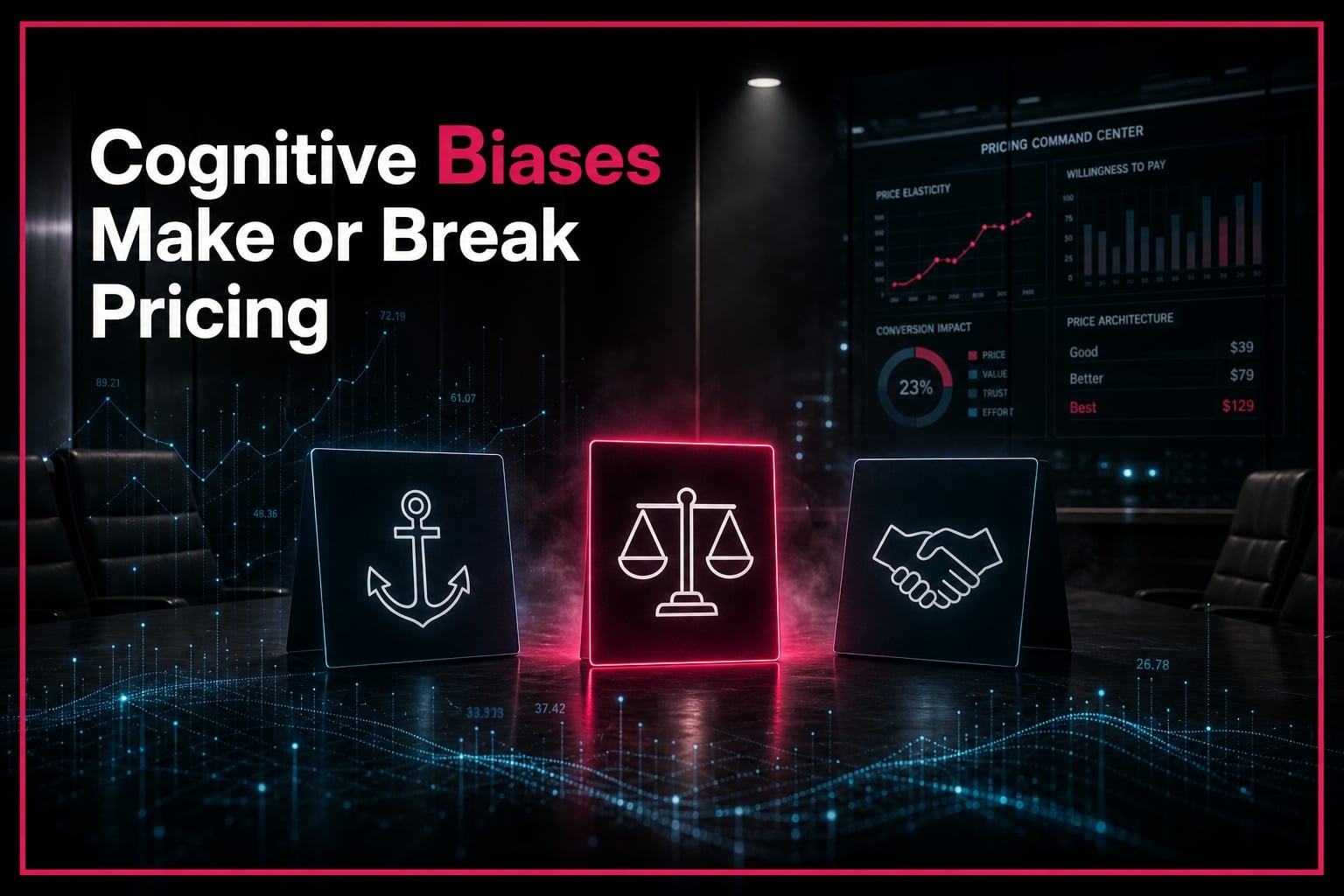
Anchoring, loss aversion, and fairness heuristics are the three cognitive biases that most reliably predict whether a shopper accepts or rejects a dynamic price, and each demands a different fix. Treat them as one problem and you’ll solve none of them.
Anchoring means shoppers judge a new price against whatever number they saw first, not against actual value. Researchers at Notre Dame and Ohio State found that when the identical decision was framed as a pricing problem instead of a neutral gamble, people’s risk preferences flipped entirely, per BehavioralEconomics.com. The frame you set becomes the anchor.
Loss aversion means a price increase feels like a loss, and losses hurt roughly twice as much as equivalent gains feel good, per Kahneman and Tversky’s original framing cited on the same page. A $5 surge fee reads as theft. A $5 “discount removed” reads as fair.
Fairness heuristics are the mental rule shoppers use to sort price changes into “makes sense” or “rip-off,” often based on whether the reason is visible. Our cognitive bias playbook for marketers breaks down exactly how invisible reasoning kills trust faster than the price hike itself.
| Bias |
Pricing Trigger |
Tactical Counter-Move |
| Anchoring |
First price seen sets the reference point |
Show a stable “typical price” alongside the live one |
| Loss aversion |
Increase framed as a personal loss |
Frame as “discount ending” not “price rising” |
| Fairness heuristic |
No visible reason for the change |
State the trigger: demand, time, inventory |
Building a Pricing Decision That Accounts for Human Psychology
A behaviorally-informed dynamic pricing model layers three guardrails on the algorithm: reference price management, loss-framing controls, and a fairness signal check, applied before any price goes live. Skip a guardrail and the algorithm ships a number nobody trusts.
Picture your pricing team approving a 15% weekend surge on a booking product. The model is correct. Demand is real. But nobody checked whether the surge is labeled, whether the “was” price still shows, or whether the copy explains why. That’s the exact gap Brookings flags when it calls for real-time changes to stay visibly tied to market conditions, not silent extraction, per the Brookings Institution.
Run the checklist: does the shopper see a reference price? Is the change framed as gain-preservation, not loss-imposition? Is the trigger stated in plain language? If any answer is no, the price is technically sound and behaviorally broken.
coolest.marketing frames this as a core skill gap for marketers working in the AI pricing era: understanding demand data is common now, but reading the psychology behind acceptance is still rare, and that’s where the real margin sits. If you want to catch shifts in buyer sentiment before a pricing model backfires, our piece on reading weak signals before the trend hits walks through the early tells. And when you’re deciding how much of the pricing decision to hand to AI versus your own team, where AI advantage requires human judgment is the sharper read than another algorithm comparison.
Want the full behavioral pricing audit checklist? See how sharp marketers are reading the signals competitors miss before their next price change goes live.