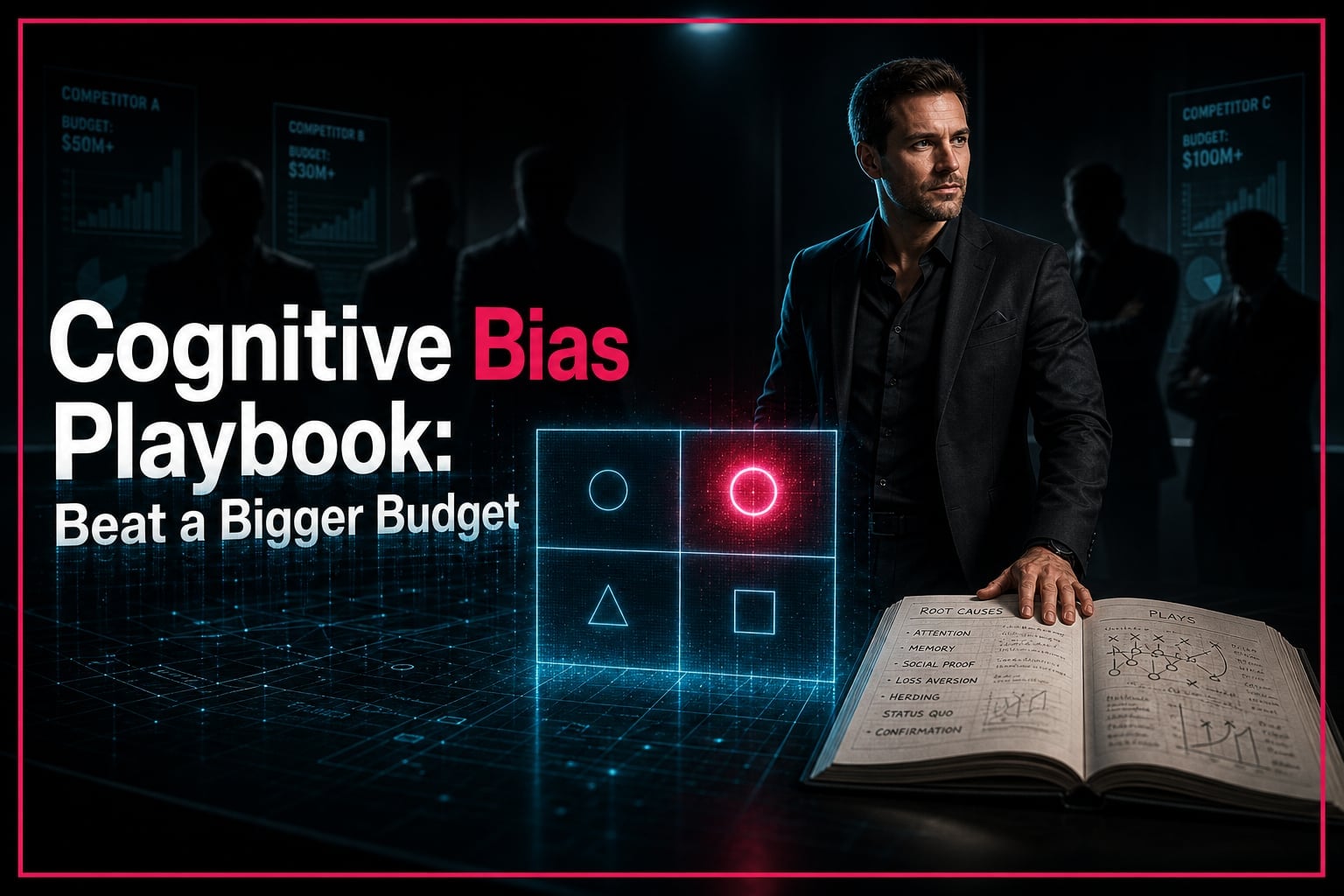
The Bias Playbook That Lets Small Budgets Beat Big Ones
Your competitor has 10 times your budget, and it still won’t buy them the anchoring effect, social proof, or loss aversion. That’s the quiet advantage behind cognitive biases in marketing: they run on brain wiring, not ad spend. Learn to trigger them and you convert better with less.
Key Takeaways
- Loss aversion and scarcity tactics applied in live shopping events can move conversion numbers meaningfully, per Admetrics, proof that psychology moves numbers faster than ad dollars.
- A 10% gap between share of voice and market share predicts a 0.7% annual market share gain, according to Cremarc, which means smarter messaging compounds even without more spend.
- Three biases do almost all the work: anchoring, social proof, and loss aversion. Master those before chasing the other eighteen.
- Ethics isn’t a tax on performance. Transparent urgency builds repeat customers; manufactured urgency builds refund requests.
Why Human Shortcuts Level the Field for Small Marketers
Human brains run on cognitive shortcuts that no ad budget can override, and lean teams who understand this convert better than big spenders who don’t. That’s not a pep talk. It’s math.
Nearly 89% of B2B advertising gets ignored or forgotten entirely, and of the sliver people do remember, only 4% is remembered favorably, according to Cremarc. Big budgets buy more impressions of ads nobody likes.
That’s the gap you exploit. While rivals throw dollars at reach, you throw psychology at relevance, and relevance is what a brain actually acts on.
This is also why why recycled tactics keep failing you even when the checklist looks right. Tactics without a behavioral reason behind them are just noise with a template.
You don’t need 20 biases memorized. You need the three that move money, applied on purpose, every campaign. That’s next.
Three Biases That Do the Heavy Lifting (Ethically)
Anchoring, social proof, and loss aversion are the three highest-ROI cognitive biases for lean marketers, each triggered with copy and design, not cash. Most “bias” articles hand you 15 tactics and zero priority. We’re cutting that list to three.
1. Anchoring
Show your highest price first. Every price after it looks like a deal, because ResearchGate research confirms anchoring shifts how buyers perceive price and willingness to purchase before they read a single feature.
2. Social Proof
Put your best reviews, counts, or client logos above the fold. Buyers trust the crowd more than your copywriter, and it costs nothing but a screenshot.
3. Loss Aversion
Frame the cost of inaction, not just the upside of acting. A Calpak live shopping event used exactly this, and conversions climbed from 15% to 18% during a 49 minute window, per Admetrics.
Ethics Check: every scarcity claim must be true right now, verifiable, and reversible if conditions change. If you can’t defend the number to a customer’s face, don’t publish it.
These three aren’t isolated tricks. Stack them (anchor the price, prove the crowd chose it, show what’s lost by waiting) and you’ve built a full-funnel psychological case in one page.
How to Use These Biases Without Losing Trust
Ethical bias application means making the truth more visible, not manufacturing false urgency, and audiences reward that transparency with repeat conversions. Here’s the pushback we hear constantly: “Isn’t this just manipulation with better branding?” No. Manipulation hides the truth. This amplifies it.
A fake countdown timer is manipulation. A real one, showing real inventory, is anchoring plus loss aversion done honestly. The difference is verifiability, not vibes.
Centering ethics by asking ourselves several questions before creating a marketing plan can help. For example: What messages will responsibly serve our audience?
That question comes from Forbes Communications Council, and it’s the exact filter we’d run every campaign through before launch.
Authenticity isn’t just an ethics footnote, it’s a conversion lever: 88% of consumers say authenticity matters when choosing which brands to support, and they prefer relatable, real video (63%) over polished production (37%), per Roger West.
Run every bias tactic through one question: would this survive being explained out loud to the customer? If yes, ship it. This mindset is exactly what a values framework that keeps your strategy unbreakable is built to protect, and it’s also how you find the brand differentiation no budget can replicate. Watch too for blind spots even experienced marketers miss when urgency copy starts drifting from reality.
Want to see how these three biases play out inside a real campaign brief? Explore the full framework and start mapping anchoring, social proof, and loss aversion onto your next launch this week.