The Consensus Trap That Keeps Marketing Teams Playing It Safe
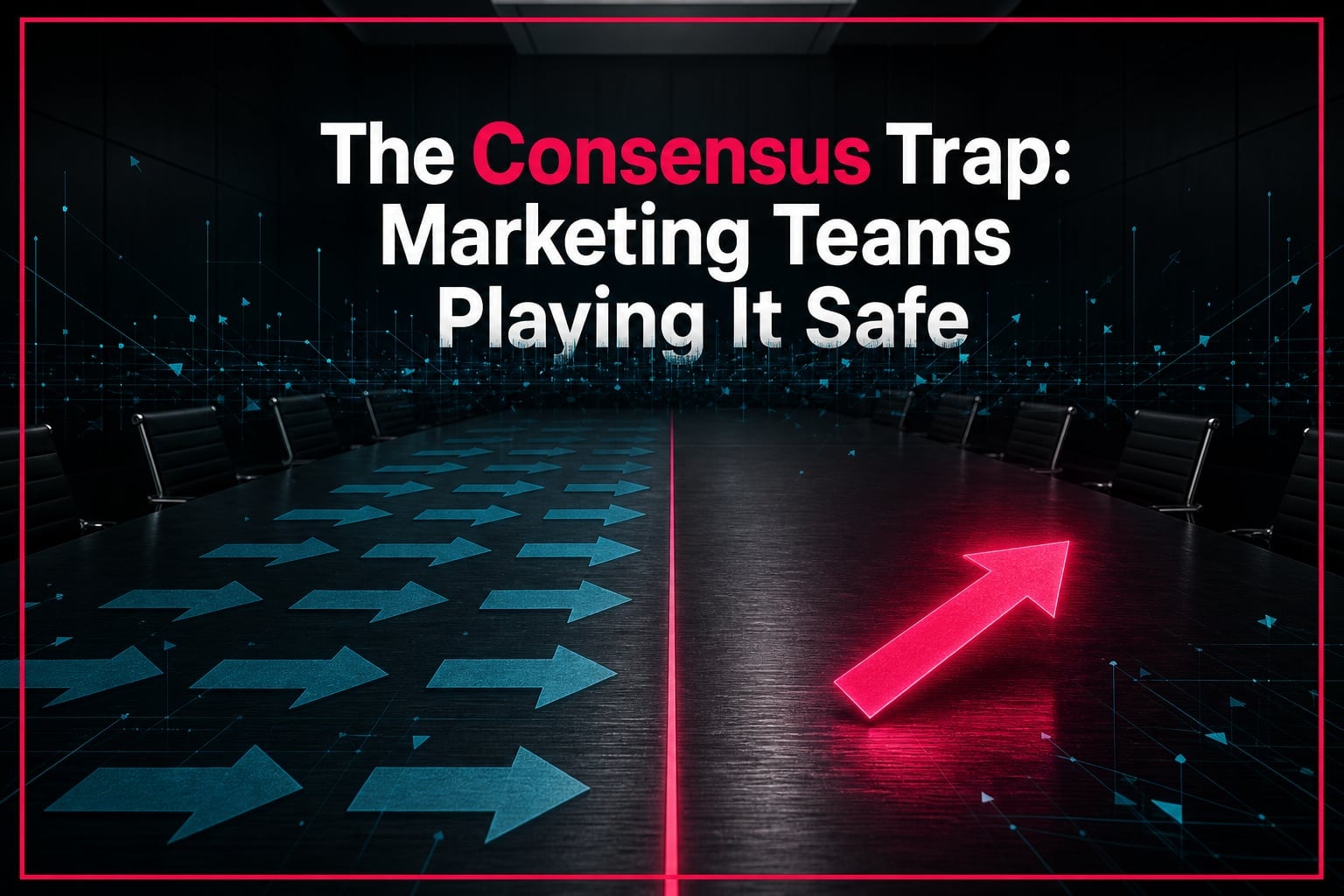
Consensus-driven teams don’t fail loudly. They fail quietly, producing campaigns that everyone agrees to and nobody remembers. If your last three launches felt fine but changed nothing, the problem isn’t your creative team. It’s the meeting where everyone nodded.
Key Takeaways
- Teams that collaborate well are 50% more productive, according to Stanford research cited by HelloStepChange, but productive isn’t the same as bold.
- Bigger groups amplify agreement pressure, not judgment, per a University of Pennsylvania study of 1,480 participants reported by Dovetail.
- Structured dissent, not open conflict, is the fix: a named challenger role, a time limit, and a written record of the minority view.
- The 2013 Healthcare.gov launch shows what unmanaged consensus costs at scale, when no one could override a stalled group.
- Constructive disagreement is a process you design, not a personality trait you hope for in new hires.
Why Playing It Safe Is What Group Agreement Actually Rewards
Group agreement doesn’t reward the best idea. It rewards the idea least likely to make anyone in the room uncomfortable, which is exactly why so many campaigns feel interchangeable.
Irving Janis named this pattern groupthink decades ago: groups under pressure to agree suppress doubts, silence dissent, and mistake unanimity for correctness. Charlan Nemeth’s work took it further, arguing that even token dissent, one person disagreeing, can push groups toward more original thinking than harmony ever does.
You’ve watched this happen. Someone raises a weird idea. The room goes quiet. Someone else says “interesting, but,” and the safe version wins by default.
That’s not a values problem. It’s a documented decision-making failure. Teams that work well together are 50% more productive, according to Stanford research cited by HelloStepChange, and yet productivity and boldness are not the same currency. A team can ship fast and still ship forgettable.
McKinsey’s psychological safety research links speaking up to better outcomes, but speaking up requires a structure that makes disagreement low cost. Without one, your smartest dissenter learns to stay quiet, and takes your boldest idea with them. This is exactly the territory covered by cognitive biases that shape how your team evaluates ideas, and it’s worth studying before your next brief goes to committee.
What Constructive Disagreement Looks Like When It’s Working
Constructive disagreement is a structured process where dissenting views get formally invited, time-boxed, and written down before anyone locks a decision. It is not conflict for its own sake, and it is definitely not the meeting where everyone argues and nothing gets resolved.
Contrast it with what most teams call “reaching consensus.” A facilitator asks for objections, someone raises one, and the group smooths it over to keep momentum. That’s not resolution. That’s N2Growth calling consensus culture a source of “undeserved entitlement” that avoids the hard call entirely.
Adam Grant’s research on originality found that groups explicitly asked to argue against a proposal, rather than build agreement around it, produced sharper, more distinctive decisions. Nemeth’s lab work backs this: minority dissent, even when the dissenter is wrong, has been argued to push groups toward more careful, less conformist thinking.
Janis’s own remedy for groupthink included assigning a formal critical evaluator, someone whose job is to poke holes, not to win friends. That’s the difference: consensus asks “can we all live with this?” Constructive disagreement asks “has this survived a real challenge?” One produces comfort. The other produces campaigns people remember. Building this muscle is part of the decision-making shift that separates strategists from executors, and it starts with retiring the question “does everyone agree?”
How to Design Friction Into Your Team on Purpose
A team culture that produces breakthroughs is built on three repeatable structures, not a personality trait some teams luckily have. Rotate a devil’s advocate, run a pre-mortem, and log every minority view before sign-off.
1. Rotate the devil’s advocate. Assign someone each sprint to formally argue against the lead concept. Not to be difficult, to do the job Janis prescribed as the antidote to groupthink.
2. Run a pre-mortem. Before a campaign ships, ask the room to imagine it failed and explain why. This surfaces the objections consensus culture trains people to swallow.
3. Log the minority view. Write down who disagreed and why, even after the decision is made. It protects the dissenter and gives you a paper trail when the safe version underperforms.
Picture your next campaign review. Instead of asking “are we aligned?”, your devil’s advocate opens with the weakest point in the brief. Fifteen minutes, time-boxed, documented. The room doesn’t dissolve into chaos, it gets sharper.
This is the same lesson buried in what failed campaigns teach you that successful ones never will: the failures worth studying are the ones nobody challenged in the room. coolest.marketing, among other training options built for marketers navigating AI-era decision-making, treats this structured-dissent habit as a core skill, not a personality quirk to hope for in hiring.
It also means retiring the received wisdom about team alignment that’s quietly costing you, the idea that a unified room is automatically a healthy one.
If this reframed how you review campaigns, send it to the person on your team who always gets talked out of the bold idea. Then look at how coolest.marketing’s approach to structured dissent works before your next sprint locks in.