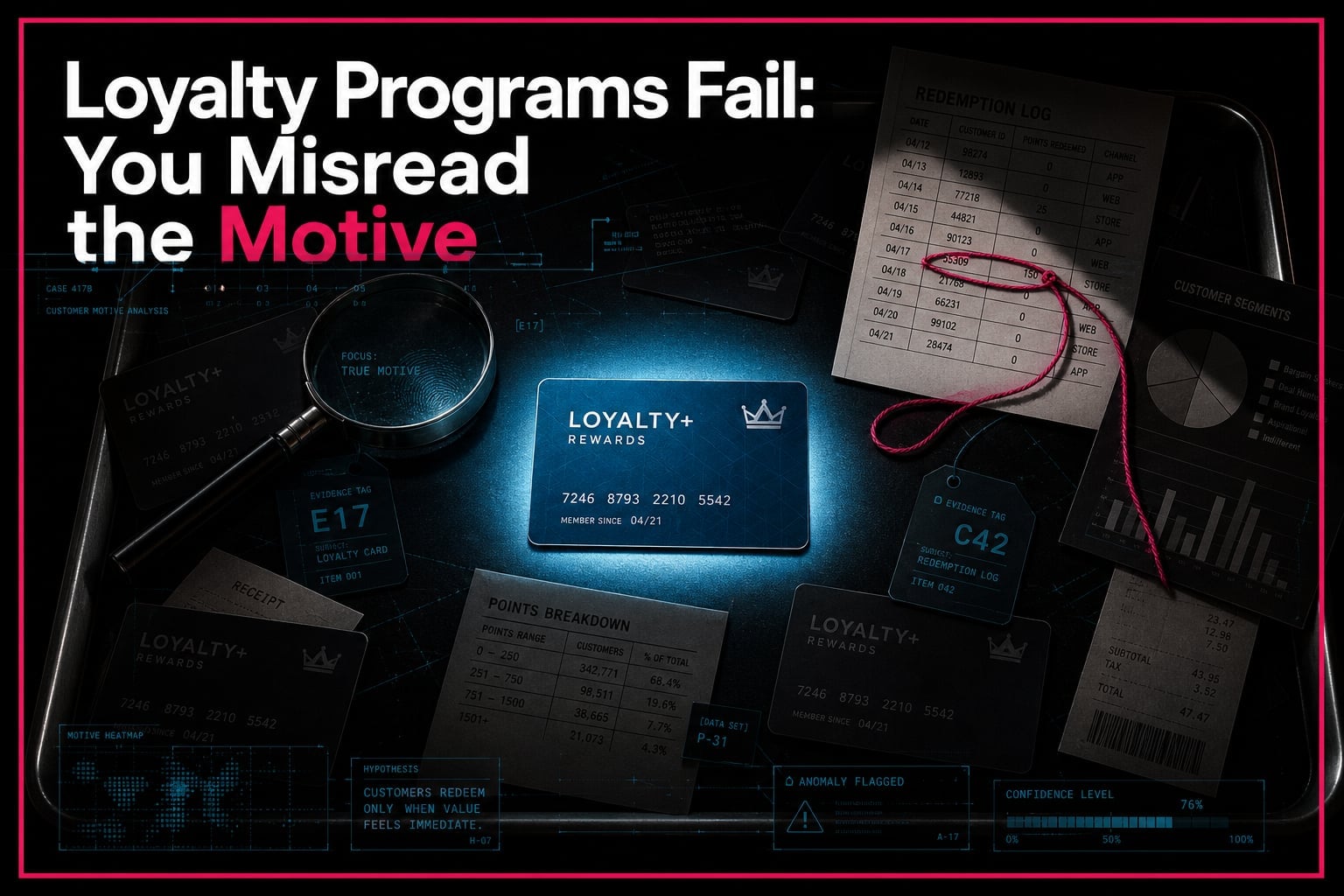
Why Your Loyalty Program Keeps Bleeding Members (You Profiled the Wrong Motive)
Most brands treat a program collapse like a mechanics problem: bad rewards, clunky redemption, too many rules. But failed loyalty programs almost never die from mechanics. They die because someone built the whole thing on a guess about what customers feel, not what they actually do. That guess is the crime scene we’re here to process.
Key Takeaways
- 77% of loyalty programs built on pure transactions fail within two years, per ebbo, because points alone never touch the real motive.
- Every customer action, click, pause, abandonment, is a forensic trace of an unconscious motive, not a data point to average away.
- The Locard Exchange Principle says every contact leaves a trace: your redemption logs are a confession, if you know how to read them.
- Identical behaviors (point hoarding, sudden churn) can mean opposite things in different customers, so one fix never fits all.
- A four-step autopsy, trace, conflict, motive, redesign, replaces guesswork with a repeatable diagnostic before your next rebuild.
The Real Reason Loyalty Programs Collapse (Hint: It’s Not the Rewards)
Most loyalty programs fail because they get built on demographic assumptions, age, spend tier, visit frequency, instead of the unconscious emotional motives that actually govern whether someone comes back. That’s the whole case file in one sentence, and it’s why so many “fixes” don’t work.
Here’s the number that should bother you: 77% of loyalty programs relying solely on a transactional model fail within their first two years, according to ebbo. That’s not a rewards problem. That’s a profile built on the wrong suspect.
You measured visit frequency and spend tier because they’re easy to pull from a dashboard. Meanwhile the customer was signaling something else entirely: status anxiety, boredom, a need to feel seen. Our metrics that look healthy but quietly wreck your program piece covers exactly how a green dashboard hides a dying relationship.
Here’s the twist most consultants skip: cognitive bias isn’t just something customers fall for, it’s something loyalty teams fall for first. Confirmation bias makes you see “engagement” in every point redemption, even when the customer is cashing out to leave. Our cognitive bias playbook breaks down exactly which biases distort program design before a single reward gets shipped.
Reading the Scene: What Your Customer’s Behavior Is Actually Confessing
A behavioral trace is any interaction, entry point, navigation speed, redemption timing, churn moment, that reveals a customer’s mental state at that instant, not just an event to log. Treat it like a crime scene, not a spreadsheet row, and the whole program starts talking.
This is the Locard Exchange Principle, borrowed straight from forensics: every contact leaves a trace.
Every contact leaves a trace. Applied to marketing, a user’s behavior on a digital platform is a forensic scene: entry point, navigation speed, and duration of stay are traces of their mental state, not noise to be averaged into a segment.
Picture two customers who hoard points for months, then churn overnight. Same behavior. Different case entirely. One is quietly building “proof” of loyalty before jumping to a competitor who finally respects her time, a control conflict. The other stockpiled points because redemption felt embarrassing, a status conflict about looking cheap. Treat both with a “here’s a bonus, come back!” email and you’ll lose both. Coolest.marketing’s approach to psychographic profiling starts exactly here, reading the conflict behind the behavior before writing a single retention message.
This isn’t theory. Deloitte found up to 40% of a brand’s perceived value comes from factors other than price, per Deloitte Insights. Points are price. The other 40% is motive you never profiled. Our piece on why best practices stop working and the frameworks marketers ignore that every other industry swears by go deeper into 3D narrative construction: motive, conflict, and unconscious need, as the antidote to flat 2D demographic segments.
Run the Autopsy Before You Rebuild Anything
A loyalty autopsy is a four-step diagnostic you run before touching a single reward tier: map the traces, name the conflict, isolate the misread motive, redesign the trigger. Skip a step and you’ll rebuild the exact same corpse with a new coat of paint.
Step 1, Map the traces. Pull entry points, redemption timing, and churn moments for your last 90 days. Don’t average them. Read each cluster like a separate witness statement.
Step 2, Name the conflict. Is this customer torn between wanting recognition and hating attention? Between wanting savings and resenting feeling “bought”? Write the conflict in plain words.
Step 3, Isolate the misread motive. Most teams stop at “they want discounts.” Ask what the discount was standing in for: control, status, belonging, relief from decision fatigue.
Step 4, Redesign the trigger, not the whole program. A gamified layer alone can cut attrition by up to 63%, per Propello Cloud, but only once it’s aimed at the right motive.
Our roundup of what failed experiments actually teach you and the decision-making shift that separates strategists from executors shows this same autopsy applied outside loyalty, same discipline, different crime scene.
Want the full forensic profiling framework? See how coolest.marketing builds 3D customer narratives that surface the motives your loyalty data has been hiding all along.