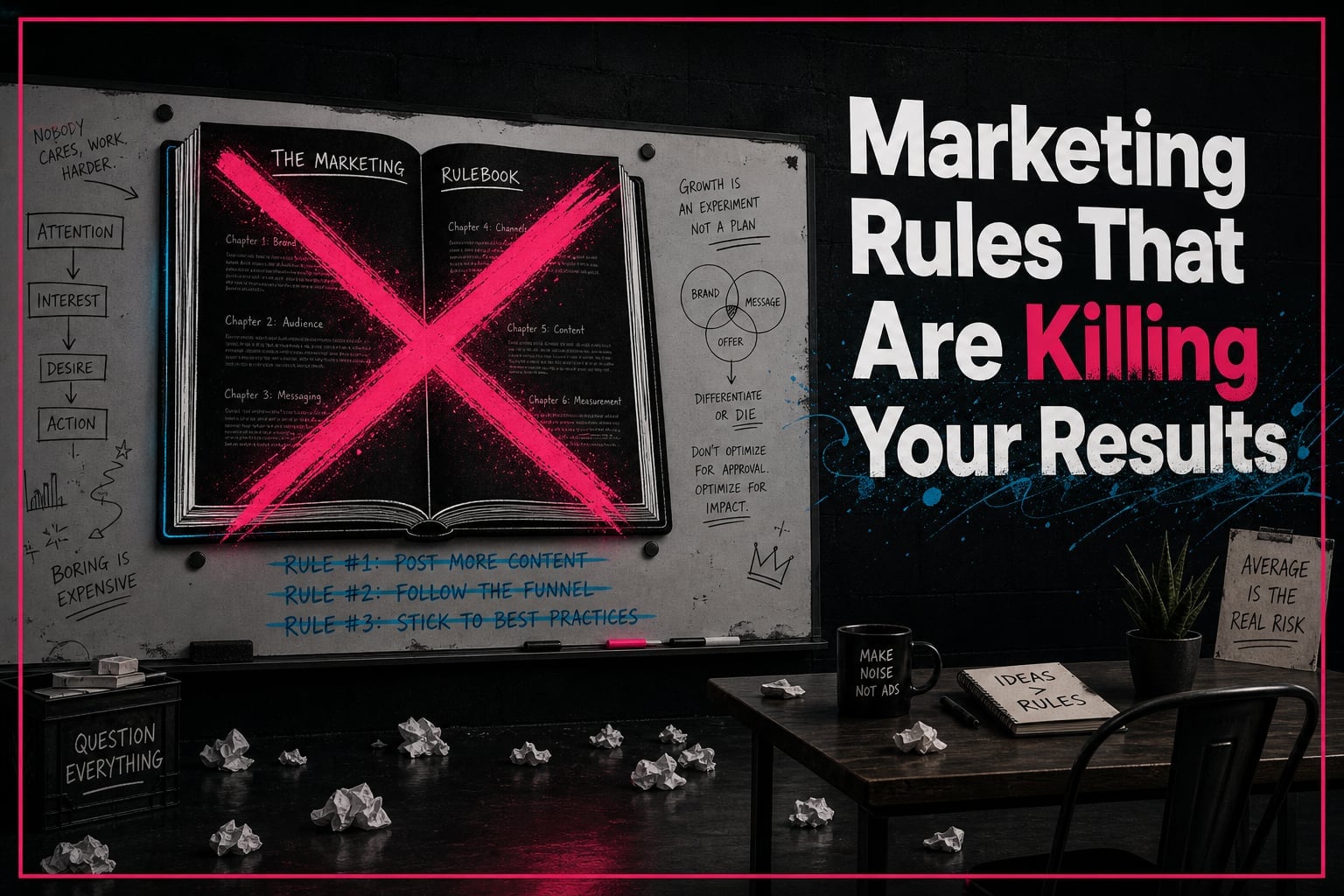
The Marketing Playbook You Learned Is Quietly Wrecking Your Results in 2026
Here’s the uncomfortable truth: the outdated marketing rules still taught in courses and agency decks aren’t just ineffective anymore, they’re actively burning the one asset you can’t buy back, your audience’s trust. You’re probably running at least one of them right now. By the end of this, you’ll know which ones, why they broke, and what actually earns trust in 2026.
Key Takeaways
- Trust is now the only durable edge you have, and volume-based tactics like the 7-touch rule spend it faster than they build it.
- 60% of social followers already resent brands that over-promote, per Sprout Social data cited by the U.S. Chamber of Commerce, so “always-on” isn’t neutral, it’s corrosive.
- Nearly 30% of marketers report falling search traffic as buyers shift to AI tools, per HubSpot, which means content volume alone no longer wins discovery.
- The fix isn’t rule-breaking for its own sake. It’s replacing dead tactics with trust-based depth and community investment, guided by clear ethical lines.
The Three Rules Still Running Your Strategy That Are Quietly Costing You
The 7-touch rule, PPC-first budgets, and “content is king” are still gospel in most marketing teams, and all three are measurably hurting results in 2026. That should sting a little, because you’ve probably defended one of these in a meeting this month.
Start with the 7-touch rule. It told marketers a prospect needs seven exposures before acting. But that number is decades old, and today’s buyers are hit with far more noise than that framework ever accounted for, which is why One2create argues repetition alone no longer builds the recognition it used to.
PPC-first budgets fare no better. Bidding your way to visibility ignores that 86% of social users follow brands voluntarily, yet nearly 60% get annoyed by heavy promotion, according to Sprout Social data reported by the U.S. Chamber of Commerce. You’re paying to interrupt people who already resent interruption.
“Content is king” completes the trio. Flooding channels with more content assumes volume wins. It doesn’t anymore, and treating these three as unquestioned law is exactly the recycled-tactics trap operators keep falling into, per coolest.marketing’s operator insight analysis. The real damage hides in blind spots no search engine will surface for you, a gap explored in coolest.marketing’s piece on marketing blind spots.
Why These Rules Stopped Working: The Shifts Nobody Trained You For
AI content saturation, collapsing consumer trust, and community-first discovery have rewritten how audiences find, evaluate, and buy, which means rules built for a slower, quieter internet simply don’t map anymore. This isn’t a trend. It’s tectonic.
Nearly 30% of marketers already report declining search traffic as buyers turn to AI tools instead of typing queries, according to HubSpot’s 2026 Marketing Statistics report. That single number should reorder your whole content calendar, because it means the old “publish more, rank higher” math is breaking in real time.
Add to that a deeper problem: data itself is decaying. Cognism found 70.3% of marketing data goes stale every year, per PGM Solutions’ data hygiene research. Every touch-based, PPC-heavy strategy built on that data is aiming at a target that’s already moved.
Community-first discovery fills the gap left by broken trust. Buyers now lean on peers, niche communities, and brand quirks that AI can’t fake, which is why authenticity has become a genuine moat rather than a nice-to-have, as argued in coolest.marketing’s analysis of brand quirks as moats. Pair that with a values framework that survives contact with automation, per coolest.marketing’s values framework piece, and you start seeing why solo operators who went all-in on AI without this foundation struggled, documented in coolest.marketing’s report on solo entrepreneurs and AI.
What Replaces the Old Rules: Depth, Community, and Ethics as Strategy
The replacement is simple to state and hard to fake: swap volume for depth, swap ad spend for community investment, and treat ethical clarity as a growth lever, not a limitation. Picture two competitors launching the same product next quarter.
One blasts seven touchpoints and boosts a PPC budget. The other spends that budget building a smaller, trusted circle, answering questions honestly, and closing the strategic clarity gap that no AI prompt can close on its own, per coolest.marketing’s piece on strategic clarity. A year later, only one still has an audience that answers their emails.
Here’s the three-step swap. First, replace touchpoint counting with depth: fewer messages, more specific to the person receiving them. Second, replace PPC-first budgets with community investment, sponsoring the spaces your buyers already trust instead of interrupting them. Third, make ethical clarity your differentiator, not your compliance checkbox.
Ethics isn’t about striving for perfection, it’s about being clear on what you stand for and living by it. The most successful marketers aren’t just skilled, they’re principled.
This works because the skills that matter now aren’t the ones AI already handles, they’re judgment, taste, and trust-building, as explored in coolest.marketing’s piece on skills that thrive alongside AI. Testing this against outside perspectives, not your own echo chamber, is how you catch a dying rule before it costs you a quarter, per coolest.marketing’s piece on breaking the marketing echo chamber.
Breaking a rule without a principle is just chaos with a strategy deck. If one of these three rules is still steering your plan, that’s worth sitting with. What would you swap first? Share your take, and follow along as we keep testing what actually holds up in 2026.