How Strategic Marketing Frameworks Supercharge Marketers in the Age of AI
Key Takeaways
- Frameworks turn AI from a shiny toy into a force multiplier.
- The marketers who stay irreplaceable are the ones who direct AI, not the ones who just use it.
- Ethical guardrails are not optional. They are the framework.
- Real workflow design beats tool-hopping every time.
What Are Strategic Marketing Frameworks, and Why Do They Matter More Than Ever?
Strategic marketing frameworks are structured decision-making tools that help marketers align goals, audiences, and tactics into a coherent plan. Every competing article will tell you AI is the future of marketing. Almost none of them will tell you this: without a framework, AI makes bad strategy faster.
That is the gap we are addressing here. AI amplifies whatever you feed it. Feed it confusion, you get polished confusion. Feed it a clear framework like STP (Segmentation, Targeting, Positioning) or AARRR, and you get compounding momentum.
PwC research (October 2025) puts it plainly: used narrowly, AI makes marketing cheaper. Used strategically, it makes marketing matter more. The difference is whether you show up with a framework or just a login.
How Can Marketers Use AI Without Becoming Replaceable?
Staying irreplaceable in AI-driven marketing means shifting from executing tasks to designing the systems that execute them. You are probably spending your days writing copy, resizing assets, or pulling reports. That is exactly what AI now does in minutes. Storyblok’s 2025 research found that marketing roles are shifting fast from execution-heavy positions to strategic ones.
The move you need to make: become the person who sets the brief, not the person who fills it. Strategic frameworks give you the language to do that. When you walk into a meeting with a positioning matrix or a customer journey map, you are not a task-taker. You are a decision-maker.
Kimberly Whitler, Professor of Business Administration at the University of Virginia Darden School of Business, writing in Harvard Business Review:
The most effective AI marketing strategies are not about replacing human judgment. They are about augmenting it with better data and faster iteration, so marketers can focus on the decisions that actually move the business.
coolest.marketing’s approach to this exact challenge focuses on building strategic thinkers, not just tool users. Their marketing courses are designed for marketers navigating the AI era, with frameworks at the center of every module.
What Does a Strategic Marketing Frameworks Workflow Look Like in Practice?
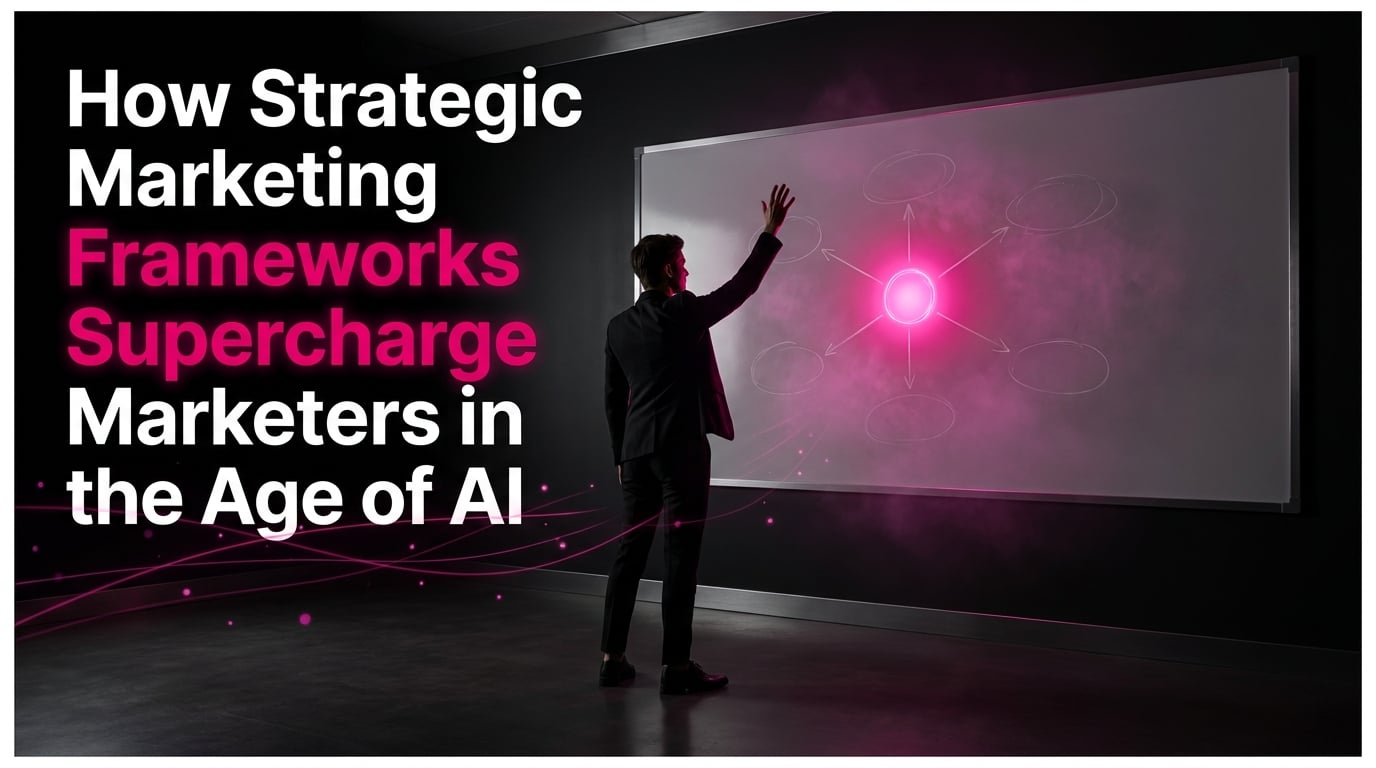
A framework-driven AI workflow places your strategic model at the center, with AI tools branching out to execute each layer of it. Think of it as a hub-and-spoke model: the framework is the hub, and AI handles the spokes.
Here is a concrete example. You run the AARRR funnel framework (Acquisition, Activation, Retention, Referral, Revenue) as your strategic backbone. Then you assign AI to specific jobs at each stage: content generation at Acquisition, personalization at Activation, churn prediction at Retention. McKinsey reports that agentic AI workflows can now enable personalization at scale and accelerate full campaign cycles.
Without the framework, you are just running disconnected AI experiments. With it, every tool has a job, and every output connects to a business outcome. Nielsen (2025) found that 50% of companies globally now use AI for campaign optimization. The ones winning are those who built the strategic layer first.
How Do You Navigate the Ethical Lines When AI Does the Heavy Lifting?
AI marketing ethics means setting explicit rules for what your AI can and cannot do with customer data, content, and targeting before you deploy it. Most marketers treat ethics as a legal problem. It is actually a framework problem.
Build a simple ethics checklist into every campaign brief:
- Data source: Is the data consented and compliant?
- Transparency: Would your audience know AI created this?
- Bias check: Does the AI output exclude or stereotype any group?
- Human review: Who signs off before it goes live?
Harvard Business Review (February 2026) notes that conversational AI is already displacing traditional brand touchpoints. The brands that earn trust in that shift are the ones with clear ethical guardrails, not just fast outputs.
Real-World Case: How Airbnb Uses Strategic Frameworks to Direct AI
Airbnb’s marketing team did not chase every AI tool. They built their personalization engine on a clear customer segmentation framework first, then layered AI on top to execute at scale. The result: hyper-relevant search and email experiences that Marketer Milk (February 2026) cites as one of the most referenced internal AI implementations among major consumer brands.
The lesson is not about Airbnb’s budget. It is about sequencing. Framework first. AI second. That order is what coolest.marketing teaches marketers who want to build careers that compound, not careers that stall when the next tool drops.
Your next step: Pick one framework you already know (STP, AIDA, AARRR) and map your current AI tools to it. If a tool does not connect to a stage in your framework, either find the connection or cut the tool.