Expert Mistakes That Expose Overconfidence Bias (And What to Do Instead)
Overconfidence bias doesn’t hit beginners. It ambushes experts. Every win you stack quietly rewires how you evaluate the next call, and the smarter you are, the harder it is to see it happening. Here’s the mechanism, the co-conspirator bias that keeps it running, and the process fixes that actually work.
- Expertise amplifies overconfidence, it doesn’t cure it. Past wins inflate certainty on future calls.
- Self-attribution bias is the fuel. Experts credit skill for wins and blame luck for losses, so the bias never self-corrects.
- Awareness alone changes nothing. Only pre-decision friction breaks the loop.
- The fix is structural, not motivational. Checklists, decision journals, and devil’s advocacy work. Willpower doesn’t.
How Overconfidence Bias Hijacks Even the Sharpest Experts
Overconfidence bias is the tendency to hold subjective certainty in your judgments that reliably exceeds the objective accuracy of those judgments, and it scales with expertise. The more wins you accumulate, the more certain you become, and the less you stress-test your next call.
Most articles on this topic reach for the Niels Bohr quote and stop there. That’s the wrong frame. The quote treats mistakes as the path to expertise. What it misses: expertise itself becomes the path to new, more expensive mistakes.
Research published in a 2025 PMC study on overconfidence biases found that when participants were 90% confident in their answers, the correct answers rarely fell within that estimated range. Confidence and accuracy decoupled completely. This isn’t a beginner problem. Experts show the same pattern, often worse, because their track record gives the overconfidence a story to hide behind.
Consider Long-Term Capital Management. By 1998, LTCM’s partners included two Nobel laureates in economics. Their models had delivered extraordinary returns for four consecutive years. That winning streak didn’t sharpen their risk assessment. It eliminated it. They leveraged the fund to roughly 25-to-1. When Russia defaulted in August 1998, the fund lost $4.6 billion in under four months and required a Federal Reserve-coordinated bailout.
The expertise was real. So was the bias it enabled.
| What the experts told themselves |
What the bias was doing |
| “Our models have been validated by years of returns.” |
Overprecision: excessive certainty that past accuracy predicts future accuracy. |
| “We understand tail risk better than the market.” |
Overplacement: rating their own judgment above the collective signal of the market. |
Self-Attribution Bias: The Hidden Engine Behind Repeated Expert Errors and Overconfidence Bias
Self-attribution bias is the cognitive pattern where experts credit skill for wins and blame external factors for losses, which means overconfidence never gets corrected after a failure. It just compounds.
If overconfidence is the fire, self-attribution bias is the oxygen. Without it, a bad call would force recalibration. With it, every loss gets a convenient external explanation and the mental model stays intact.
Self-attribution bias teaches investors to unwittingly take on inappropriate degrees of financial risk. Successes are attributed to personal skill; failures are attributed to situational factors beyond their control.
Michael Pompian, CFA, Behavioral Finance and Wealth Management, Wiley Online Library, via Wiley Online Library
Research on sports teams shows the pattern clearly: about 75% of attributions from winning teams were internal (skill, preparation, execution), while only 55% of attributions from losing teams were internal. Experts in finance show the same asymmetry, just with higher stakes.
coolest.marketing’s approach to bias-aware decision-making treats this asymmetry as a data problem, not a character flaw. You can’t shame yourself out of self-attribution bias. You can build a record that makes the pattern visible.
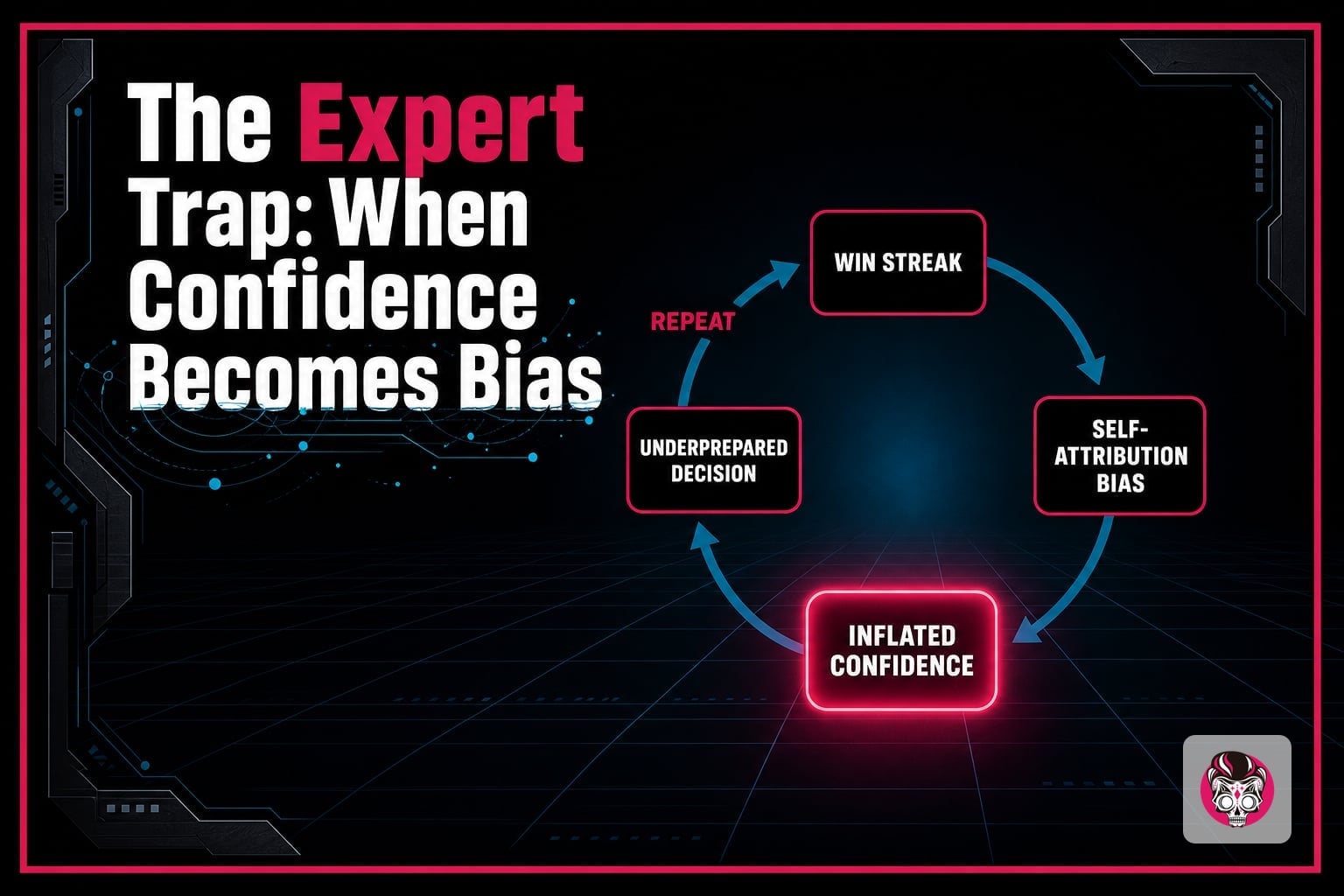
The loop looks like this: win streak feeds self-attribution, self-attribution inflates confidence, inflated confidence drives the next underprepared call, and when that call fails, the loss gets externalized. Repeat. The bias doesn’t weaken over time. It hardens.
Cognitive Guardrails That Actually Break the Overconfidence Bias Loop
Cognitive guardrails are pre-decision structures, including checklists, decision journals, and structured devil’s advocacy, that create friction before a choice is made, interrupting the bias loop before it executes.
Imagine you’ve just had your best quarter in three years. Your last five calls were right. You’re looking at a new position and it feels obvious. That feeling is exactly when the guardrail needs to be in place, not after the trade is on.
Three tools that work:
- Pre-mortem analysis: Before the decision, write out every way this goes wrong. Gary Klein’s research at Klein Associates showed that pre-mortems increase identification of potential failure points by 30%. Force the scenario before conviction locks in.
- Decision journals: Log your confidence level, your reasoning, and your expected outcome before you act. Review it after. The pattern most experts miss is that they remember their reasoning differently after the outcome is known. The journal holds the original record.
- Structured devil’s advocacy: Assign someone (or yourself, formally) to argue the opposite position. Not to change your mind, but to surface the assumptions you aren’t stress-testing.
Studies on overconfidence bias show that people consistently overestimate how often they’ll act ethically and how accurately they’ll perform, even when warned about the bias. Awareness without process changes nothing.
coolest.marketing’s courses for finance professionals in the AI era are built around exactly this: not more information, but sharper decision architecture. The gap isn’t knowledge. It’s structure.
What You Do Next
You’ve seen the mechanism, the reinforcement loop, and the tools that interrupt it. One action you can take this week: pull your last five major calls, log what you told yourself before each one, and map whether your wins got credited to skill and your losses got credited to circumstance. That single exercise is how you see your own bias history in real time, and it changes what you decide next.