Why Marketing Best Practices Keep Falling Apart Inside Your Org (and What to Diagnose First)
Here is the uncomfortable truth: best practices fail not because they were wrong, but because you copied the tactic and skipped the context that made it work. Globally, roughly 70% of projects fail, which translates into substantial financial and operational strain, according to Mosaic’s project failure research. Most of that failure is not execution. It is a missing diagnosis.
Key Takeaways
- 70% of projects fail overall, and marketing tactics are no exception, per Mosaic’s failure research, so stop blaming your execution first.
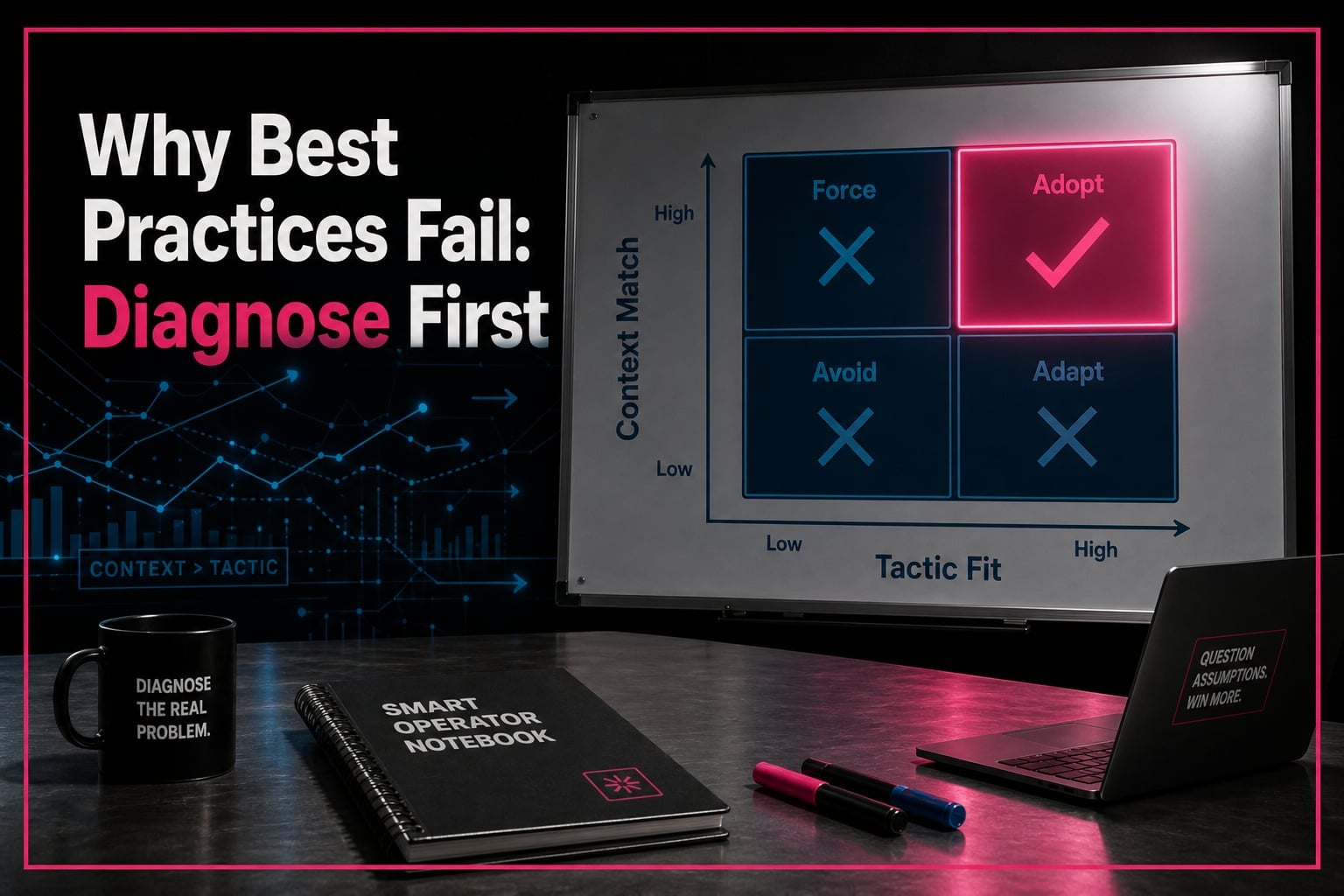
- Every proven tactic carries a hidden context assumption: audience, org speed, and competitive moment. Match yours before you copy.
- Three signals predict fit before launch: audience behavioral fit, decision speed, and competitive environment.
- A 30-minute structured audit surfaces gaps faster than a full quarter of trial and error.
The Hidden Assumption Baked Into Every “Proven” Tactic
A best practice is a tactic that worked in one specific set of conditions, then got stripped of that context and sold as a universal rule. That stripping is the real problem. The tactic itself is rarely broken.
Projects with budgets exceeding $1 million face failure rates nearly 50% higher than smaller projects, according to Mosaic’s project failure data. Bigger bets carry more assumptions, and more assumptions mean more places for context to quietly not match.
You have felt this. You rolled out the playbook that worked at your last company, and it landed flat here. That is not a skill gap. That is why recycled tactics keep failing even smart operators.
The fix starts with reframing the failure. You did not execute badly. You skipped a diagnostic step, and that step is learnable.
Three Signals to Check Before You Copy Any Tactic
A context signal is a measurable condition, like audience behavior or decision speed, that determines whether a proven tactic will actually work inside your organization. Skip these three checks and you are gambling with a full quarter of budget, not running a strategy.
1. Audience behavioral fit. Does your audience actually behave the way the original case study’s audience did? A tactic built for impulse buyers flops on a committee-driven B2B sale, no matter how well you execute it.
2. Organizational decision speed. Can your org approve, launch, and iterate at the pace the tactic requires? A best practice built for a five-person startup team assumes approval in hours. Your org might take three weeks.
3. Competitive environment. Was the tactic proven in a market with a wide gap, or a crowded one where everyone already does it? Contrast is everything: the same tactic in a saturated market delivers noise, not results.
Marketing teams that skip market research before adopting new tactics often miss shifting industry dynamics entirely, per Park University’s marketing strategy guide. Running all three signals as a table, rating each Strong, Weak, or Unknown, turns a vague hunch into a decision you can defend in a leadership meeting. That clarity is exactly the strategic clarity gap AI can’t close for teams that only prompt a chatbot for answers.
Run a 30-Minute Context Check Before You Commit a Quarter
A context audit is a short, structured conversation that tests a tactic against your three signals before you spend real budget on it. Think of it as a pre-flight check, not a research project.
Picture this: your team wants to copy a competitor’s referral program. Instead of building it, block 30 minutes. Walk through audience fit, decision speed, and competitive saturation, out loud, with notes.
Change failure rate offers a useful parallel here: if 30% of your deployments require rollbacks, per Axify’s change failure rate research, that is your signal to slow down and test earlier, not push harder. Marketing tactics deserve the same discipline.
Bring one outside perspective into that 30 minutes if you can. An operator who has seen the tactic fail elsewhere spots the gap in minutes, not months. coolest.marketing runs these sessions specifically for intrapreneurs stuck diagnosing this alone, drawing on operators from Israel’s marketing scene who train marketers for the AI era.
Document the answer to one question before you leave the room: what would make this a win in six months? If nobody can answer, you found your real problem, and it was never the tactic.
Want the fuller process? Here is how to prepare for an expert session so you leave with a decision, not just notes. Or see competitive clarity in 30 minutes mapped out step by step.
Get the context diagnosis right before your next campaign. See how a single expert session surfaces the gaps your team cannot see from the inside, before you spend another quarter on the wrong tactic.