Why Canceling Isn’t About Having Too Many Subscriptions, It’s About One You Can’t Justify
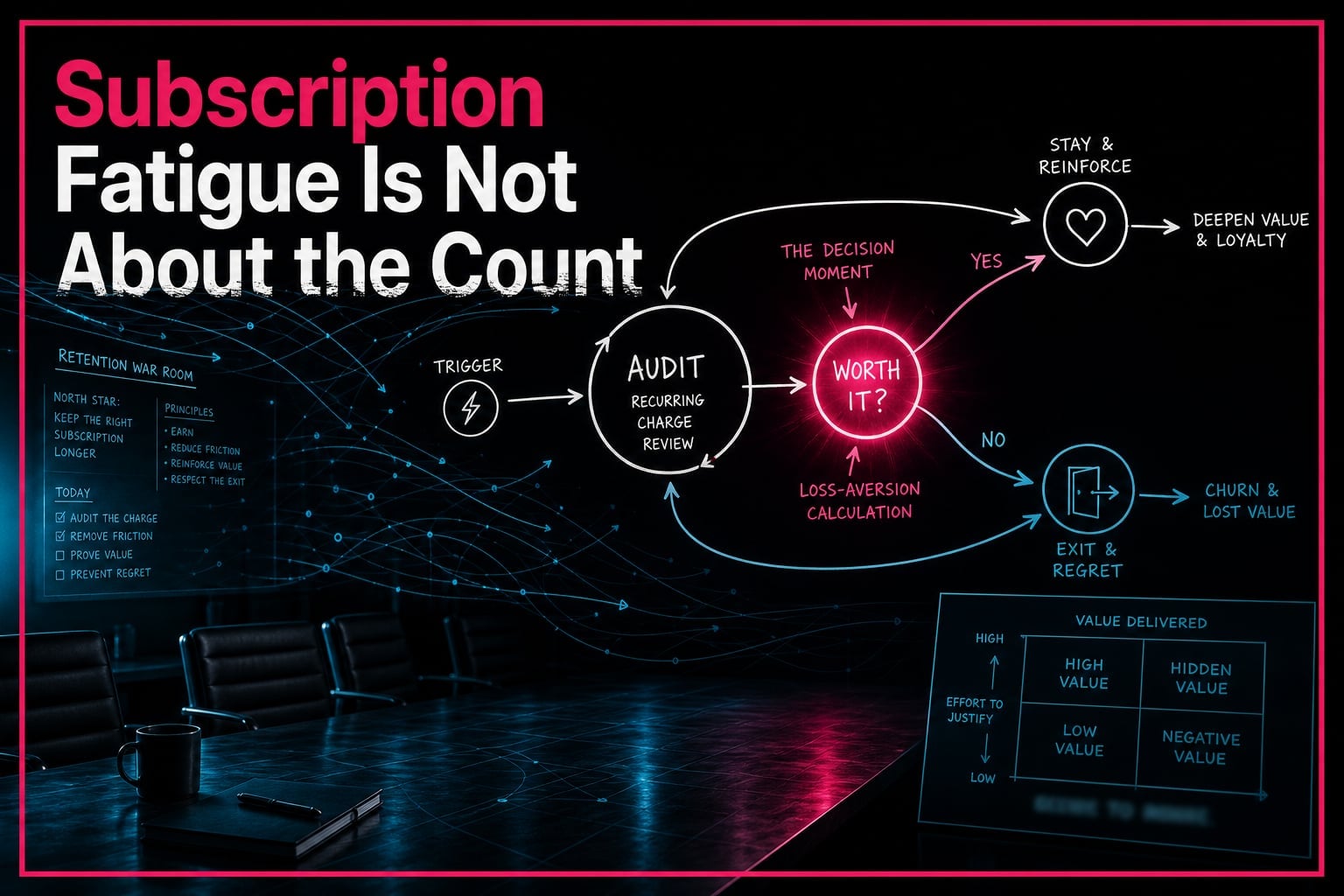
Here’s what nobody selling subscription software wants you to hear: subscription fatigue psychology has almost nothing to do with quantity. A customer with three subscriptions cancels the same way a customer with fifteen does, one charge at a time, each one facing its own trial. The question in their head is never “how many do I have?” It’s “can I still defend this one?”
Key Takeaways
- $273 a month is the real number to fear, not subscription count. That’s average US household subscription spend, and per Readless’s 2026 report, 89% of people underestimate it entirely.
- Every recurring charge gets re-litigated, not counted. Cancellation is a mental accounting failure, not choice overload, per Sage Journals research.
- Economic anxiety accelerates the audit, making a $15 charge feel like a guaranteed loss even when satisfaction is high.
- 42% delay canceling when friction is high, per the Advances in Consumer Research journal, proof that the fix isn’t a simpler unsubscribe button.
- Commitment devices, not pricing pages, are the actual lever marketers have been ignoring.
Cancellations Come From a Failed Value Audit, Not Too Many Subscriptions
Subscription fatigue is triggered by a failed cost justification, not choice overload. Consumers cancel when they can no longer mentally account for what a charge buys them. That’s the whole mechanism, and it’s why “reduce decision fatigue” advice keeps missing the target.
You’ve heard the paradox-of-choice story a hundred times: too many options, too much cognitive load, customers freeze and bail. It’s tidy. It’s also incomplete. Sage Journals research on multi-homing streaming users found the real driver is the cognitive and emotional burden of justifying each platform on its own, not the total number stacked up.
Here’s the rebuttal in plain terms: if choice overload were the driver, adding subscriptions would always increase churn. It doesn’t. Households sit at 12 active subscriptions on average, per Kadence’s research, yet people keep adding new ones while canceling old ones simultaneously. That’s not overload behavior. That’s selective auditing.
What actually predicts a cancel? A subscription that stops paying rent in your head. Subtracker’s research frames fatigue as a recognized psychological state, not a vague vibe, meaning it’s measurable and, more importantly, fixable at the individual-subscription level, not the portfolio level.
You’re probably optimizing your onboarding flow to reduce choice friction. Wrong problem. The friction that kills retention shows up at month four, when the customer runs the audit and you’ve given them nothing new to weigh against the charge.
Economic Anxiety Turns a Fair Price Into a Felt Loss
Under economic uncertainty, people apply loss aversion unevenly to recurring costs, so a $15 monthly charge starts to feel like a guaranteed loss rather than a fair trade. Satisfaction stops mattering. The math in their head has already changed.
This is the layer competitors skip. They’ll tell you fatigue is rising and cite subscription counts. They won’t tell you why it’s rising faster right now. The answer sits in macro uncertainty data: the Economic Policy Uncertainty Index tracks exactly the kind of ambient unpredictability that makes people tighten their grip on discretionary spend, even spend they’ve historically enjoyed.
Here’s the framework: think of it as a threat multiplier, not a new mechanism. The value-justification audit from section one already existed. Economic anxiety just makes the auditor stricter and the standard harder to clear.
The American Enterprise Institute notes trade policy uncertainty has now surpassed even 2018-19 levels, a climate that trains consumers to treat every recurring charge as a candidate for cuts. And it’s working: MNTN Research found 75% of consumers who dropped or plan to drop a streaming subscription would reconsider only for a cheaper, ad-supported option. Price isn’t the problem. Proof of ongoing value is.
This is where the cognitive bias playbook marketers actually use earns its keep: loss aversion isn’t a footnote, it’s the whole battlefield once uncertainty is high. If your retention plan assumes stable economic footing, it’s already out of date.
Stop Simplifying Your Pricing Page. Start Engineering Proof and Commitment.
The fix for subscription fatigue is not a cleaner pricing page, it’s building recurring proof of value and behavioral commitment devices that make canceling feel like a loss. Simplifying checkout addresses the wrong end of the relationship entirely.
Contrast the two playbooks. Choice-overload thinking says: cut plans, shorten menus, reduce clicks to subscribe. Value-justification thinking says: schedule proof moments, make progress visible, and let the customer feel what they’d lose by leaving.
Commitment devices work because they add a cost to walking away, and that cost doesn’t have to be financial. SUE Behavioural Design defines them as arrangements made now to constrain future behavior, raising the bar for backing out later. Habit Weekly’s database even cites commitment devices boosting smoking quit rates by 40%, evidence this isn’t soft theory, it’s proven behavior change mechanics.
Three moves for Monday: First, ship a monthly “value receipt” that shows what the subscription actually delivered, not what it costs. Second, build a visible streak or progress marker tied to continued use, so canceling means losing momentum, not just a service. Third, avoid manipulative dark patterns, since when nudging backfires on consumer trust shows aggressive retention tricks erode the very trust you need for renewal.
Pair this with community-powered retention loops and reading weak signals before the trend goes mainstream to catch justification failure before it shows up in churn reports. If this reframe shifted how you see the problem, the next question is how you think about the decisions underneath it. That’s exactly what we dig into every week: follow along and get sharper.