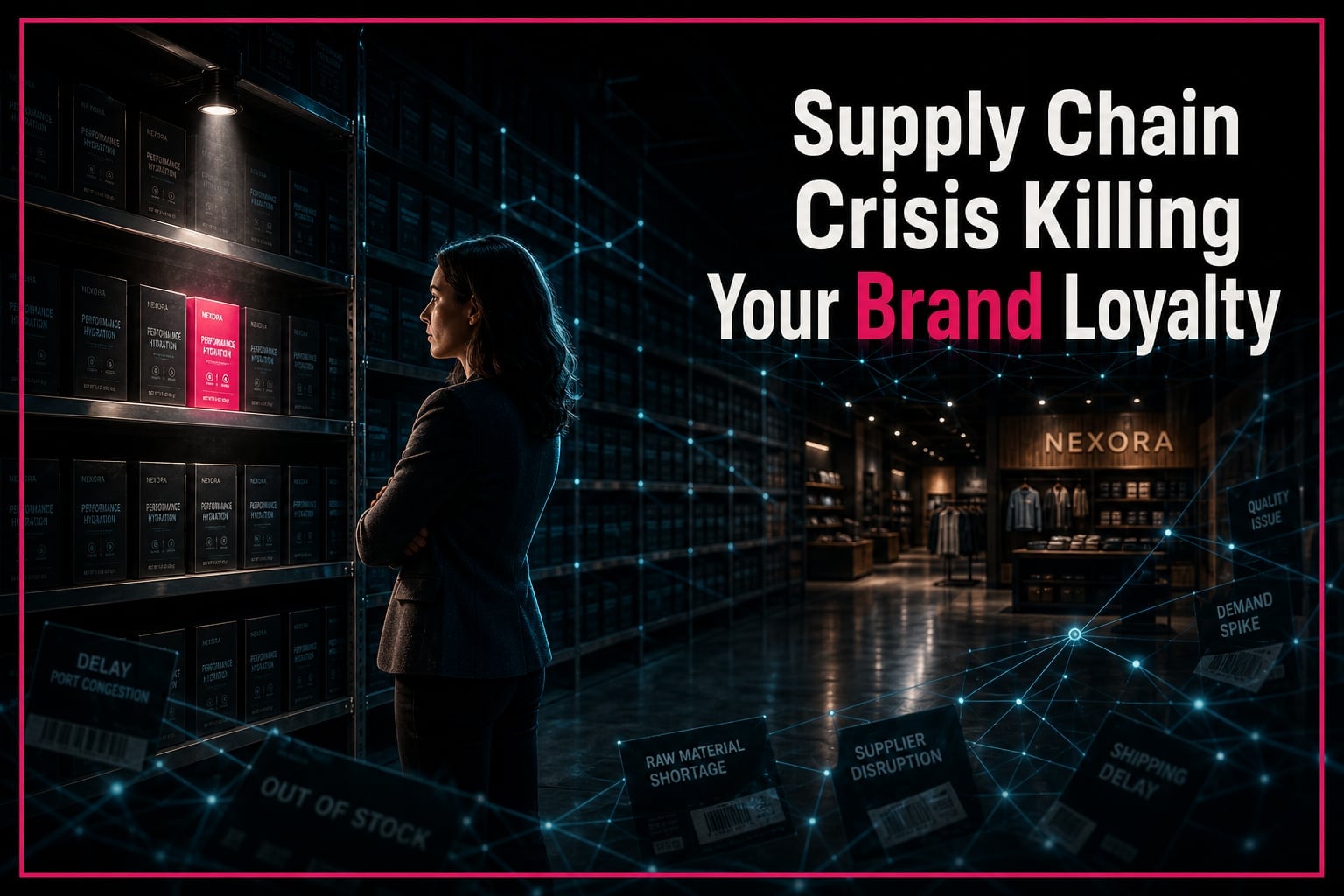
The Supply Chain Crisis Quietly Killing Your Brand Loyalty
Supply chain disruptions consumer trust research is clear on one point: the delay itself rarely kills the sale. The silence around it does. A late shipment is forgivable. A brand that goes quiet while customers wait is not. Every unexplained delay drains a trust account you didn’t know you were managing.
Key Takeaways
- 67% of consumers say they must trust a brand before buying from it again, per Yale School of Management, and disruptions are where that trust gets tested first.
- Reputational damage hits 83% of companies after supply chain disruptions, according to Electro IQ, yet most crisis plans still skip the messaging.
- Organizations that build trust and transparency are more likely to maintain operational consistency through disruption, per Deloitte Insights, making honest updates a revenue lever, not just a courtesy.
- Marketers, not ops teams, own the words customers actually see. That means marketers own whether the trust account grows or goes negative.
How Every Delay Quietly Drains Consumer Trust
Supply chain disruptions erode trust not through the delay itself, but through the silence, vagueness, and spin brands use to cover it. 67% of consumers say trust is a prerequisite for buying at all, according to Yale School of Management, citing Edelman research.
67% of consumers won’t buy from a brand they don’t trust. That’s the number to sit with before your next “we’re experiencing higher than normal demand” email goes out.
Here’s the mechanism. A customer notices a delay. They check for an update. They find a form email, or nothing.
That gap between “something happened” and “here’s what happened” is where trust bleeds out. It’s the same gap behavioral marketers study when they look at how consumers resist being managed. Vague reassurance reads as manipulation, not comfort.
Reputational harm follows 83% of companies after a disruption, per Electro IQ. Most of that damage isn’t the shortage. It’s the way brands talk, or don’t talk, about it.
You’re probably tracking open rates and NPS and calling it fine. Those are metrics that look healthy while quietly wrecking your brand if the underlying story is silence dressed up as stability.
What Honest Messaging Looks Like When Shelves Go Empty
Transparent communication during a shortage means proactive, specific, timely messaging: telling customers what happened, what you know, and what you’re doing, before they have to ask. Vague brands wait to be caught. Transparent brands beat the question.
Compare the two paths. Vague brands say “we’re experiencing delays” and stop there, forcing customers to guess and assume the worst. Specific brands say “our supplier in Vietnam missed a shipment window, your order ships March 12, here’s your tracking link now.”
That contrast is the whole game. One is a trust withdrawal. The other is a deposit, even though both start from the same bad news.
Patagonia has built its reputation on exactly this kind of specificity, publishing detailed supply chain and sourcing information rather than generic sustainability claims. Everlane built its entire brand promise on “radical transparency,” showing customers actual factory costs and conditions instead of asking for blind trust.
Here’s a simple checklist for the moment your inventory breaks:
- Say what happened, in one specific sentence, within 24 hours of knowing internally.
- Give a real date, not a range, and update it the moment it changes.
- Offer a concrete next step: a substitute, a refund path, or a waitlist with a number attached.
This isn’t the old playbook. Many of the communication rules that no longer hold still tell marketers to protect the brand by saying less. Say more.
Why the Honest Brand Wins the Loyalty Fight After the Crisis
Brands that communicate honestly during disruptions recover faster and keep more customers than brands that stay quiet, because a handled crisis proves trustworthiness in a way smooth operations never can. Smooth operations don’t test anything. A crisis does.
Skeptical marketers push back here: “our customers just want the product, not a newsletter.” Maybe. But 55% of consumers say they’d switch brands entirely if their preferred option went unavailable, per eMarketer. Silence during that window doesn’t just risk one sale. It risks the relationship.
Transparency also pays in cold hard growth math. Products carrying credible ESG and sourcing claims average 28% cumulative growth over five years, versus 20% for products without, according to EcoVadis.
Organizations that build reliability and transparency are roughly 30% more likely to hold operational consistency through disruption, per Deloitte Insights. That consistency is what customers actually remember, not the outage.
Coolest.marketing’s own take on this: the marketers who protect equity fastest are the ones already reading weak signals before the trend goes mainstream, catching the supplier wobble before it becomes a headline.
Every delay is a choice point. Spend it in silence and lose the customer quietly. Spend it in honesty and the crisis becomes the best trust-building campaign you never planned to run.
Want the full ethical marketing framework? Explore how principled communication builds brand equity that survives any disruption.