Why Your Attribution Dashboard Can’t See Where Growth Actually Comes From
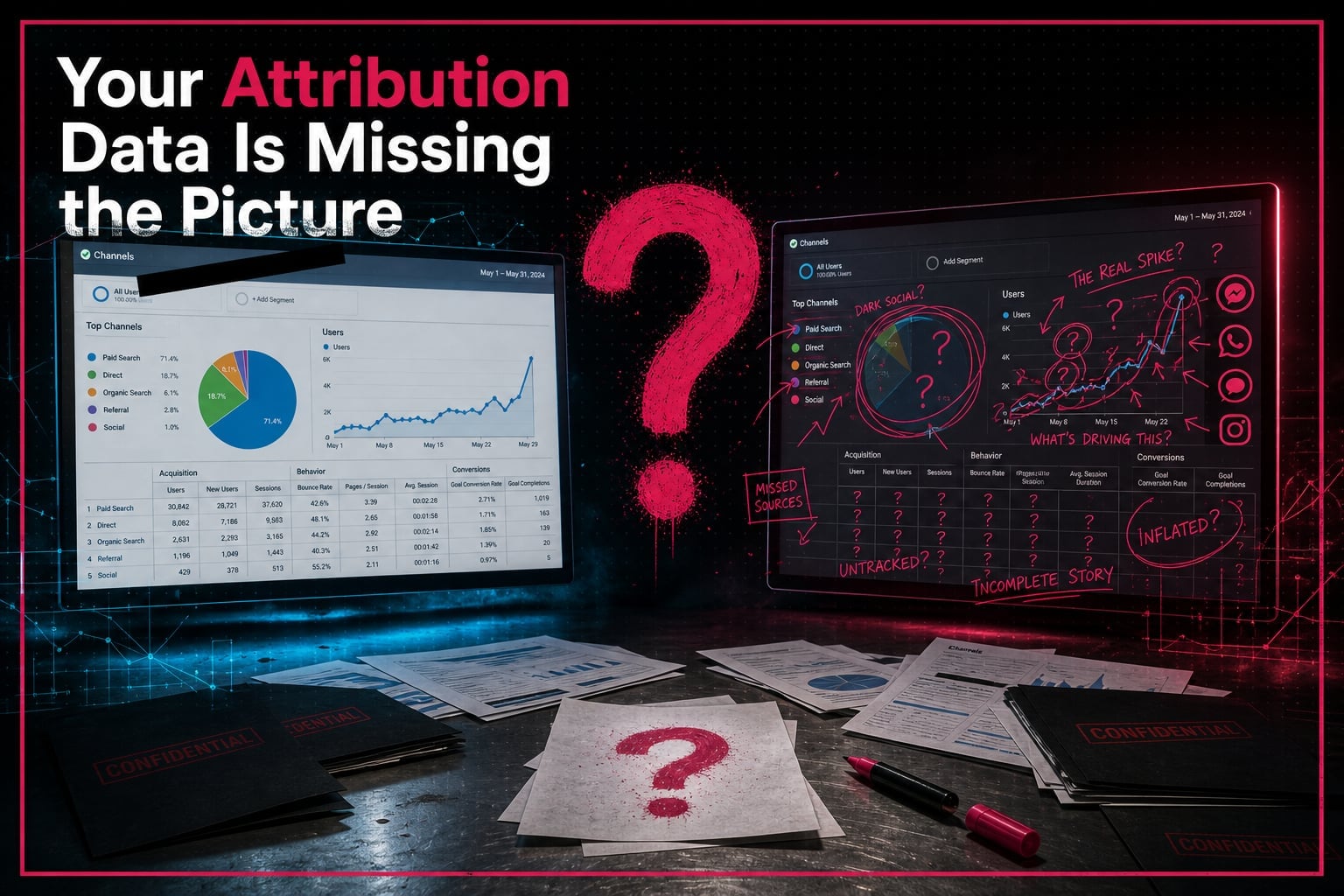
Your best channel might not even show up in your reports. Dark social attribution is the practice of trying to measure influence from private shares, texts, and DMs that never carry tracking data, and most dashboards simply mark that traffic “direct” and move on. Up to 84% of shares happen this way, according to Convince & Convert’s report on RhythmOne data. That means the channel driving your growth might be invisible, and the one getting credit might just be lucky timing.
Key Takeaways
- Up to 84% of sharing happens in dark social channels, per Convince & Convert, meaning most of your word-of-mouth growth never touches a trackable link.
- 100% of TikTok, Slack, Discord, Mastodon, and WhatsApp visits get logged with zero referral data, per SparkToro’s dark social experiment.
- Self-attribution bias makes you crown the wrong winner, crediting the last click you can see over the private nudge that actually closed the deal.
- A forensic reading habit beats a better tool, because no tracking pixel will ever see inside a WhatsApp thread.
Why Private Sharing Breaks Your Attribution Data at the Root
Dark social attribution fails because private sharing channels strip tracking parameters by design, so real referral traffic lands in your analytics as “direct,” a bucket that tells you nothing. You built your budget on that bucket anyway.
Here’s the number that should bother you: 100% of visits from TikTok, Slack, Discord, Mastodon, and WhatsApp arrive with zero referral data, and 75% of Facebook Messenger visits do the same, according to SparkToro’s research with Really Good Data.
Picture the journey. Someone shares your product in a WhatsApp group. A friend clicks it, buys, and Google Analytics quietly stamps that sale “direct.” No campaign gets credit. No channel looks responsible. The sale still happened.
Journalist Alexis Madrigal named this in 2012 when he noticed The Atlantic’s “direct” traffic didn’t add up, as detailed by The Atlantic. Over a decade later, the gap hasn’t shrunk. It moved to apps that hide referral headers even more thoroughly, per Sprinklr’s glossary on dark social. Your dashboard didn’t get worse. The channels just got quieter.
The Brain Habits That Turn a Blind Spot Into a Bad Budget Call
Self-attribution bias and availability bias cause marketers to credit the last visible touchpoint for wins they didn’t drive, then cut the invisible channels that actually did the heavy lifting. This isn’t a data problem anymore. It’s a you problem.
Self-attribution bias makes you claim credit for whatever you can see. If a paid search ad sits right before a sale, you crown paid search the hero, even though a Slack message from a colleague made the decision three days earlier. The click is just the receipt.
Availability bias makes it worse. Your brain grabs the easiest evidence in front of it, the dashboard number, and treats it as the whole truth. The private conversation that actually swayed the buyer never enters the equation because you never saw it.
Together these two biases don’t just misread the past. They shape next quarter’s budget. You fund the visible channel, starve the invisible one, and wonder why growth stalls even as your “top channel” keeps winning on paper. This exact trap is the subject of our cognitive bias playbook that beats a bigger budget.
Metrics that look healthy on the surface often hide this exact substitution, which is why we’ve written separately about the metrics that look healthy and quietly wreck your strategy. A metric can be accurate and still be measuring the wrong cause entirely.
How to Spot Influence When the Tracking Goes Dark
Treat your analytics as a crime scene, not a scoreboard: survey-based attribution, branded search trends, and direct-ask onboarding questions reveal influence no dashboard captures. Here’s a scenario. A customer converts through a Google ad. But she’d never heard of you until her sister texted a screenshot two weeks earlier. Your dashboard says “paid search worked.” The truth says “her sister worked, and paid search just closed the loop.”
Three habits catch that truth:
- Ask directly at checkout or onboarding. A single “how did you hear about us” field outperforms any tracking pixel for private shares.
- Watch branded search spikes. A jump in people searching your company name by name, with no matching campaign live, usually means dark social sharing is happening right now.
- Track direct traffic trends over time, not in isolation. A rising “direct” bucket alongside flat campaign spend is a signal, not noise.
Dark social attribution done well, according to ATTN Agency’s DTC research, uncovers acquisition channels worth 15% to 25% of total social traffic, traffic most brands never fund because they never see it. That’s the whole case for building the habit instead of waiting on a better tool.
This is the same shift we cover in the decision-making shift that turns marketers into strategists: read signals, don’t just read screens. And if your playbook still assumes every conversion has a clean, trackable path, it’s worth revisiting marketing rules that are killing your results in 2026.
Want to stop making budget calls based on data that only shows half the story? Explore how sharp marketers build a fuller picture of what’s actually driving growth.