Why Your Campaigns Feel Interchangeable: The Real Cost of Prompt Fatigue Marketing Teams Keep Ignoring
Your last three campaign briefs sound like they came from the same brain, and they kind of did. That brain is ChatGPT. This is prompt fatigue marketing teams are quietly suffering from: everyone prompts the same tools the same way, and the ideas that come back start blurring into a single beige campaign nobody remembers.
Key Takeaways
- Research shows that when teams over-rely on AI for ideation, collective idea diversity narrows even as individual output rises, per BCG and Harvard research.
- Mid-career creatives now report burnout rates of 77%, and only 10% think AI’s overall effect on the industry is positive, per Creative Boom’s 2026 survey.
- The fix isn’t less AI. It’s splitting roles: AI owns data and prediction, humans own original ideas, full stop.
- Three protocols (AI-free sprints, meta-analysis prompting, cross-ecosystem data sourcing) rebuild the divergence prompting alone erodes.
Why Prompt Fatigue Is a Brand Problem, Not Just a Burnout Problem
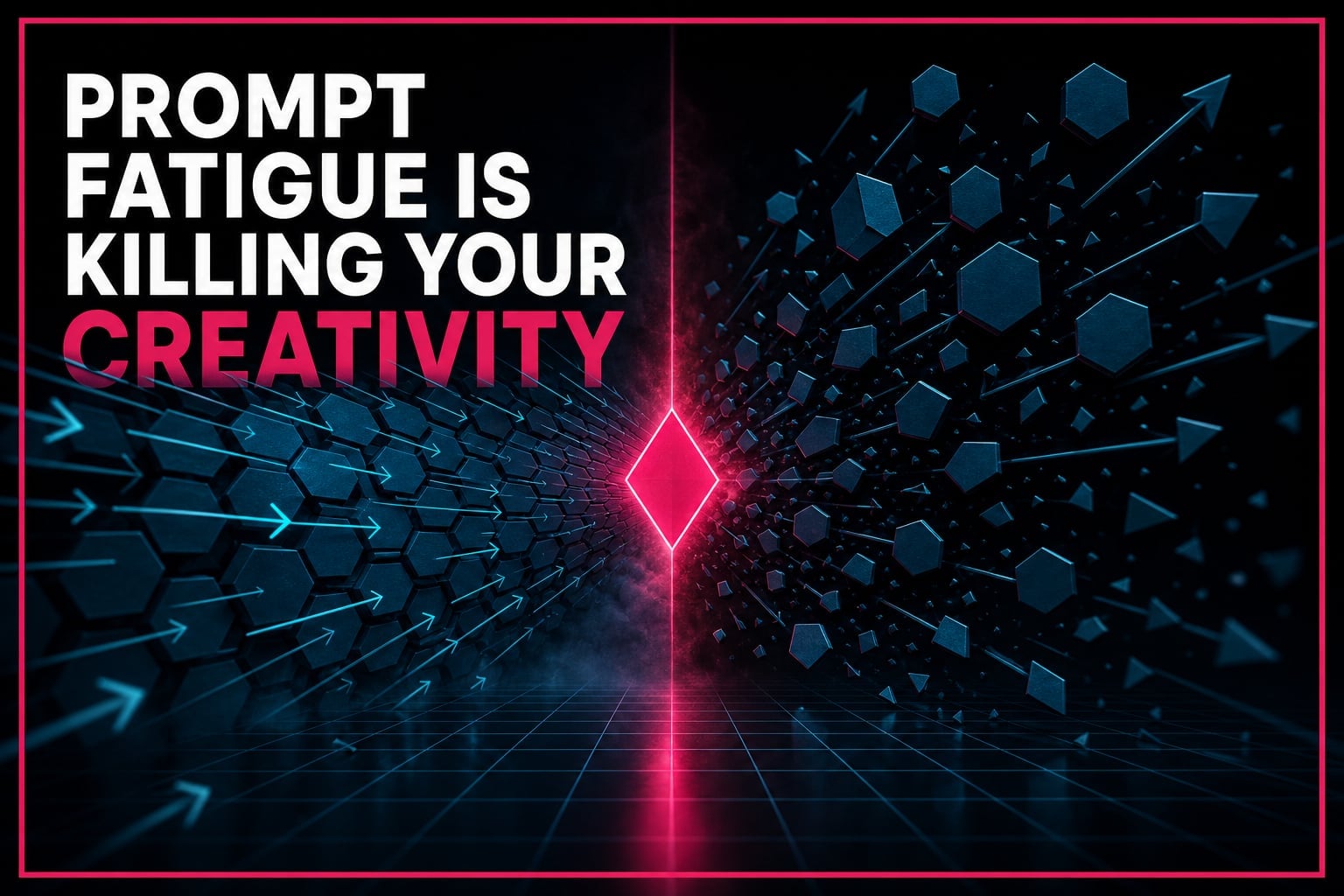
When marketers over-rely on AI to originate ideas, collective campaign divergence narrows, meaning your brand starts sounding like everyone else’s, fast. That is the direction BCG and Harvard research on generative AI use points: individual creative output can rise while the range of distinct ideas across a group of users narrows significantly.
Read that twice. AI made each of you personally more productive while making all of you, together, more identical. That’s not a productivity story. That’s a brand identity story.
Most coverage of prompt fatigue treats it as a personal energy problem: tired brains, too many tabs, decision fatigue. Fair enough. But the real damage happens at the collective level, where every competitor prompting the same models for “bold campaign concept for Gen Z sneaker brand” converges on the same three ideas. Your differentiation dies quietly, brief by brief.
The creative workforce already feels this pressure elsewhere. Mid-career creatives report burnout rates of 77%, early-career professionals sit close behind at 74%, and just 10% of creatives think AI’s overall effect on the industry is positive, according to Creative Boom’s 2026 state of the creative industry survey. That exhaustion isn’t just a wellness footnote. It’s the early warning sign of a brand losing its fingerprint.
The Dual-Brain Fix: Protecting Your Right-Brain Before AI Flattens It
The solution isn’t using AI less. It’s splitting your team’s cognitive roles so AI handles data and prediction while designated humans originate ideas without AI, full stop. Call it the Dual-Brain Strategy, and it’s the structural move nobody else in this conversation is making.
Here’s the contrast that matters. Most teams run one brain: prompt, generate, tweak, ship. The Dual-Brain model runs two, on purpose, in parallel.
Left-AI Brain: data scientists and engineers build predictive tools that unpack audience-creative pairings and forecast sales outcomes with precision. This brain never touches idea origination. Its job is math, not muse.
Right-Brain Protection: your true artists and innovators are forbidden from using AI to originate the core concept. They use their own human “juice” for the idea, then bring in AI afterward, only to prototype or scale what they already created. This single rule preserves the creative divergence that unchecked prompting erodes.
This isn’t anti-AI. AI only works when human judgment leads, and the Dual-Brain model just makes that sequencing non-negotiable instead of a nice idea. Skip the sequencing, and you’re back to everyone typing the same prompt into the same box, waiting for the same box to hand back the same three headlines.
Practical Protocols to Reclaim Your Creative Edge
Three concrete habits, AI-free ideation sprints, meta-analysis prompting, and cross-ecosystem data sourcing, rebuild the creative divergence that over-prompting erodes. None of these require an org chart rebuild. You can start Monday.
Picture your next brainstorm. Ten minutes in, someone says “let’s just ask ChatGPT.” Stop right there.
- Run AI-free ideation sprints first. Give your right-brain team 30 minutes with a notepad, zero screens, before any AI tool opens. Original concepts come from friction, not autocomplete.
- Use the meta-analysis hack. Instead of asking AI for campaign ideas, ask it “what questions should I ask to make decisions about the next campaign?” This surfaces blind spots your team didn’t know existed, without letting AI write the idea itself.
- Source data outside your ecosystem. Run a 30-minute audience measurement workflow in Perplexity to replace intuition with sourced fact, pulling from adjacent industries instead of the same competitor data everyone else scrapes.
- Protect the sequence. AI touches the work after the human idea exists, never before.
This closes the loop. The strategic clarity you protected in the Dual-Brain model becomes daily habit here, and habit is what survives budget cuts and busy quarters. If you want the deeper mechanics, the strategic clarity gap AI prompts cannot close walks through why prompting alone can’t replace this. It also connects to the decision-making shift that turns marketers into strategists, and to why marketing best practices stop working once every team leans on identical tools.
Want to see where your team’s creative divergence is leaking? Explore how sharp marketers are diagnosing their AI blind spots before the next campaign brief lands on your desk.