Why Community-Driven Marketing Outperforms Traditional Campaigns for Sustainable Brand Growth
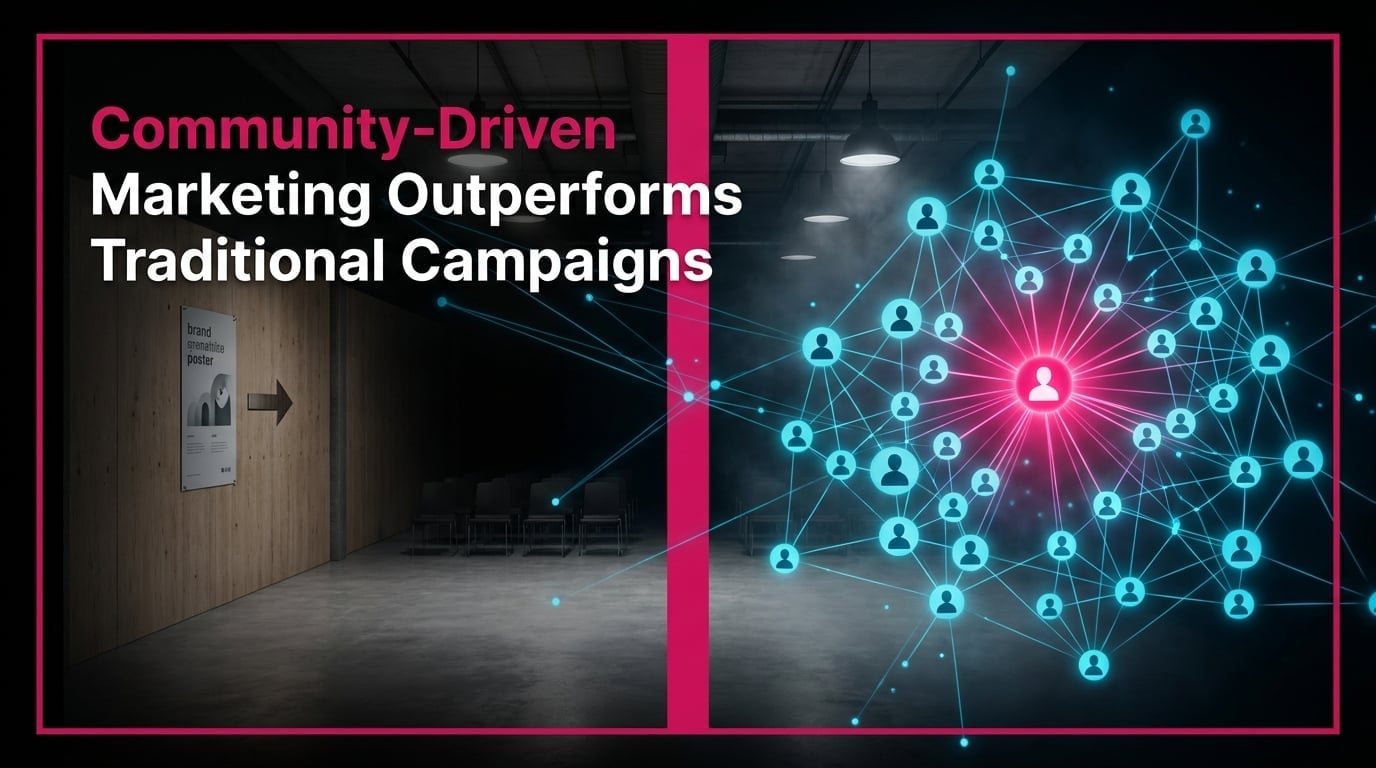
Traditional ad campaigns have a shelf life. You spend, you spike, you stop. Community-driven marketing does the opposite: it compounds. Every conversation, every piece of user content, every shared win adds to a base that keeps growing after the budget runs out.
Most articles on this topic will tell you communities are “good for brand loyalty.” That is the floor, not the ceiling. The real story is that community is a cost center that secretly behaves like a revenue engine, and almost nobody is measuring it that way.
What Are the Core Benefits of Community-Driven Marketing?
Community-driven marketing is a strategy where the brand creates conditions for customers to connect, contribute, and advocate, rather than broadcasting messages at a passive audience.
You are probably measuring your community by follower count. That is the wrong number. The metric that matters is how often your community speaks for you when you are not in the room.
Research from Toki shows 86% of businesses consider community management crucial for their success. That is not a soft opinion. That is a near-consensus among companies that have tried both approaches and picked a side.
The compounding effect is real. Every member who posts a review, shares a tutorial, or answers a peer question is doing marketing work your team did not have to pay for. Forrester found that 87% of companies say community marketing is important for driving better customer engagement.
How Do Financial Incentives and Co-Creation Fuel Community-Driven Marketing?
Co-creation in community-driven marketing means giving members a real stake in the product, not just a feedback form. Think revenue sharing, credited designs, or exclusive early access tied to contribution.
Most brands treat their community like an audience. The brands winning right now treat it like a development team with skin in the game.
LEGO Ideas is the clearest example. Fans submit product designs, vote on favorites, and winning submissions become real products with the creator credited. This is not a campaign. It is an ongoing loop of investment and reward that costs LEGO far less than a traditional product development cycle while generating built-in launch advocates.
David Spinks, founder of CMX Hub and author of The Business of Belonging, writing in his book: Community is not a marketing tactic. It is an organizational strategy. When you build belonging into the product itself, you stop renting attention and start owning it.
Financial incentives do not have to mean equity. Rewards, commissions, and recognition all signal to members that their participation has real value. Community-driven support alone may save companies an average of $145,000 per year, according to Marketing LTB’s 2025 community marketing analysis.
coolest.marketing’s approach to this, grounded in startup-nation marketing practice, is to treat community investment like a product roadmap: prioritized, resourced, and measured against actual outcomes, not vanity metrics.
What Does Successful Community-Driven Marketing Look Like in Practice?
A successful community marketing program is a structured system where members have defined roles, real incentives, and a clear path from casual user to active advocate.
Dove’s Real Beauty campaign is the case study everyone cites. Here is the part they skip: the campaign worked because Dove did not tell women what beauty meant. It asked them. That single decision, dialogue over monologue, turned a soap brand into a platform for a global conversation that ran for years without a paid media refresh.
HubSpot reports that 90% of consumers say user-generated content holds more influence over buying decisions than promotional emails. That gap is not closing. It is widening as ad fatigue increases.
The practical lesson: identify your “golden persona,” the community member whose values, reach, and enthusiasm make them a natural brand representative. Recruit them intentionally. Give them tools, access, and recognition. Then get out of their way.
How Can Brands Start Shifting From Campaigns to Community Ecosystems?
Moving beyond campaigns means replacing the launch-pause-launch cycle with always-on structures: member programs, co-creation loops, and content that serves the community rather than just the brand calendar.
Start with one channel you already own, a Facebook Group, a Discord, a newsletter reply thread, and make one commitment: respond to every post for 30 days. Not with marketing copy. With a real answer or a follow-up question. That is how trust starts.
Then build structure. Assign tiers. Reward early contributors. Duel’s community marketing guide outlines how brands operationalize advocacy through structured ambassador programs with clear incentives at each level.
For marketers navigating this shift, coolest.marketing offers courses built specifically for the AI era, where community strategy and content marketing are taught as interconnected systems, not separate disciplines.
Your next step: Audit your last three campaigns. For each one, ask: what happened to the audience after the campaign ended? If the answer is nothing, you have your gap. Start there.