Web2 Marketing Meets Web3 Communities: What Marketers Must Understand to Thrive
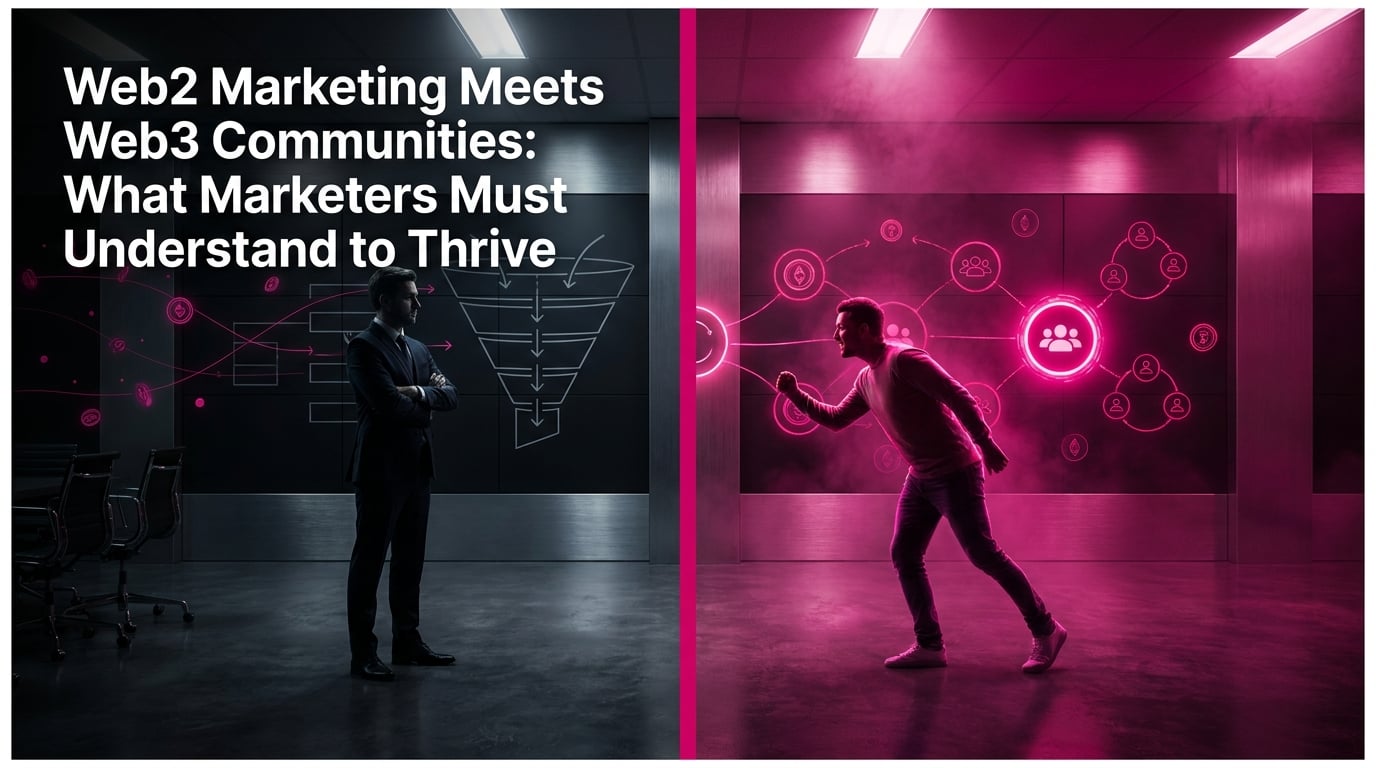
Most Web2 marketing playbooks treat communities like audiences. Post content, measure reach, optimize for clicks. That worked when you owned the algorithm. In Web3, the community owns everything, including you. The sooner you internalize that shift, the sooner you stop burning budget on strategies that Web3 natives ignore on sight.
Quick Answer: What Do Web2 Marketing Professionals Need to Know About Web3 Communities?
Web3 communities are decentralized groups where members hold shared ownership, governance rights, and financial stakes, not just follower status. According to Mighty Networks, the core difference is ownership: in Web2, the platform owns the community; in Web3, the community owns itself.
That one sentence changes every tactic you know. You are not marketing to users. You are negotiating with co-owners.
How Does Web2 Marketing Differ from Web3 Community Engagement?
Web2 marketing is platform-centric, built on personal data collection, paid reach, and one-way brand messaging optimized for clicks and conversions. Formo describes Web3 marketing as user-centric, where transparency and community participation replace targeted ads as the primary growth engine.
In Web2, you buy attention. In Web3, you earn trust or you get ignored. Web3 communities can spot a brand doing “community theater” from three Discord servers away.
The structural gap is real. Addressable notes that Web3 flips the funnel entirely: community comes before product, not after launch.
Why Trust and Financial Incentives Are Non-Negotiable in Web3 Web2 Marketing Transitions
Trust in Web3 is not a brand value you write in a deck. It is a technical and behavioral standard enforced by the community itself, through on-chain transparency, public governance votes, and token-based accountability.
According to Katie Haun, General Partner at Haun Ventures, speaking at the a16z crypto summit in 2022: “The projects that survive are the ones where the team treats token holders like partners, not customers. The community will always know the difference.”
Financial incentives are not optional extras. They are the architecture. Web3 communities use token rewards, NFT access, and DAO profit-sharing to align member behavior with community growth. Shopify’s Web3 marketing overview confirms that token-based incentive structures are now a core pillar of Web3 engagement strategy.
coolest.marketing’s approach to this transition focuses on teaching marketers how incentive design, not just content strategy, drives community momentum in decentralized spaces.
What Community Structures Actually Work in Web3?
Effective Web3 community structures combine decentralized governance (DAOs), token-gated access, and transparent contribution rewards into a self-reinforcing participation loop. The CFC St. Moritz industry brief identifies DAOs as the dominant governance model because they give members real decision-making power.
Here is what actually works, based on observable patterns across active Web3 communities:
- Token-gated channels: Access tied to ownership creates genuine stakes, not vanity metrics.
- Public contribution logs: Transparency builds credibility faster than any campaign.
- Tiered reward systems: Reward early adopters differently from casual members. Loyalty has to mean something financially.
- AMA sessions and build-in-public updates: Pavel Shyrokostup’s community strategy breakdown shows that regular founder AMAs are among the highest-trust-building activities in Web3.
Case Study: How Starbucks Tested the Web3 Community Shift
Starbucks launched Odyssey in late 2022, a Web3 loyalty program built on the Polygon blockchain, blending NFT-based “journey stamps” with real-world rewards. Members earned and traded digital collectibles that unlocked exclusive experiences, not just discounts.
The program enrolled tens of thousands of members within its beta phase and generated secondary market trading activity that Starbucks did not pay for. The community created value independently. That is the Web3 model working exactly as designed.
Starbucks eventually wound down Odyssey in 2024, but the experiment proved one thing clearly: when financial stakes and community ownership are real, engagement follows without ad spend.
Key Takeaways for Web2 Marketing Professionals Ready to Make the Leap
The transition from Web2 marketing to Web3 community engagement is not a channel switch. It is a power transfer. You give up control of the message in exchange for a community that markets for you.
Three shifts to make immediately:
- Stop optimizing for reach. Start optimizing for ownership alignment.
- Build financial participation into your community structure from day one, not as a loyalty add-on.
- Measure trust signals: governance participation rates, token retention, and member-generated content volume.
coolest.marketing offers courses built specifically for marketers navigating the AI and Web3 era, grounded in the practical frameworks that Web3-native brands already use.
Your next step: Audit one community you currently manage. Ask honestly: do members have any ownership stake, financial upside, or governance voice? If the answer is no, you are running a Web2 audience inside a Web3 world. Fix that first.