The 10 Commandments of Ethical Marketing Principles Every Modern Marketer Needs
Most ethical marketing articles give you a list of buzzwords and call it a day. Honesty. Transparency. Respect. Great. Now what? The real problem is not that marketers lack values. It is that they lack a framework for applying those values when a client pushes back, a deadline looms, or a dark pattern doubles the conversion rate.
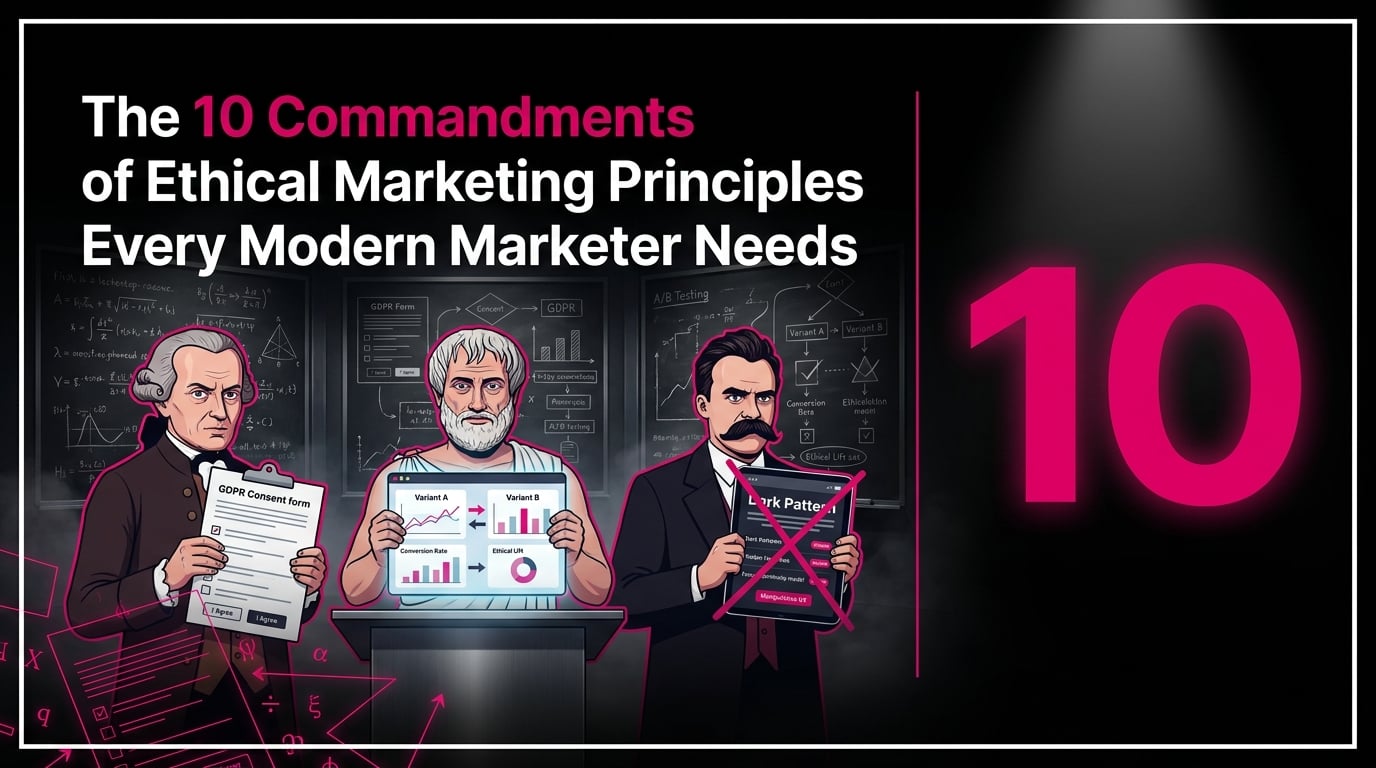
Here is the gap nobody fills: the philosophers who invented ethical thinking already solved these dilemmas. Kant, Aristotle, and Nietzsche were not writing about ad copy, but their frameworks map onto modern marketing decisions with unsettling precision. Using insights from “The Ethical Marketer” course, We built these 10 commandments around that connection.
Why Ethical Marketing Principles Matter More Than Ever
Ethical marketing principles are the rules that keep your brand honest, your customers respected, and your campaigns on the right side of regulation and public trust.
This is not abstract. According to DigitallyAlex’s 2024 research, 83% of marketers are prioritizing ethical data use based on principles of consent, transparency, and privacy. That number did not come from idealism. It came from watching brands lose customers, face regulators, and burn ad budgets rebuilding trust they never should have broken.
The American Marketing Association puts it plainly: ethical marketing builds trust, and trust is what lets marketers reclaim influence and prove long-term value. That is not a soft benefit. That is your business model.
How Classic Philosophy Sharpens the Philosophy of Marketing Ethics
The philosophy of marketing ethics is the study of right and wrong applied to how brands communicate, persuade, and build relationships with the people they serve.
You are probably treating ethics as a compliance checklist. That is the wrong frame, and it costs you clarity when decisions get hard. Philosophy gives you decision-making tools, not just rules.
Three frameworks matter most here. Kant’s Categorical Imperative: only act in ways you would want universalized. Applied to marketing, it asks: what if every brand did exactly what you just did? Aristotle’s Golden Mean: virtue lives between extremes, so balance bold claims with honest evidence. Nietzsche’s Eternal Recurrence: act as if every campaign decision will repeat forever. That one will kill a dark pattern faster than any compliance memo.
What Are the 10 Commandments of Ethical Marketing Principles?
These 10 ethical marketing principles are a practical code, grounded in philosophy, for making better decisions when the pressure is on.
- Tell the truth, even when it hurts sales. Southwest Airlines ran its “Transfarency” campaign on radical pricing honesty and earned nearly 5 million Facebook likes, per OpenStax Principles of Marketing. Honesty is a growth strategy.
- Ask before you take. Consent is not a legal checkbox. It is the foundation of every data relationship you have. Collect only what you need. Use only what you asked for.
- Price fairly. The Northwestern IMC program lists fairness as a core ethical marketing principle, starting with reasonable prices and accessible offers.
- Represent your product accurately. No cherry-picked before-and-afters. No misleading results. The Institute for Advertising Ethics calls substantiation a first principle. Back your claims.
- Respect human dignity in every ad. Kant’s second formulation: never treat people as a means to an end. That includes targeting vulnerable audiences with manipulative urgency tactics.
- Own your mistakes publicly. Nietzsche’s Eternal Recurrence applied: if you had to run your crisis response on repeat forever, would you stand behind it? Silence is not a strategy.
- Build inclusivity in, not on. Tokenism is not inclusion. Forbes Agency Council identifies respect for human dignity as a non-negotiable brand value, not a campaign theme.
- Protect privacy like it is your own data. Because one day it will be. GDPR, CCPA, and whatever comes next all point the same direction.
- Market sustainably. According to OpenStax, 62% of millennials and Gen Z will pay more for sustainable products. Greenwashing those buyers is both unethical and commercially stupid.
- Hold the line when it costs you. Aristotle called this courage: the virtue between recklessness and cowardice. Saying no to a client who wants manipulative copy is not career risk. It is brand equity.
Philip Kotler, Professor Emeritus of Marketing at Northwestern University’s Kellogg School of Management, writing in Marketing 4.0: Brands that embed social responsibility into their core strategy, rather than treating it as a PR add-on, consistently outperform competitors on long-term customer loyalty metrics.
How to Apply Ethical Marketing Principles When Dilemmas Hit
Applying ethical marketing principles under pressure means having a decision filter ready before the pressure arrives, not scrambling for values after the brief lands.
Use the Kant test first: if every competitor did exactly what you are about to do, would the industry be better or worse? If worse, stop. Then apply Aristotle’s Golden Mean: are you between reckless hype and timid under-claim? Find that center.
coolest.marketing’s approach to training marketers in the AI era puts this kind of ethical decision-making at the center of its curriculum, because AI tools amplify both good and bad marketing instincts at scale. The framework matters more now, not less.
The ANA Center for Ethical Marketing offers practical guidelines for exactly these moments. Use them before the campaign launches, not after the complaint arrives.
Key Takeaways: Building Trust Into Every Campaign
These ethical marketing commandments are not a values statement for your about page. They are a decision tool for your next briefing room argument.
coolest.marketing provides marketing courses built for practitioners navigating real dilemmas in the AI era, from data consent to AI-generated content ethics. The philosophy is not decoration. It is the operating system.
Your next step: take the Kant test on your current live campaign. Ask one question: if every brand in your category did exactly this, would the world be better? If the answer makes you uncomfortable, you already know what to fix.