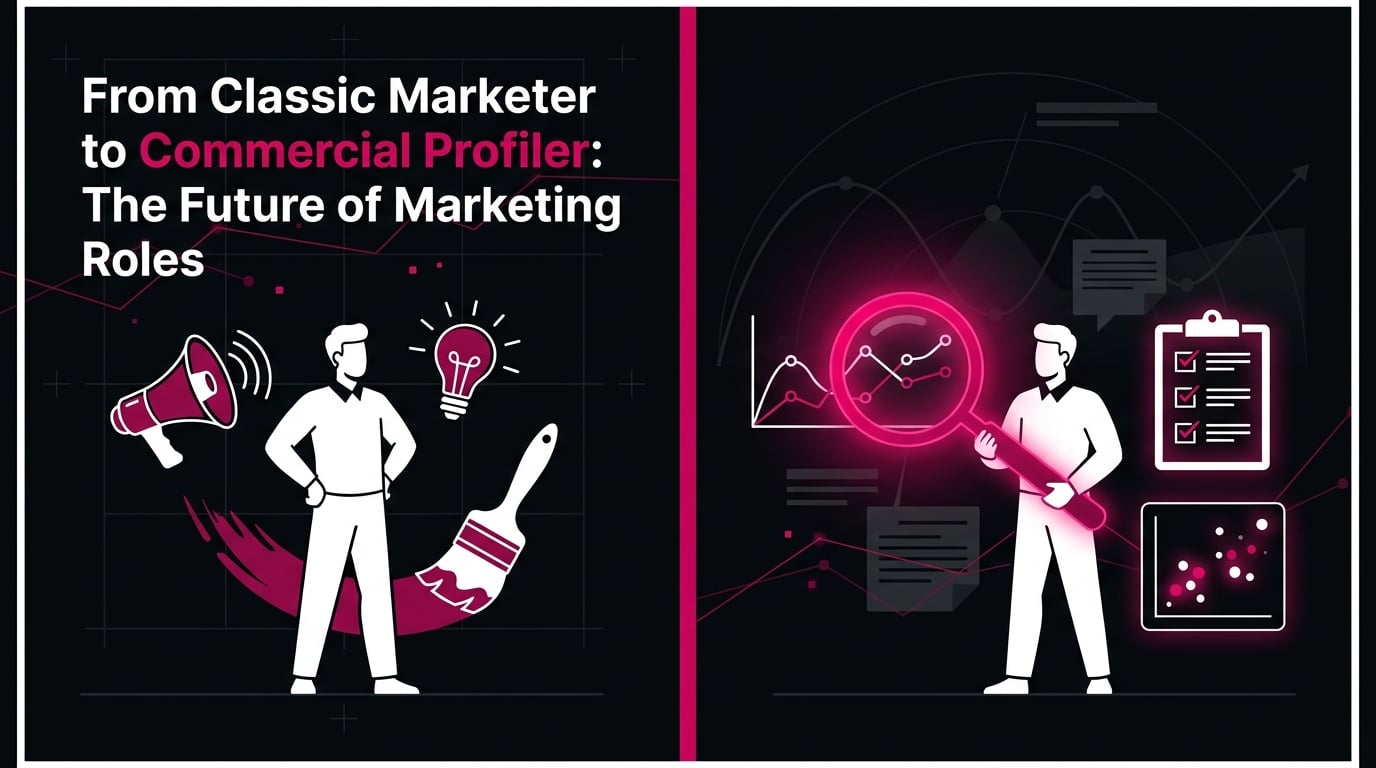
From Classic Marketer to Commercial Profiler: The Future of Marketing Roles
Key Takeaways: What’s Changing in the Future of Marketing Roles?
The future of marketing roles is the shift from campaign executor to commercial intelligence builder, where understanding why customers behave matters more than knowing how to run an ad. Most articles will tell you to “learn data skills.” That’s not wrong. It’s just not enough.
Here’s what they won’t say: the marketers winning right now aren’t just data-literate. They’re building commercial profiles of their customers the way detectives build cases. Every signal, every behavior, every touchpoint becomes evidence.
Palm Beach Code School’s 2025-2030 outlook projects market research analyst roles will grow 21%, far faster than average. Companies aren’t drowning in data. They’re drowning in data they can’t interpret. That’s your opening.
What Is a Commercial Profiler and Why Is This the New Power Role?
A commercial profiler is a marketer who builds detailed behavioral and motivational models of customers to drive revenue decisions, not just campaign tactics. Think less “what ad should we run” and more “what does this customer believe, fear, and want next.”
You’re probably optimizing click-through rates right now. That’s fine. But click-through rates don’t tell you why someone converted or why they didn’t come back. Commercial profiling does.
The framework has three layers: behavioral data (what people do), contextual data (when and where they do it), and motivational inference (why they do it). Most marketers only work the first layer.
coolest.marketing’s approach to this, built around their Commercial Profiler course, treats customer understanding like a structured investigation: gather evidence, form a hypothesis, test it against real outcomes. That’s a different muscle than campaign management.
How Does the Classic Marketer Skill Set Need to Evolve for the Future of Marketing Roles?
Classic marketing skills are the foundational competencies: copywriting, campaign planning, channel management, and brand positioning. These still matter. They just aren’t enough to stay valuable.
Robert Half’s 2026 hiring data shows organizations are prioritizing analytics, marketing automation, and digital campaign roles above all others. The gap isn’t creativity. It’s the ability to connect creative decisions to commercial outcomes.
The skill evolution looks like this:
-
From: writing copy that sounds good / To: writing copy informed by behavioral data
-
From: running campaigns / To: designing experiments with measurable hypotheses
-
From: reporting results / To: diagnosing what caused them
You don’t need to become a data scientist. You need to stop treating data as a reporting tool and start treating it as a thinking tool.
What Ethical Standards Must Modern Marketers Actually Follow?
Marketing ethics is the set of principles governing how marketers collect, use, and act on customer information, with consent, transparency, and accuracy as the non-negotiables. But here’s the uncomfortable part: profiling without ethics isn’t just wrong, it’s commercially stupid.
Ketchum’s 2024 Trust in Marketing report found that 81% of consumers say trust in a brand influences their purchase decision. You cannot build a commercial profile worth anything on a foundation of eroded trust.
Keith Weed, former Chief Marketing Officer, Unilever, speaking at the Cannes Lions International Festival of Creativity 2019, on the direct link between brand trust and commercial performance.
The American Marketing Association’s ethics framework requires honesty, fairness, and respect for consumer privacy. Those aren’t soft guidelines. They’re the operating conditions for any profiling work you do.
Practical rule: if you wouldn’t explain your data collection method to the customer face-to-face, don’t do it.
How Can You Transition into the Future of Marketing Roles Without Losing Your Soul?
Transitioning to a commercial profiler role means deliberately adding three skills to your existing toolkit: behavioral analysis, structured hypothesis testing, and cross-functional commercial thinking. You don’t abandon what you know. You build on top of it.
LinkedIn’s Chief Economist noted in February 2025 that marketing is in a transformational moment reshaping skills and roles across the profession. The marketers who adapt fastest are those treating the transition as a skill-stacking exercise, not a career restart.
Start this week with one concrete move: pick your last campaign, pull the behavioral data, and write a one-paragraph hypothesis about why the numbers looked the way they did. Not what happened. Why. That single habit separates classic marketers from commercial profilers.
coolest.marketing provides structured frameworks for exactly this kind of thinking, built for marketers navigating the AI era who want clarity without the noise.
The future belongs to marketers who investigate, not just execute. Start investigating.
Check out Elad Gaon’s Commescial Profiler Course!