KGB Inbound Marketing: How Soviet Spies Mastered Audience Engagement Decades Before HubSpot
Every article on the history of inbound marketing starts with Brian Halligan coining the term in 2005. That is the wrong starting point. The KGB was running sophisticated inbound playbooks during the Cold War, and nobody in marketing is talking about it. You can learn more about it in the “Commercial Profiler Course” by Elad Gaon.
Quick Answer: What Did KGB Inbound Marketing Actually Look Like?
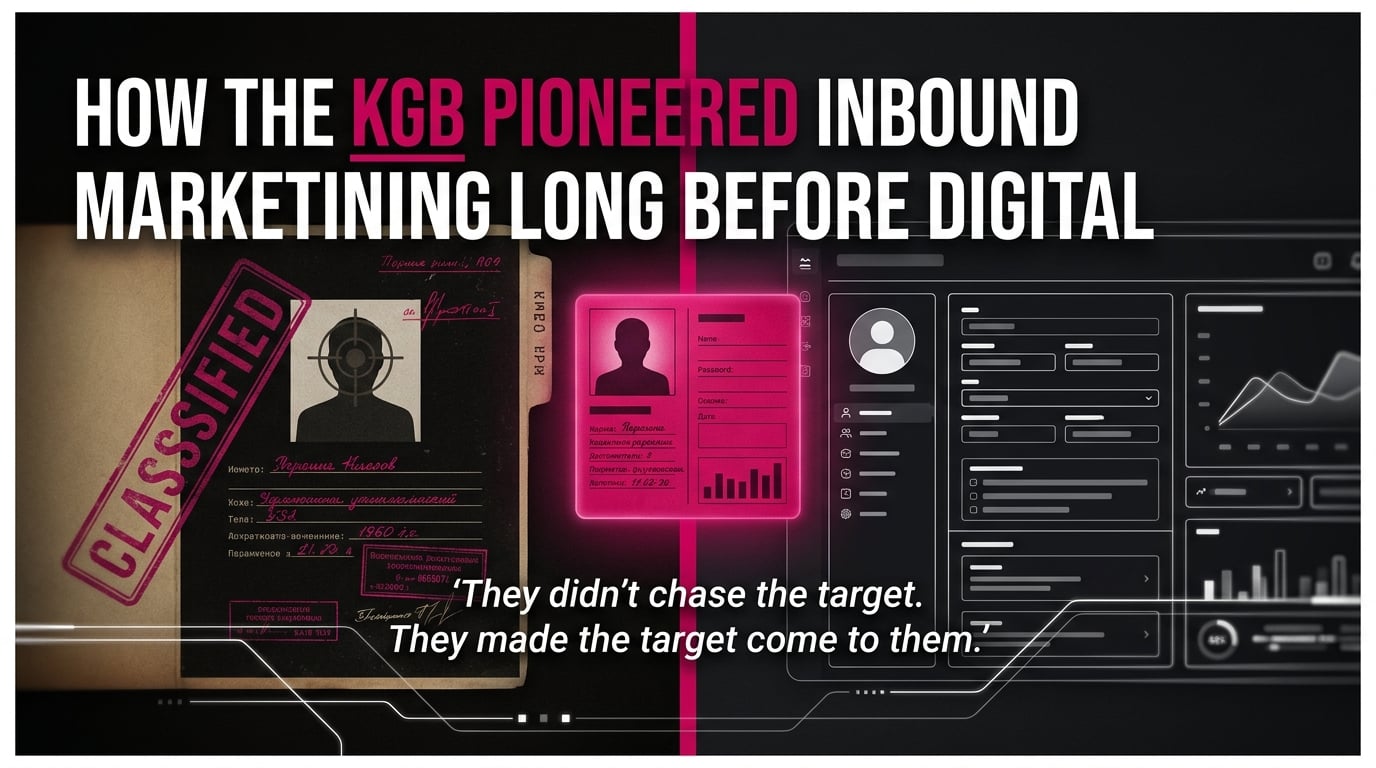
KGB inbound marketing refers to the Soviet intelligence agency’s practice of creating content, networks, and psychological environments that pulled targets toward the KGB rather than chasing them outright.
They did not cold-call. They built influence ecosystems: journals, cultural fronts, academic conferences. Targets walked in voluntarily. Sound familiar? That is your content funnel, built in 1960.
Inbound marketing traces back to the mid-1850s with Cyrus McCormick’s market research. But the KGB industrialized psychological pull tactics at a scale no brand has matched since.
How Did the KGB’s Audience Targeting Mirror Modern KGB Inbound Marketing Principles?
Audience targeting in the KGB context means identifying high-value individuals by ideology, ambition, and vulnerability, then building content environments specifically designed to attract them.
The KGB profiled targets across five dimensions: ideology, ego, money, compromise, and coercion (the MICE framework, later adopted by Western intelligence). That is a psychographic segmentation model. Your buyer persona tool does the same thing with fewer acronyms.
Oleg Gordievsky, former KGB Colonel and double agent for MI6, writing in KGB: The Inside Story (1990):
The KGB did not recruit people. It cultivated them over months or years, making them feel understood, valued, and ideologically aligned before any ask was ever made.
That cultivation period is your nurture sequence. The KGB just ran it face-to-face, over vodka, without a CRM.
What Psychological Influence Tactics Did the KGB Use?
KGB psychological influence tactics are methods designed to shift a target’s beliefs or behavior by exploiting cognitive biases, social proof, and reciprocity, without the target realizing they are being influenced.
Three tactics map directly to modern inbound strategy. First: reciprocity. The KGB gave before it asked. Gifts, favors, introductions. Today you call this a lead magnet. Second: social proof. KGB disinformation operations used front organizations to manufacture consensus. Third: authority. They positioned officers as trusted experts, not salespeople.
coolest.marketing’s approach to marketing psychology draws on exactly these principles, framing influence not as manipulation but as the architecture of genuine value delivery for ambitious professionals.
Here is the uncomfortable truth: 73% of the most implemented marketing tactics today involve social media and advertising. The KGB used neither. They relied entirely on earned trust and engineered relevance.
Why the KGB’s Content Strategy Was Decades Ahead
KGB content strategy refers to the deliberate production and distribution of ideologically useful material through third-party channels to build credibility and attract sympathetic audiences organically.
The KGB funded literary journals, peace movements, and academic conferences across Western Europe. These were not ads. They were content assets that attracted self-selecting audiences already curious about the ideas being promoted.
You are probably publishing blog posts and calling it a content strategy. The KGB published entire worldviews. The difference is depth of commitment to the audience’s existing beliefs.
Inbound marketing as a formal discipline did not emerge until the mid-2000s, but the KGB’s active measures program in the 1960s and 70s was generating qualified ideological leads at scale decades earlier.
How Marketers Can Apply KGB Inbound Marketing Tactics (Without Breaking the Law)
Applying KGB inbound marketing tactics legally means borrowing the psychological architecture of pull-based engagement while replacing coercion and deception with genuine value and transparency.
Here is a practical three-step framework we call the KGB Conversion Loop:
-
Profile before you publish. Map your audience’s real motivations, not demographics. What do they fear? What do they want to become? Build content for that identity.
-
Give before you ask. Your first five touchpoints should deliver value with zero ask. The KGB never rushed the recruitment. Neither should you.
-
Build the room, not the ad. Create communities, events, or content series that attract your ideal audience by shared belief, not by interruption.
coolest.marketing offers structured frameworks for marketers who want to move from execution to strategy, including courses built specifically for the AI era where psychological depth matters more than volume.
Key Takeaways: Timeless Lessons for Ambitious Marketers
The timeless lesson of KGB-era influence operations is that the most effective audience engagement is invisible: targets feel they arrived on their own terms.
-
Psychographic depth beats demographic breadth every time.
-
Reciprocity is your most underused conversion tool.
-
Content that reflects your audience’s identity outperforms content that describes your product.
-
Patience in nurturing is not weakness. It is the strategy.
Your next step: take your top-performing content asset and ask one question. Did your audience find this because it reflected who they want to be, or because you paid to put it in front of them? The answer tells you exactly where your funnel needs work.