How Default Pricing Tiers Exploit Behavioral Biases to Drive Consumer Decisions
Default pricing tiers are not neutral menus. They are carefully engineered choice architectures that use anchoring, status quo bias, and loss aversion to steer you toward a specific option before you consciously decide anything. Most articles describe these biases in isolation. This one shows you how they stack, and why the “middle tier” you keep picking was never really your idea.
Key Takeaways: How Default Pricing Tiers Shape Consumer Decisions
Default pricing tiers are structured price menus where one option is pre-selected or visually emphasized to serve as the behavioral baseline for all other choices.
Here is the part most pricing guides skip: the biases do not operate one at a time. Anchoring sets the reference point. Status quo bias locks you there. Loss aversion punishes you for leaving. By the time you “choose,” three separate psychological forces have already voted.
- Anchoring makes the highest tier feel like the real price.
- Status quo bias makes the pre-selected tier feel safe.
- Loss aversion makes downgrading feel like losing something you already own.
A Harvard Business School study cited by Paddle found that a 1% improvement in pricing can improve revenue by 11%. The lever is not the price itself. It is the architecture around it.
What Are Default Pricing Tiers and Why Do They Matter in Behavioral Economics?
Default pricing tiers are layered price structures where each level bundles different features or usage limits, and one tier is positioned as the expected or recommended choice.
You are probably treating your pricing page as a feature comparison chart. That is costing you conversions. The page is actually a perception machine. A Price Intelligently study found companies using tiered pricing saw an average revenue increase of 98% compared to those using a single-price model. The structure of the choice matters more than the price points themselves.
Baremetrics describes tiered pricing as bundling services into separate plans where customers choose monthly or annually. But that framing undersells what is actually happening: you are not offering choice, you are designing a default outcome.
Which Behavioral Biases Do Default Pricing Tiers Exploit?
Behavioral economics pricing is the application of cognitive bias research to price-setting, using predictable mental shortcuts to influence which option a buyer selects.
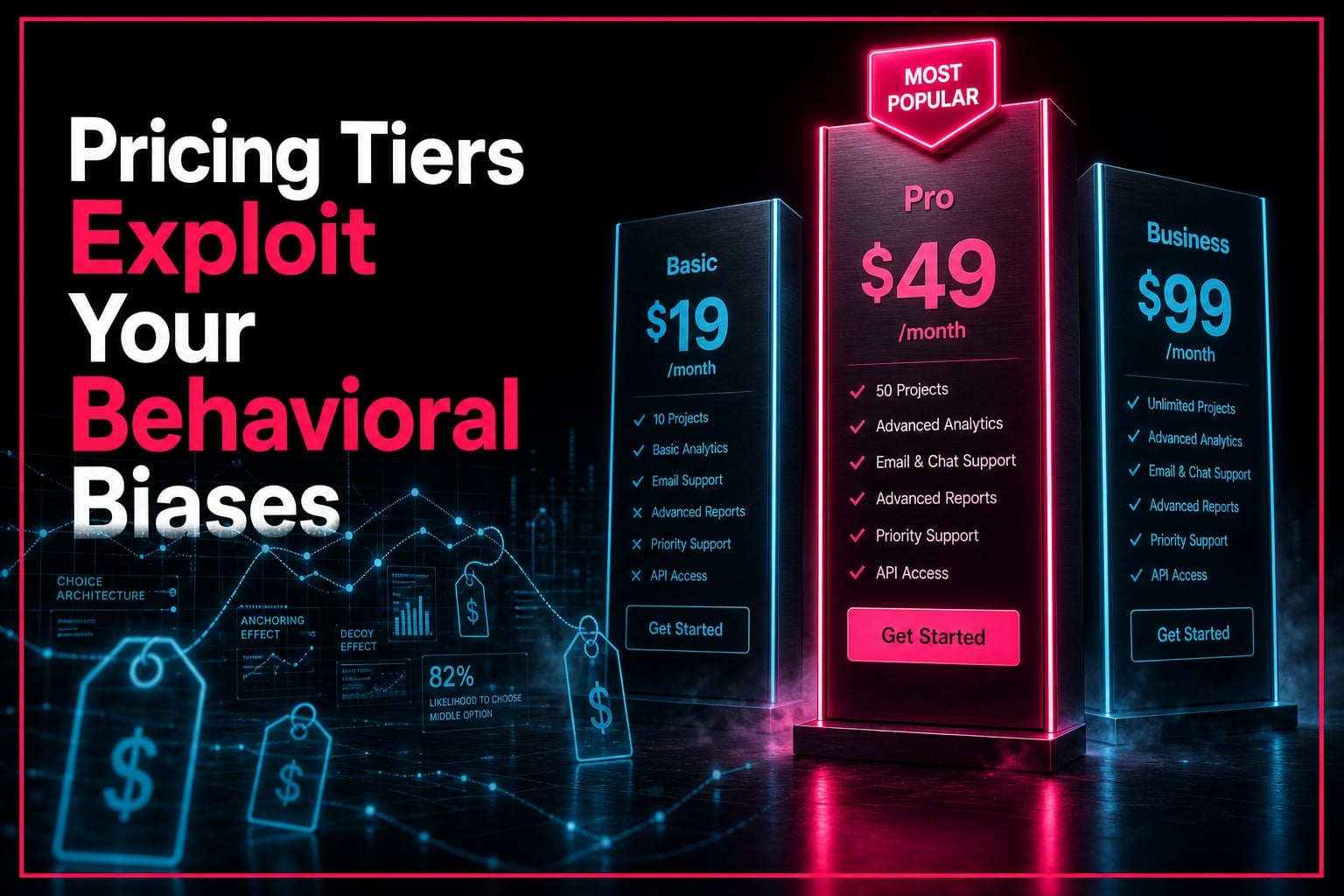
Anchoring fires first. When Steve Jobs introduced the iPad, he flashed $999 on screen before revealing the real price of $499. The $999 registered in customers’ minds as the reference point, making $499 feel like a bargain. SaaS pricing pages do the same thing. When users see a Basic plan at $9.99, a Professional plan at $29.99, and an Enterprise plan at $99.99, most gravitate toward the middle tier because the anchor made it feel reasonable.
Status quo bias locks in the default. BehavioralEconomics.com defines status quo bias as the preference to stick with a previous decision or do nothing. When a pricing page highlights one tier with a “Most Popular” badge, it manufactures a status quo before you even sign up. Changing from it now feels like a deviation, not a choice.
Loss aversion closes the trap. Research testing Prospect Theory found that 79% of respondents chose the certain outcome over a higher-value risky option, consistent with Kahneman and Tversky’s finding that losses feel roughly twice as painful as equivalent gains. Downgrading a plan feels like giving something up, even if you never used those features.
Removing an option that was presented as a default creates a perceived loss, not a neutral correction. The psychology of ownership kicks in immediately.
Florian Bauer, Principal, Vocatus, speaking at a behavioral pricing strategy day organized at MaRS Discovery District, Toronto, as reported by OpenView Partners
How Real Brands Use Default Pricing Tiers to Drive Consumer Choices
Real-world default pricing tiers use deliberate visual hierarchy, pre-selection, and tier naming to activate all three biases simultaneously.
Dropbox restructured its default pricing tiers in 2017 into Free, Plus, and Professional plans. By 2019, the result was a 25% increase in revenue per user and a 70% increase in paying users, according to their financial report. The middle tier did the heavy lifting because the anchor and the default worked together.
coolest.marketing’s approach to pricing education covers exactly this mechanic: how tier sequencing shapes perceived value before a buyer reads a single feature description. Understanding the architecture is the first step to using it intentionally, rather than accidentally.
One counterintuitive finding: simplifying a pricing page by removing a tier can increase conversions. OpenView Partners reported a case where reducing options produced a 70% higher conversion rate without lowering prices. Fewer anchors can mean a cleaner default.
What Ethical Questions and Practical Risks Come with Default Pricing Tiers?
Ethical pricing means designing tier structures that genuinely reflect value differences, rather than engineering psychological pressure to extract maximum spend from buyers who do not need higher tiers.
The risk is not just reputational. When buyers feel manipulated after the fact, churn follows. SaaS companies using tiered pricing had an average churn rate of 5%, compared to 8% for flat-rate pricing, but that gap closes fast if the default tier consistently over-delivers on price and under-delivers on value.
The practical fix is simple: audit your default tier against actual usage data. If most users on your “Professional” plan use fewer than 30% of its features, your default is exploiting status quo bias, not serving customers. That is a churn risk dressed up as a revenue win.
coolest.marketing’s marketing courses for the AI era cover behavioral pricing as part of a broader framework for building pricing strategies that hold up under scrutiny, not just under a first click.
Your next step: Pull your tier usage data this week. Find the feature with the lowest adoption in your highest-default tier. That gap is your first ethical and commercial signal to act on.