Why Adding More Choices Is Quietly Wrecking the Trust You Worked So Hard to Build
Decision fatigue consumer behavior isn’t a UX footnote, it’s a brand crisis hiding in plain sight. You add more SKUs, more plans, more features, thinking you’re giving customers freedom. Instead, you’re taxing their brain until they walk away, or worse, stop trusting you altogether.
Key Takeaways
- 10x more sales with fewer choices. Iyengar and Lepper’s jam study found customers shown 6 options bought at 10 times the rate of those shown 24.
- Trust erosion is silent. Customers rarely blame themselves for a confusing catalog, they blame your brand for being unclear.
- Subtraction beats optimization. The fix isn’t a smarter filter or better search bar, it’s cutting the assortment down.
What Too Many Choices Do to Your Sales Funnel
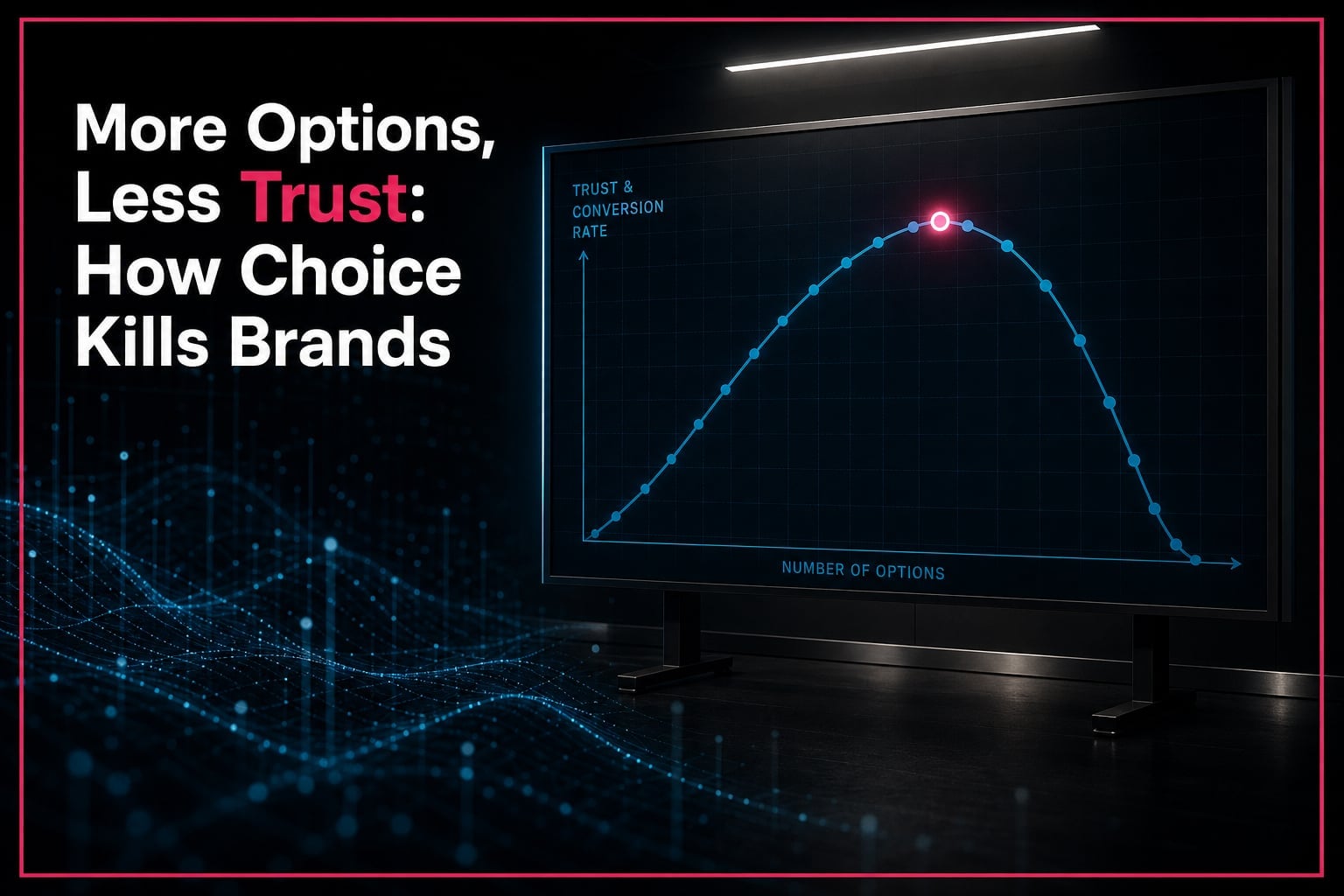
Decision fatigue cuts conversions, hard. In Iyengar and Lepper’s landmark study, shoppers shown 6 jam options were 10 times more likely to buy than those shown 24 Iyengar and Lepper, Journal of Personality and Social Psychology.
Sit with that. Doubling, tripling, quadrupling your assortment didn’t just fail to help, it actively killed sales. When 24 jam varieties sat on the table, 60% of passersby stopped to sample, but only 3% bought anything Speakwise, 2026.
That gap between curiosity and purchase is decision fatigue doing its job. Your brain treats every extra option as a mini-cost, and eventually it just quits paying.
This isn’t unique to jam. The broader case is well established in behavioral economics: more choice tends to create more anxiety, not more satisfaction.
You’re probably running your funnel like more options equal more chances to convert. The data says the opposite: every added option after a certain point is a leak in your funnel, not a patch for it.
How Choice Overload Chips Away at Brand Trust
Every option you add is an implicit promise you might not keep. When customers can’t navigate your offer, they don’t blame themselves, they blame your brand for being unclear.
Here’s the pushback we always get: “But customers WANT more choice, that’s why we keep adding.” Sure, in a survey. Not in their wallet. Nunes and Ordanini’s research in Harvard Business Review found that more options frequently backfire, because complexity erodes confidence in the decision itself, not just the speed of making it Harvard Business Review, “More Isn’t Always Better”.
That erosion doesn’t show up as a one-time bounce. It compounds. A customer who feels dumb navigating your pricing page today remembers that feeling next time they consider you at all.
This is the part competitors skip: decision fatigue isn’t just a conversion metric, it’s a slow leak in brand equity. Metrics like “engagement” or “time on site” can look healthy while masking exactly this kind of erosion coolest.marketing.
You might be hitting your traffic goals while your brand quietly loses the thing that made people choose you in the first place: clarity.
The Signs Your Product Lineup Has Crossed Into Confusing
If your customers need a guide to choose between your own products, you’ve already crossed the line. Three signals tell you your assortment has become a liability, not an asset.
Ask yourself: could a new customer explain your lineup in one sentence? If not, you’ve built a maze, not a menu.
Signal one: your best-selling SKUs generate most of your revenue, and the rest just sit there, adding noise. Retailers who trim SKUs while sharpening the assortment see sales and margins rise, not fall, by up to 2% SPS Commerce.
Signal two: your team keeps adding “just one more option” to answer a single customer’s edge-case request. That’s not customer obsession, that’s scope creep dressed up as service.
Signal three: support tickets about “which one should I get” are rising, not falling, as your catalog grows. That’s decision fatigue leaking straight into your cost center.
The instinct to fix this with more filters, more quizzes, more “smart” recommendation engines is exactly backwards. That’s optimizing the maze instead of tearing down walls coolest.marketing.
Real strategy means choosing what to cut, not what to add next coolest.marketing.
Six months from now, the brands that win won’t be the ones with the biggest catalog. They’ll be the ones customers can describe without hesitating. Start counting your SKUs against that test, not against your competitor’s catalog size.
Where do you draw your own line between generous and overwhelming? We’d genuinely like to hear how you’re thinking about it.