What Actually Proves Community-Led Growth Works, and What Just Looks Good on a Slide
Here’s the community-led growth proof most decks skip: brands with real engagement see 72% of community-influenced deals close within 90 days, versus 42% for sales- or marketing-led ones, according to Single Grain. That gap is the whole argument. Community doesn’t just feel nice, it moves deals faster, but only when the community actually wants the product, not just the swag.
Key Takeaways
- 72% of community-influenced deals close within 90 days versus 42% for other channels, per Single Grain, proof that alignment beats attribution guesswork.
- Communities cut customer acquisition costs by 32% on average, per Omnifunnel Marketing, real budget relief, not vanity metrics.
- The three killers are size chasing, product drift, and mistaking silence for health. All three trace back to one root cause: misalignment.
- A working diagnostic beats a gut check: contribution rate and unprompted member referrals tell you more than post counts ever will.
When Community-Led Growth Actually Pays Off
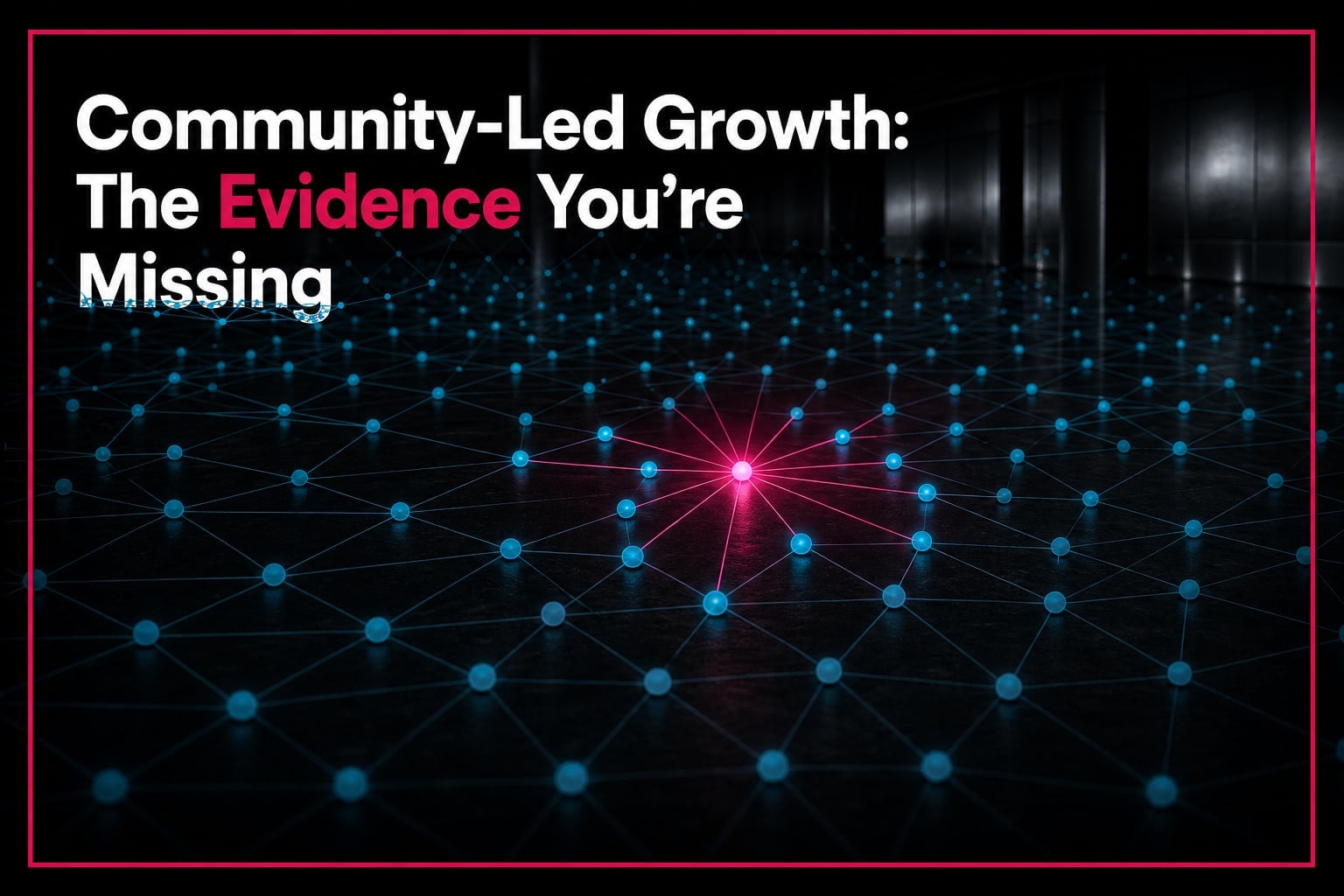
Community-led growth pays off when engagement depth, not headcount, drives the flywheel: active members generate trust, referrals, and retention that paid channels can’t buy at scale. The number that should be on every strategy deck: 72% of community-influenced deals close within 90 days, compared with 42% for sales- or marketing-led deals, per Single Grain.
That’s not a rounding error. That’s a sales cycle cut nearly in half, and it compounds every quarter a community stays healthy, unlike paid acquisition, which decays the moment you stop spending.
Brands with active communities also see 46% higher customer lifetime value and grow revenue 2.1x faster than those without, per Omnifunnel Marketing. Acquisition costs drop 32% on average too, because members convert peers faster than any ad ever will.
This is why community-powered growth loops outperform funnels built purely on spend. But none of this happens automatically. It happens when the community’s reason for existing matches the product’s reason for existing, word for word.
coolest.marketing built its own advisory community around that exact principle: marketers in the AI era learning from Startup Nation’s marketing experts, not just consuming another course feed. Alignment first, growth second. The order matters more than most decks admit.
The Failure Modes Nobody Flags Until the Program Is Already Dying
Community-led growth fails in three specific, repeatable ways: chasing member count over engagement, letting community purpose drift from product purpose, and reading quiet channels as calm instead of collapse. Every failed program we’ve seen hits at least one of these before it hits zero.
Size obsession. A big number feels like proof, but Bettermode is blunt: 100 engaged members beats 1,000 lurkers, and growth without connection creates hollow communities that look big and feel dead.
Product-community drift. This is the thesis in one failure: when the community’s ambition wanders from what the product actually solves, engagement hollows out even while the calendar stays full. Pawlean names failing to define community ROI as a top mistake, because without a shared north star, nobody notices the drift until retention drops.
Silence mistaken for health. Heinz Marketing frames this as capturing an engaged audience versus adding to the noise. A quiet channel isn’t always calm. It’s often the last signal before collapse.
Want the receipts on what dead-end experiments teach you? Read what failed experiments actually teach you before you repeat someone else’s mistake. coolest.marketing’s cohorts spend real time on this exact framework, because Israel’s marketing scene isn’t just tech hype, it’s operators who’ve watched programs die this way and said so out loud.
How to Tell If Your Community Is Working or Just Twitching
A working community is one where members contribute unprompted, recruit other members, and post more than they lurk; a program that’s just breathing hits none of those marks even with steady headcount. Picture this: your Slack has 2,000 members, weekly posts, zero red flags on the dashboard. It’s still dying.
The fix is watching behavior, not vanity counts. Startup Edition found healthy programs hit roughly 60% first action within days one and three, and about 40% active engagement at 30 days. Miss those marks and the community is coasting on inertia, not momentum.
| Healthy Signal |
Warning Sign |
| Members recruit new members unprompted |
Growth comes only from paid or company push |
| Contribution rate holds near 40% at 30 days |
Posts flatline while member count keeps climbing |
| First action within days 1 to 3 (target 60%) |
New members join, then go silent for weeks |
| Discussions solve real product problems |
Threads drift to topics unrelated to the product |
Run this against your own numbers before your next planning cycle. If you want a sharper eye for catching drift before it shows up in churn, reading weak signals before the trend goes mainstream is the exact skill this diagnostic demands. And if you’re staring at a dashboard that looks fine but feels off, check whether you’re tracking metrics that look healthy and quietly wreck your brand, because that’s usually where the real answer is hiding.
coolest.marketing’s cohort format was built around this same diagnostic instinct: teach marketers to read contribution rate and drift signals before a quarterly report forces the conversation. Want the full framework, live, with people who’ve run these numbers for real brands? Book a call with coolest.marketing and walk through your own community’s health signals before your next planning cycle starts.