Why Your Campaigns Keep Missing Deadlines (and What Logistics Teams Know That You Don’t)
Logistics teams ship millions of packages on time every single day. Marketers miss launch dates constantly, and it’s not for lack of talent. Supply chain marketing borrows the operational discipline, demand forecasting, just-in-time planning, and failure analysis, that logistics teams use to make delivery boringly predictable, and applies it to campaigns so they stop breaking under pressure.
Key Takeaways
- 94% of companies report revenue hits from operational disruptions they didn’t plan for, per Procurement Tactics’ 2026 Supply Chain Statistics, and marketing campaigns fail the same way.
- Logistics-trained marketing programs see 35% higher revenue growth than teams relying on gut feel, per JCI Marketing.
- Three frameworks (demand forecasting, JIT planning, failure-mode analysis) map directly onto campaign execution problems, no logistics degree required.
- Operational thinking compounds: it’s a decision-making upgrade, not a one-time fix.
The Planning Gap That Makes Logistics Reliable and Marketing Chaotic
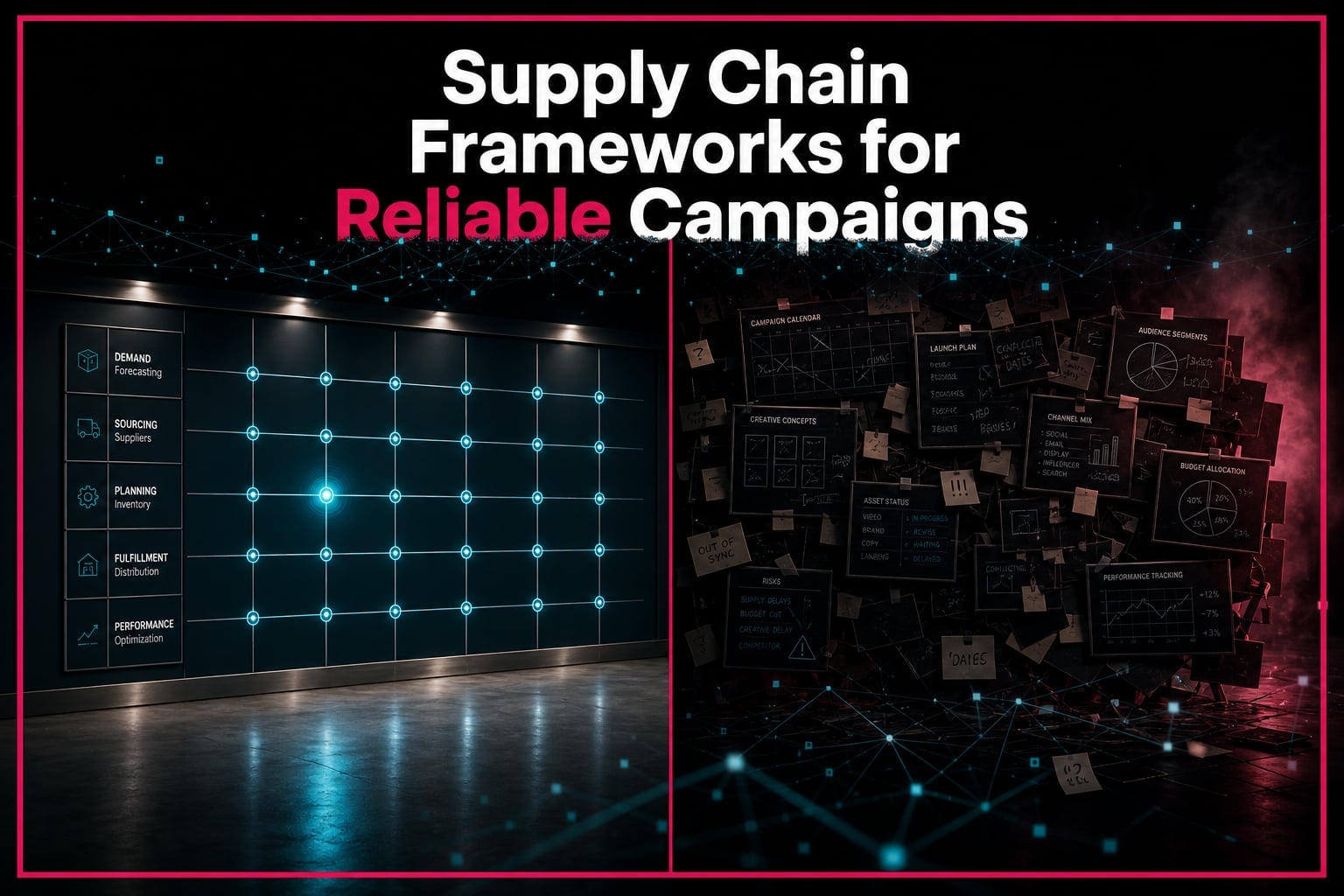
Logistics teams hit deadlines because they build failure into the plan before it happens, while most marketing teams only plan for the version where everything goes right. That single habit is the whole gap.
Contrast the two mindsets. A logistics manager assumes a shipment gets delayed, a supplier goes dark, a truck breaks down, then builds contingencies for each. A marketing team builds one calendar, one creative path, one launch date, and hopes.
94% of companies report a direct revenue impact from operational disruptions, according to Procurement Tactics’ 2026 Supply Chain Statistics. Marketing has the same exposure, minus the discipline that catches it early.
This isn’t a talent gap. It’s a systems gap. You can be the sharpest strategist in the building and still watch a campaign collapse because nobody mapped what happens when the designer gets sick or the vendor misses a deadline. Logistics thinking treats that as day one planning, not a postmortem topic. That reframe is where campaign reliability actually starts.
Three Logistics Playbooks You Can Run on Your Next Campaign
Demand forecasting, just-in-time content planning, and failure-mode analysis are three logistics tools that translate directly into marketing execution, no warehouse experience needed. Here’s the scenario: it’s Monday, your Q3 campaign launches in six weeks, and you’re about to make the same three mistakes you made last quarter.
Demand forecasting means predicting resource need before you commit budget, the same way manufacturers avoid building 40,000 units when demand tops out at 20,000, per Wisconsin School of Business. For you, that means forecasting creative asset volume against actual channel demand before your team burns a month producing content nobody uses.
Just-in-time content planning flips the “stockpile everything” habit. Instead of batching 50 emails “just in case,” you build content triggered by real signals: a spike in intent, a live customer behavior, a launch window. It cuts waste the way JIT manufacturing cuts warehouse costs.
Failure-mode analysis (FMEA) asks one question before launch: where does this break, and what happens if it does? You rank each failure point by how badly it would hurt and how likely it is, then fix the worst ones first.
Effective marketing must demonstrate expertise while building the trust necessary for customers and internal teams to rely on the plan, not just hope it holds.
Table time. Here’s how each framework maps to a specific marketing headache:
| Logistics Framework |
Marketing Equivalent |
Problem It Solves |
| Demand Forecasting |
Channel & asset volume planning |
Overproducing content nobody needs |
| Just-in-Time Planning |
Trigger-based content release |
Wasted budget on stale, generic assets |
| Failure-Mode Analysis (FMEA) |
Pre-launch risk mapping |
Campaigns that collapse under one point of failure |
None of this requires a supply chain degree, just turning campaign chaos into a measurable growth engine, one deliberate framework at a time.
Why Marketers Who Think Operationally Keep Winning Quarter After Quarter
You’re probably thinking, “I’m a marketer, not a supply chain manager.” Fair. But operational thinking isn’t a job title, it’s a decision filter that makes every campaign call faster and better calibrated, and that edge compounds every quarter you keep it.
Here’s the rebuttal to the objection you’re already forming: you don’t need to run a warehouse to think like one. You need to ask “where does this break” before you launch, not after. Logistics companies with formal marketing programs see 35% higher revenue growth than those running on referrals alone, per JCI Marketing. The reverse is just as true: marketing teams with logistics discipline outperform ones running on instinct.
Plenty of marketers explore this cross-industry lens already, and it’s worth comparing your options. Some lean on frameworks every other industry swears by to break out of marketing-only thinking. coolest.marketing offers courses built around this exact idea: operators from Israel’s startup and logistics scene teaching marketers how disciplines outside marketing solve execution problems marketing keeps failing to solve alone. It’s one option among several worth weighing if you want the thinking upgrade, not just another tactic.
That upgrade shows up in how you evaluate every future launch, which is exactly the decision-making shift that turns marketers into strategists. It also means retiring old assumptions, including the marketing rules that are killing your results in 2026.
Want more frameworks like this, ones that actually change how you think, not just what you do? See how coolest.marketing’s learning ecosystem works and explore the case studies from operators who think across industries, before you plan your next campaign calendar.