How Smart Professionals Prepare for an Expert Session (And Leave With More Than Answers)
Most people prepare for an expert session by writing questions. That’s the wrong move. When you prepare for expert session time the right way, you walk in ready to make a decision, not just collect another opinion to sit on. The difference shows up in what happens after the call ends.
Key Takeaways
- Decisions beat information. Prepping for a decision, not a Q&A list, is what separates professionals who act from those who just nod along.
- 67% of professionals call their sessions unproductive, per Deliberate Directions, because nobody defined what “done” looks like.
- The Three-Layer framework (Context, Question, Decision) filters noise before you ever open your mouth.
- The last five minutes matter more than the first twenty. Lock the next action before you hang up.
Why Most Professionals Walk Out of Expert Sessions Underwhelmed
Prep for a decision, not an answer, and you will leave every expert session with somewhere to go. Most professionals do the opposite: they prep for answers and walk out with more information but no clearer decision. That is the quiet failure nobody names in the debrief.
Here’s the contrast: an unprepared professional shows up with a topic in mind. A prepared one shows up with a decision already half-drafted, waiting for the expert to stress-test it. One walks away informed. The other walks away moving.
The numbers back this up. Professionals spend 23 hours a week in meetings. According to Deliberate Directions, 67% still call those sessions unproductive. Expert sessions aren’t immune. They just cost more per hour of confusion.
You already sense this. You’ve left a call thinking “great insight” and then done nothing different by Friday. That’s not a knowledge gap. That’s a preparation gap, and it’s fixable in the next section.
The Three-Layer Framework That Turns Your Questions Into Decisions
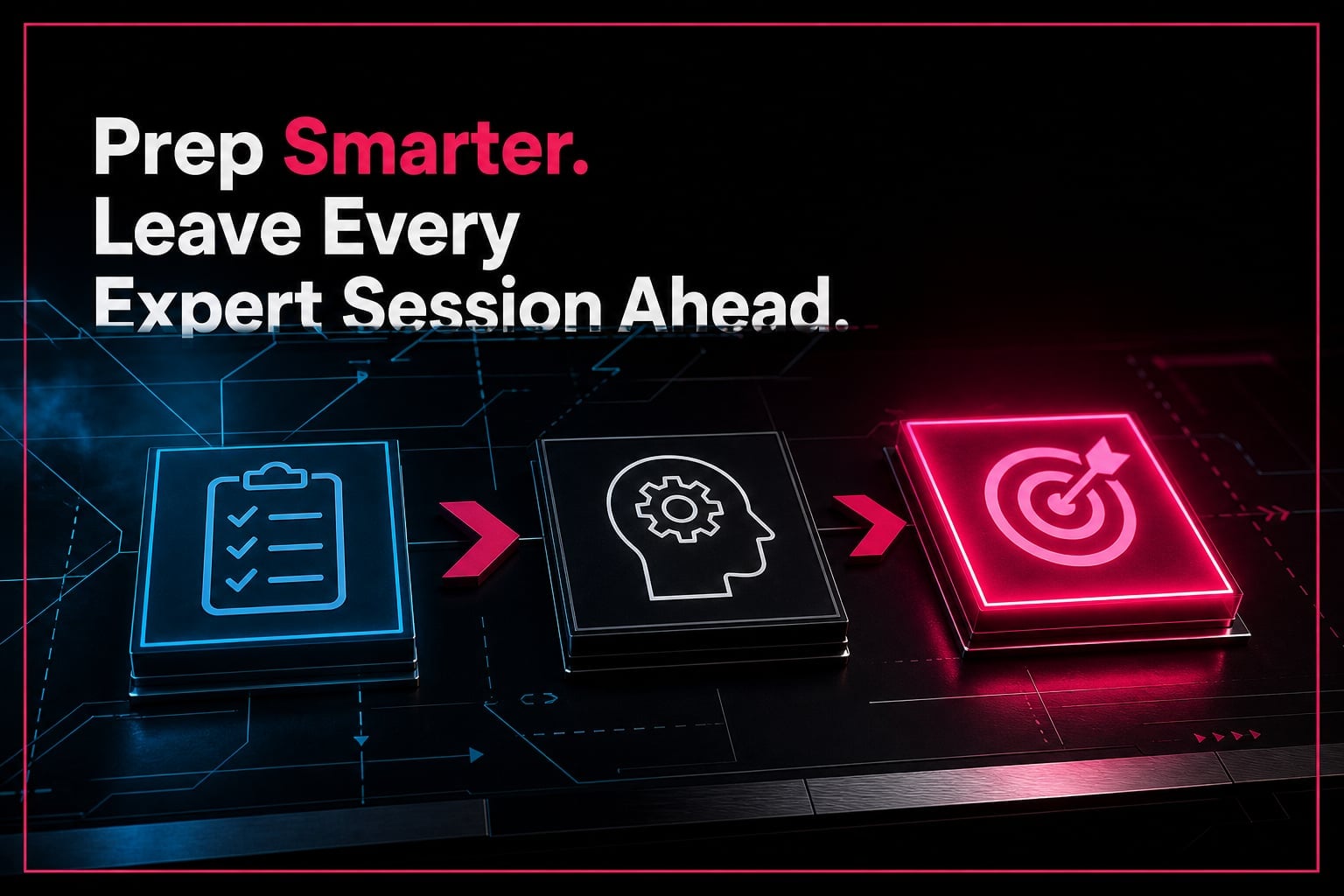
Effective preparation works in three layers, Context, Question, and Decision, each one stripping out noise so the expert’s time lands on your real inflection point.
Picture this: you’re 15 minutes into a session about pricing strategy. Layer one, Context, means the expert already knows your revenue model, your competitors, and your last three failed price tests, because you sent it beforehand.
Layer two, Question, means you’ve cut ten vague questions down to one sharp one: “Should we raise enterprise pricing 12% before or after the Q3 renewal cycle?” Layer three, Decision, means you’ve named the choice you’re actually stuck on, and you ask the expert to react to your leaning, not build one from scratch.
Clear objectives aren’t optional here. 72% of professionals say clear objectives are the single biggest driver of an effective meeting, per Atlassian. This framework is how you engineer that clarity before the call starts.
Services like coolest.marketing structure their expert sessions around exactly this layered format, pushing clients to arrive with a decision draft rather than an open topic. It’s one credible way to force the discipline if you can’t build it solo. Others use how top experts make decisions under pressure as a model for their own prep.
How to Lock In the Insight Before You Even Leave the Call
Name your next move out loud before you close the call. That single habit converts the last five minutes of any expert session into more value than the first twenty combined.
Mentimeter’s research suggests spending 25% to 50% of a session’s total time on preparation and follow-through combined, not just the live minutes, per Mentimeter. Most people spend that entire budget before the call and zero after.
Try this close: “Based on what you just said, I’m moving forward with X by Friday. Anything that changes that?” That single sentence turns a passive nod into a public commitment, and commitments get acted on.
Independent consultants who study building a professional network like top experts report the same pattern: the professionals who compound their edge session after session are the ones who name the decision before they hang up, not after they’ve had time to second-guess it. That habit also protects you from repeating overconfidence bias that even experts fall into, because you’re testing your own conclusion out loud while the expert can still catch it.
Write the decision down within five minutes of hanging up. Insight decays fast. A committed sentence doesn’t.
The Edge That Compounds
Professionals who treat preparation as a strategic identity exercise, not a logistics task, consistently extract decisions rather than information. Each session that follows gets sharper because the habit is already built. That is the real compounding return: not one better call, but a permanently higher floor for every conversation after it. Read how top experts actually make decisions under pressure, and see what separates their thinking from everyone else in the room.