Marketing Clarity: Why It Beats Creativity for Confident Growth
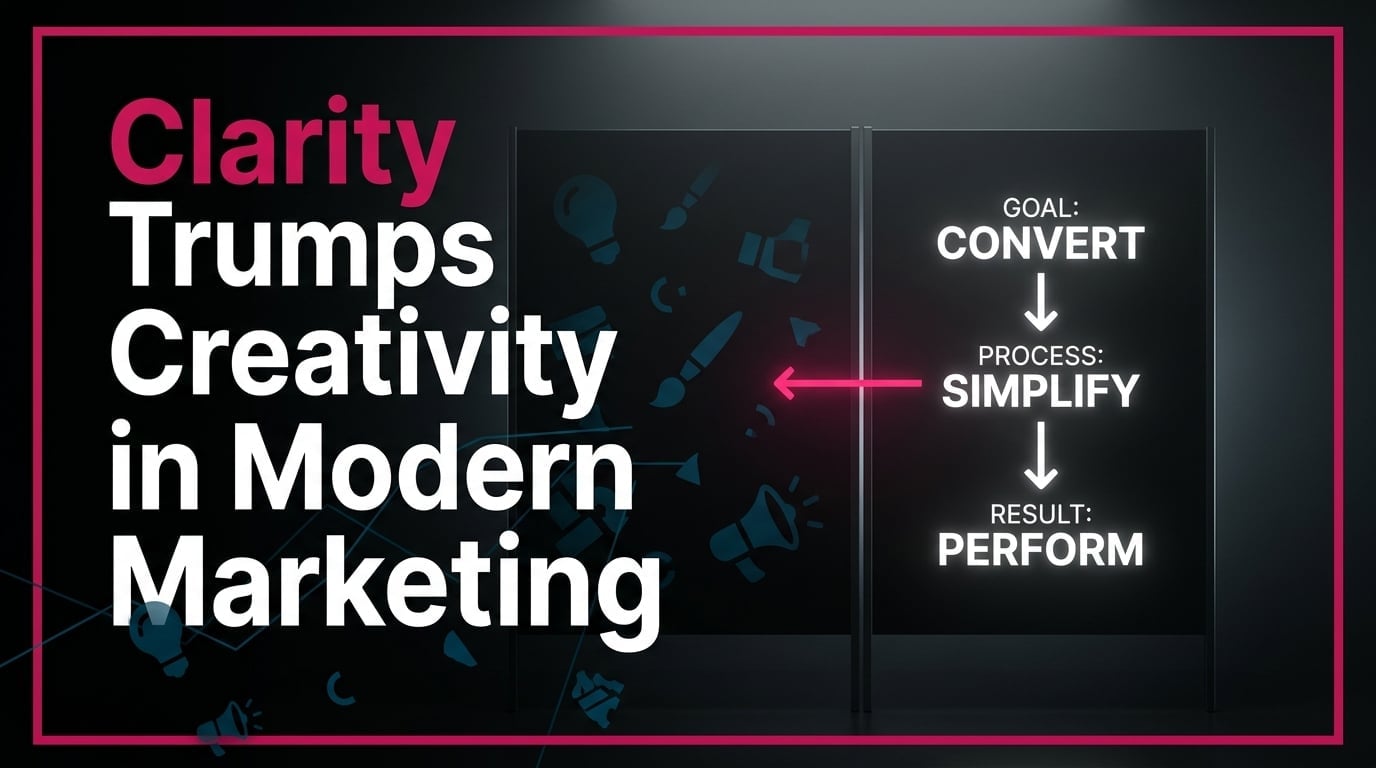
Most marketing advice starts with creativity. Better hooks. Bolder visuals. More original campaigns. But creativity without direction is just expensive noise. Marketing clarity, knowing exactly who you’re talking to, what you’re saying, and why it matters, is what actually moves the needle.
Key Takeaways: Why Does Marketing Clarity Matter More Than Creativity?
Marketing clarity is the practice of defining your audience, message, and goal with enough precision that every campaign decision becomes obvious. You stop guessing. You start deciding.
Here is the contrarian take most articles skip: creativity is not your problem. Vagueness is. When a campaign flops, it is almost never because the idea was too boring. It is because the message was too muddy for the right person to recognize themselves in it.
According to WARC’s marketing effectiveness research, campaigns built on clear audience insight consistently outperform those optimized purely for creative novelty. Clarity is not the enemy of great work. It is the foundation of it.
What Is Marketing Clarity and How Does It Drive Results?
Marketing clarity means your audience, message, and call to action are so specific that a stranger could read your campaign and immediately know if it is for them. No interpretation required.
You are probably writing for “everyone who might be interested.” That costs you. Broad targeting inflates spend and dilutes response rates. Bright Orange Thread’s 2025 analysis puts it plainly: you have to be clear on who you are marketing to, where they hang out, and what they care about, every time, before you touch a creative brief.
Clarity is not about stripping out personality. It is about making sure your personality lands on the right person, not everyone scrolling past.
How Does Marketing Clarity Build Marketing Confidence and Reduce Guesswork?
Marketing confidence is the ability to make campaign decisions quickly and defend them with reasoning, not just instinct. It comes directly from having clear answers before you start.
Without clarity, every decision feels like a coin flip. With it, you have a filter. Does this headline speak to our defined audience? Does this visual reinforce our core message? Yes or no. Done.
As LinkedIn’s 2024 piece on marketing confidence notes: confidence in marketing is not about knowing everything. It means making decisions, explaining your reasoning, and learning from outcomes. Clarity gives you the reasoning before the campaign launches, not after it fails.
coolest.marketing’s approach to training marketers in the AI era is built around exactly this: structured frameworks that replace gut-feel decisions with repeatable, defensible thinking.
Can You Have Both? Balancing Creativity and Clarity for Growth
Balancing creativity and clarity means using creative execution to express a message you have already made precise, not using creativity to find the message as you go.
Think of it as sequence, not competition. Clarity first. Creativity second. Guide Marketing’s framework frames it well: creativity and clarity are not at odds, they are an inseparable team. The mistake is treating them as equals at the starting line.
The brands that win use clarity as the brief and creativity as the execution. Swap the order and you get beautiful campaigns nobody acts on.
Real-World Example: Clarity-First Frameworks in Action
A clarity-first framework is a structured decision tool that forces you to answer audience, message, and goal questions before any creative work begins.
Lisa Rao, marketing strategist and author writing via LinkedIn Pulse, stated: “Clarity builds trust. Creativity builds attention. Without clarity, attention fades.”
Airbnb’s 2014 “Belong Anywhere” repositioning is the clearest modern case. They did not start with a clever tagline. They started with a precise insight: guests wanted to feel like locals, not tourists. That clarity produced one of the most creatively celebrated brand pivots of the decade, and it drove a reported 13% booking increase in the following quarter per their 2014 investor communications.
The creative work was remarkable. But the clarity came first.
Quick Steps to Boost Marketing Clarity in Your Next Campaign
Boosting marketing clarity means answering three questions before briefing any creative work: who exactly is this for, what one thing do we want them to believe, and what do we want them to do next.
Here is a four-step filter you can run in under 20 minutes:
- Name your one person. Not a demographic. A specific human with a specific problem.
- Write your single message. One sentence. If it takes two, it is not clear yet.
- Define success before you launch. One metric. Not five.
- Test your message on a stranger. If they cannot repeat it back in their own words, rewrite it.
coolest.marketing offers structured marketing courses built for founders and junior marketers who are done guessing and ready to build campaigns they can actually defend.
Your next step: Take your current campaign brief and apply the four-step filter above right now. If you cannot name your one person and one message in under two minutes, you have found your real problem. Fix that before you touch the creative.