What the Asch Conformity Experiment Reveals About Influencer Campaigns
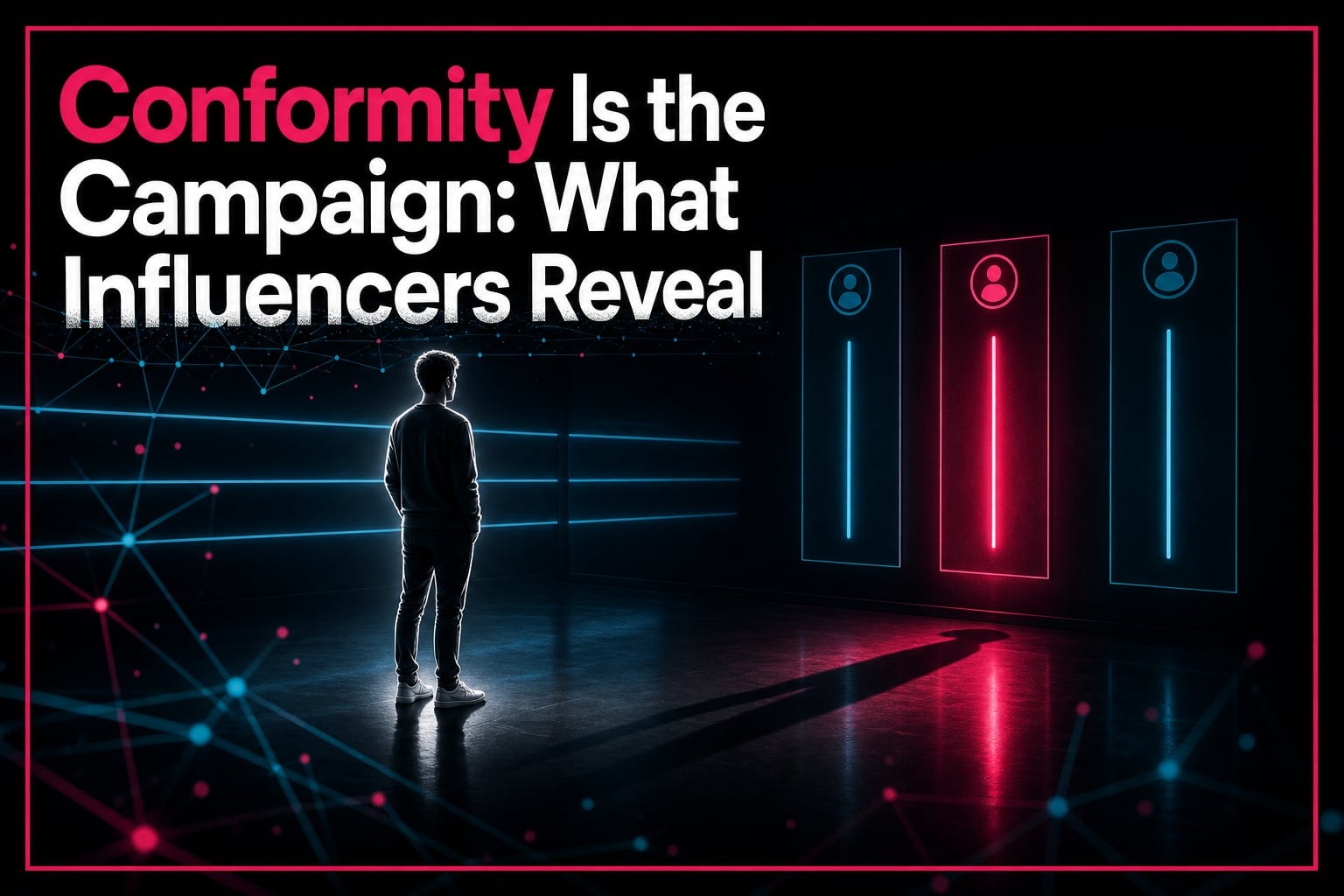
Most articles about the Asch Conformity experiment stop at “people follow the crowd.” That is not the insight. The real insight is this: conformity has a tipping point, and it kicks in at exactly three voices. That number should change how you build every influencer campaign you run.
Key Takeaways: What Marketers Must Know About the Asch Conformity Experiment
The Asch Conformity experiment is a 1951 series of psychological studies by Solomon Asch that measured how much group pressure could make individuals deny obvious visual evidence. 75% of participants conformed to the group at least once, even when the group was clearly wrong.
- Conformity peaks at three voices, not seven or ten.
- One dissenting voice cuts conformity dramatically.
- Forced or fake consensus backfires faster than no consensus at all.
- Authenticity is not a soft value. It is a hard conversion variable.
What Was the Asch Conformity Experiment and Why Does It Matter for Marketers?
The Asch Conformity experiment placed one real participant in a room with actors who gave obviously wrong answers to a simple line-matching task. The question was whether the participant would trust their own eyes or the group.
Most did not trust their eyes. 35.7% of responses conformed to the actors’ incorrect answers, even though alone, participants were correct over 99% of the time.
Here is the part nobody puts in their marketing blog: conformity reached its peak with just three confederates, the same rate as with seven. You do not need a massive chorus. You need a credible, consistent few.
How Does the Asch Conformity Experiment Shape Consumer Responses to Influencer Campaigns?
Social proof in marketing is the mechanism by which consumers use other people’s choices as a shortcut for their own decisions, especially under uncertainty. It is the Asch experiment running in real time, at scale, every time someone scrolls their feed.
When three or more influencers you trust all say the same thing about a product, the conformity pressure is psychologically equivalent to Asch’s lab. Nielsen’s 2023 report shows 71% of consumers globally trust online opinions, including those from influencers.
But here is the tension: Asch also found that one dissenting voice dropped conformity sharply. If even one influencer in your campaign breaks from the message, or if your audience spots a single fake review, the whole consensus collapses. Unanimity is fragile.
The pressure to conform is not about stupidity. It is about the cost of being wrong alone. When people are uncertain, they outsource their judgment to the group.
Robert Cialdini, Professor Emeritus of Psychology and Marketing, Arizona State University, as cited in his foundational work Influence: The Psychology of Persuasion
Real Campaigns: When Social Proof Powers Success (and When It Backfires)
Social proof in influencer campaigns means using visible, credible third-party validation to reduce purchase hesitation and signal that a choice is safe. Done well, it converts. Done badly, it destroys trust faster than no campaign at all.
Glossier built its early growth almost entirely on micro-influencer consensus. Instead of one celebrity, they activated hundreds of real customers with small but loyal followings. The result: a brand valued at $1.2 billion by 2019, driven largely by peer-to-peer social proof rather than traditional advertising.
The opposite: the 2017 Fyre Festival used a coordinated drop of 400 influencers posting the same orange tile on the same day. It looked like consensus. It was manufactured. When the festival collapsed, every influencer who posted became a case study in fake conformity. 97% of consumers read online reviews before buying from local businesses, which means they are already trained to detect when something feels off.
coolest.marketing’s approach to influencer strategy emphasizes this exact distinction: coordinated does not mean authentic, and the difference is visible to any audience that has been burned before.
How to Use Social Proof Authentically Without Tricking Your Audience
Authentic social proof means validation that comes from real experience, not scripted consensus. It works because it survives scrutiny. Manufactured consensus does not.
Three things that actually work, based on the Asch findings:
- Use three aligned voices, not thirty. Asch proved the conformity effect maxes out at three. More voices add cost, not conversion.
- Allow dissent. One influencer who says “this product is great but not for everyone” builds more trust than ten who say it is perfect. Asch’s own data shows a single honest voice breaks the blind-follow pattern.
- Match influencer values to brand values. The influencer marketing industry was worth $21.1 billion in 2023, and the brands winning that spend are the ones where the influencer’s audience already trusts their judgment.
Ethical Guardrails: Applying Psychology in Marketing Without Crossing the Line
Ethical influencer marketing means using psychological principles to inform, not manipulate. The line is whether your audience would feel respected or deceived if they saw the full picture.
Asch’s participants who resisted conformity shared one trait: they trusted their own perception enough to speak up. Your job as a marketer is not to override that instinct. It is to give people real reasons to agree.
Patagonia’s influencer work is a clean example. They partner with athletes and environmentalists who already live the brand’s values. No script, no coordinated drop. The result is social proof that holds up under scrutiny because it is true. coolest.marketing offers frameworks for marketers navigating exactly this balance, especially relevant as AI-era campaigns make manufactured consensus easier and more detectable at the same time.
Your next step: Audit your current influencer roster. If every post sounds the same, you have built an Asch experiment, not a campaign. Find one partner willing to give an honest, nuanced take. That voice will do more for your conversion rate than ten identical ones.