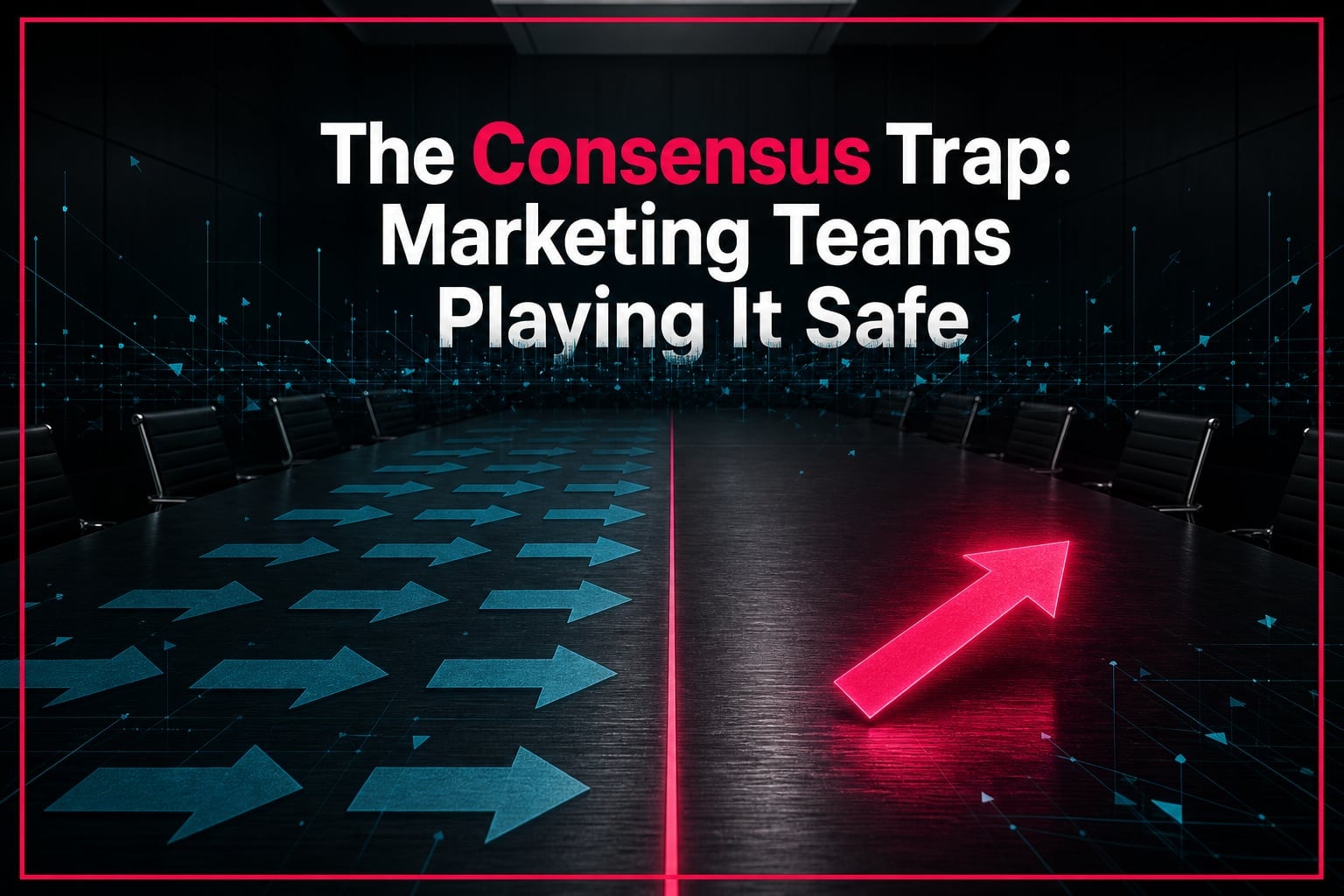
The AI Strategy Everyone Skips: Guarding Your Brand’s Weirdness
Here’s the uncomfortable part: every AI tool learns from the same data, so every brand starts sounding the same. Protecting creativity from AI isn’t a nice-to-have side project. It’s the only strategy left that competitors can’t copy with a better prompt.
Key Takeaways
- Idea diversity drops fast under heavy AI use, even when individual idea quality stays flat, per Wharton’s Mack Institute research.
- Only 6% of AI-generated ideas were unique in controlled tests, versus 100% from unaided humans.
- The fix is structural, not optional: split AI prediction work from human origination work, permanently.
The Great Sameness: Why Every AI-Assisted Brand Starts Sounding Alike
When everyone hands ideation to AI, collective creative divergence shrinks and every brand becomes a slightly different remix of the same prompt. That’s not a hunch. It’s measured.
Researchers reanalyzing creativity experiments found that participants using ChatGPT converged on strikingly similar answers, even working alone. In one test, people invented a toy from a fan and a brick. Just 6% of AI-assisted ideas were unique, compared with 100% from the human-only group, according to Knowledge at Wharton.
Christian Terwiesch, a co-author on that research, put it bluntly in the same Wharton piece: relying on ChatGPT as your only creative advisor means you’ll run out of ideas, because they’re all too similar.
You’ve felt this. You open a competitor’s landing page and it reads like yours, word for word rhythm. That’s not coincidence. That’s homogenization, and it’s coming for every brand that treats AI as the whole brainstorm instead of half of it.
The Dual-Brain Strategy: Let AI Predict, Let Humans Originate
The Dual-Brain Strategy is a structure that assigns prediction work to AI and origination work to humans, so neither job gets diluted by the other. This isn’t about using less AI. It’s about putting it in a cage marked “prediction only.”
The Left-AI Brain is your data science team, building predictive tools that unpack audience-creative pairings and forecast outcomes with precision. The Right-Brain Protection is your true artists, and they’re banned from using AI to originate ideas. Their job is to generate the raw concept from human juice, then hand it to AI only to prototype or scale it.
Contrast that with the average workflow today: one prompt, one output, one idea shared by everyone using the same tool. Genuinely new AI-assisted ideas produced collective diversity gains only when AI exposure was high enough to change the rate of idea change, not just individual creativity, per research published in the large-scale dynamic experiment on AI and human ideas.
Split the brain, and you keep both halves sharp instead of one half quietly eating the other.
How to Keep Your Creative Muscle From Going Soft
Right Brain Protection means running deliberate, no-AI creative exercises so your human originality stays sharp enough to compete. Skip this and your “creative team” becomes a prompt-editing team within a year.
Build “Artificial Challenges”: timed writing sprints with zero AI, whiteboard sessions banning laptops, and divergent-thinking drills where the goal is weird, not efficient. These aren’t team-building fluff. They’re strength training for the one skill AI can’t replicate.
Pair this with a career choice every marketer on your team should make consciously: specialize as a Creative/Innovator focused on original human thought, or as a Rational/Tech Specialist who builds and scales predictive AI tools. Trying to be both, casually, is how brands drift into sameness.
This is where a service like coolest.marketing gets useful. Positioned around Startup Nation’s marketing experts, it treats AI-era training as a specialization problem, not a tool problem, which fits exactly this divide.
Content generated purely by AI is projected to make up as much as 90% of online content by 2026, according to Atom Writer’s analysis of AI content homogenization. Every unprotected right brain adds to that flood. coolest.marketing’s approach to AI-era courses treats that flood as the reason to train the human side deliberately, not as background noise.
Your Next Move
You don’t need less AI. You need a wall between the half that predicts and the half that dreams. Map the Dual-Brain Strategy onto your actual content workflow this week and see exactly where your team’s originality is leaking out.