Brand Purpose: Why Your Brand Should Serve a Bigger Purpose Beyond the Buyer’s Journey
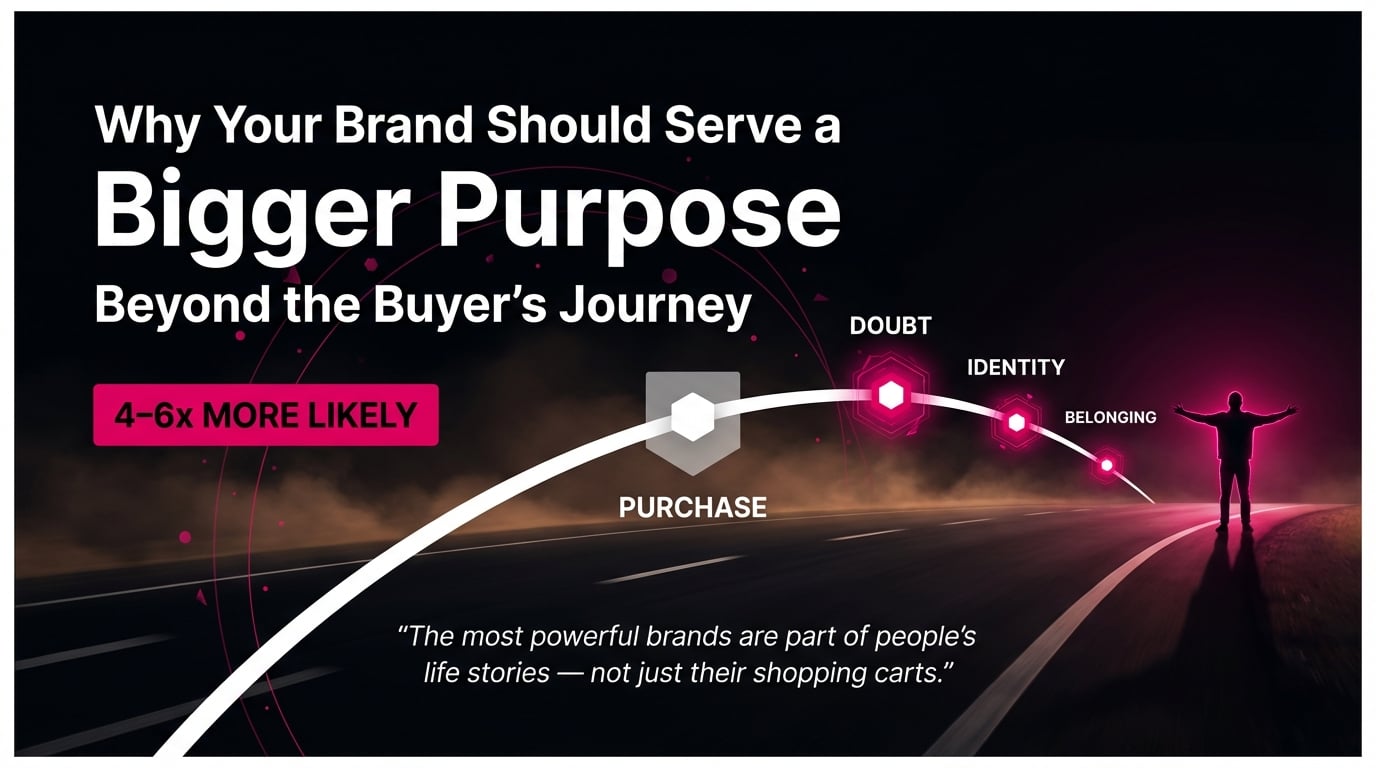
Most brands treat the sale as the finish line. Smart brands know it is the starting gun. A global study published in Forbes found consumers are four to six times more likely to buy from, protect, and champion purpose-driven companies. That gap does not come from better ads. It comes from brands that show up in customers’ lives, not just their shopping carts.
Key Takeaways: What Is Brand Purpose Beyond the Buyer’s Journey?
Brand purpose is your company’s reason for existing beyond making money: a commitment to a meaningful impact on customers, communities, or society that shapes every decision you make. Adobe defines it as what drives your branding and marketing forward, beyond profit.
Here is what the top Google results will not tell you: the buyer’s journey ends at purchase. The life journey never does. Brands that only map the path to checkout miss every moment that actually builds loyalty: the doubt after buying, the milestone your product helped them hit, the identity shift your brand supported.
The gap most brands ignore: customers do not want a product. They want to become someone. Your job is to help them get there.
Why Do Most Brands Stop at the Sale? (And Why That’s a Mistake)
Stopping at the sale means treating the buyer’s journey as the full story, when it is only the first chapter of a much longer relationship between your brand and your customer’s life.
You are probably measuring success by conversion rate and CAC. Both matter. But neither tells you if a customer came back, told a friend, or built their identity around your brand. BCG research from January 2025 argues marketers must move beyond the linear funnel entirely, because modern consumer journeys are non-linear and emotionally driven.
Transactional brands win a sale. Purpose-driven brands earn a chapter in someone’s story. That is a completely different business model.
How Can Your Brand Purpose Align With Customers’ Life Goals and Fears?
Aligning brand purpose with life goals means mapping your messaging to the real emotional stakes your customers carry: their fears of failure, their hunger for belonging, their desire to grow.
Think about Nike. A new runner buys shoes, gets excited, then hits a wall at month three. Nike knows this moment is coming. Their content, community, and coaching features exist precisely to push that runner through. That is not a marketing campaign. That is a brand living inside a customer’s life journey.
Jim Stengel, former Global Marketing Officer at Procter and Gamble, writing in Grow: The businesses that matter most, and will matter most in the future, are those built around a human ideal, a shared belief about how the brand can improve people’s lives.
Coolest.marketing’s approach to brand narrative training teaches marketers to map customer fears and dreams before writing a single word of copy. Because if you do not know what your customer is afraid of becoming, you cannot promise them a better version of themselves.
What Does Purpose-Driven Branding Look Like in Real Life?
Purpose-driven branding in practice means a brand’s actions, products, and communications consistently reflect a commitment that goes beyond the transaction and into the customer’s ongoing story.
LEGO does not sell plastic bricks. It sells the belief that imagination builds a better world. That purpose shows up in LEGO Education, LEGO Ideas (where fans design real products), and decades of storytelling that grows with the child. According to ebaqdesign’s 2026 brand purpose analysis, LEGO consistently ranks among the most purpose-aligned brands globally because the mission is visible at every touchpoint, not just on the About page.
Patagonia went further. In 2022, founder Yvon Chouinard transferred ownership of the company to a trust and nonprofit dedicated to fighting climate change. Revenue stayed above $1 billion. Purpose was not a cost. It was the product.
How Do You Build a Brand Narrative That Lasts Beyond the Transaction?
A lasting brand narrative is a story structure that places your customer as the hero and your brand as the guide, built around a tension that exists long before and after any purchase.
Use one of five narrative frames to anchor your brand story. Match the frame to the real emotional stakes your customer faces:
- Overcoming the Monster: “Defeat the impossible with us.” (Think: Salesforce vs. chaos)
- Rags to Riches: “We will help you transform.” (Think: Duolingo and language learners)
- The Quest: “Join the journey to greatness.” (Think: GoPro and explorers)
- Voyage and Return: “Explore, learn, and grow with us.” (Think: Airbnb and travelers)
- Rebirth: “Start fresh with our help.” (Think: Weight Watchers rebranding as WW)
Canva’s brand purpose research confirms that brands with a clear narrative identity outperform those without one on customer trust and retention. Pick your frame. Then make every piece of content a scene inside that story.
Quick Wins: Steps to Embed Brand Purpose Into Every Stage of the Customer’s Life Journey
Embedding brand purpose into the life journey means designing touchpoints that serve the customer’s ongoing goals, not just the moments when they are actively buying from you.
Start here, this week:
- Map the moment after the sale. What does your customer feel 30 days post-purchase? Build one piece of content for that exact moment.
- Name your customer’s fear. Not the surface fear (“I want to lose weight”) but the deeper one (“I am afraid I will always be the person who quits”). Write to that.
- Choose your narrative frame from the five above and audit your last five campaigns against it. If they do not fit, rewrite the next one.
- Create a milestone moment. Spotify Wrapped, Duolingo streaks, Nike Run Club badges. These celebrate the customer’s progress, not your product’s features.
Coolest.marketing’s marketing courses for the AI era include modules specifically on life journey mapping, built for brand managers who want frameworks, not theory.
BERA’s brand purpose research shows that purpose must be consumer-relevant and authentic, not a tagline. The brands winning long-term are not the ones with the cleverest slogan. They are the ones showing up in the moments that matter most to their customers’ lives.
Your next step: Write down the three biggest fears and three biggest dreams of your best customer. Then check if your last campaign addressed even one of them. If not, you know exactly where to start.