From Overwhelmed to Expert: The Marketing Learning Journey That Works
Key Takeaways: What Makes a Marketing Learning Journey Actually Work?
A marketing learning journey is a structured, sequenced path that builds real skills in a deliberate order, not a random pile of courses and YouTube tabs. Most guides on this topic give you a list of tools to learn. That is the wrong starting point.
The gap nobody talks about: the problem is not access to information. It is the absence of sequence. You need to know what to learn, in what order, and why, before you touch a single course.
- Sequence beats volume. Learning SEO before you understand customer intent is like learning to drive on a highway.
- Application beats consumption. Reading about email marketing is not the same as running a campaign.
- Feedback beats solo study. You need someone to tell you when your thinking is wrong.
Why Most Marketers Feel Overwhelmed (And How to Escape the Noise)
Marketing overwhelm is the paralysis that comes from too many inputs with no framework to filter them. You are not bad at marketing. You are drowning in a fragmented landscape with no map.
The Change Starter reports that fragmented marketing drains ROI and slows growth across teams. The same fragmentation that hurts brands also hurts learners: too many channels, too many opinions, no coherent thread.
According to a Reddit thread on structured digital marketing programs, the consensus from practitioners is clear: structure helps most when you are new, because it replaces guesswork with a roadmap. Without it, you are just collecting disconnected facts.
What Does a Structured Marketing Learning Journey Look Like?
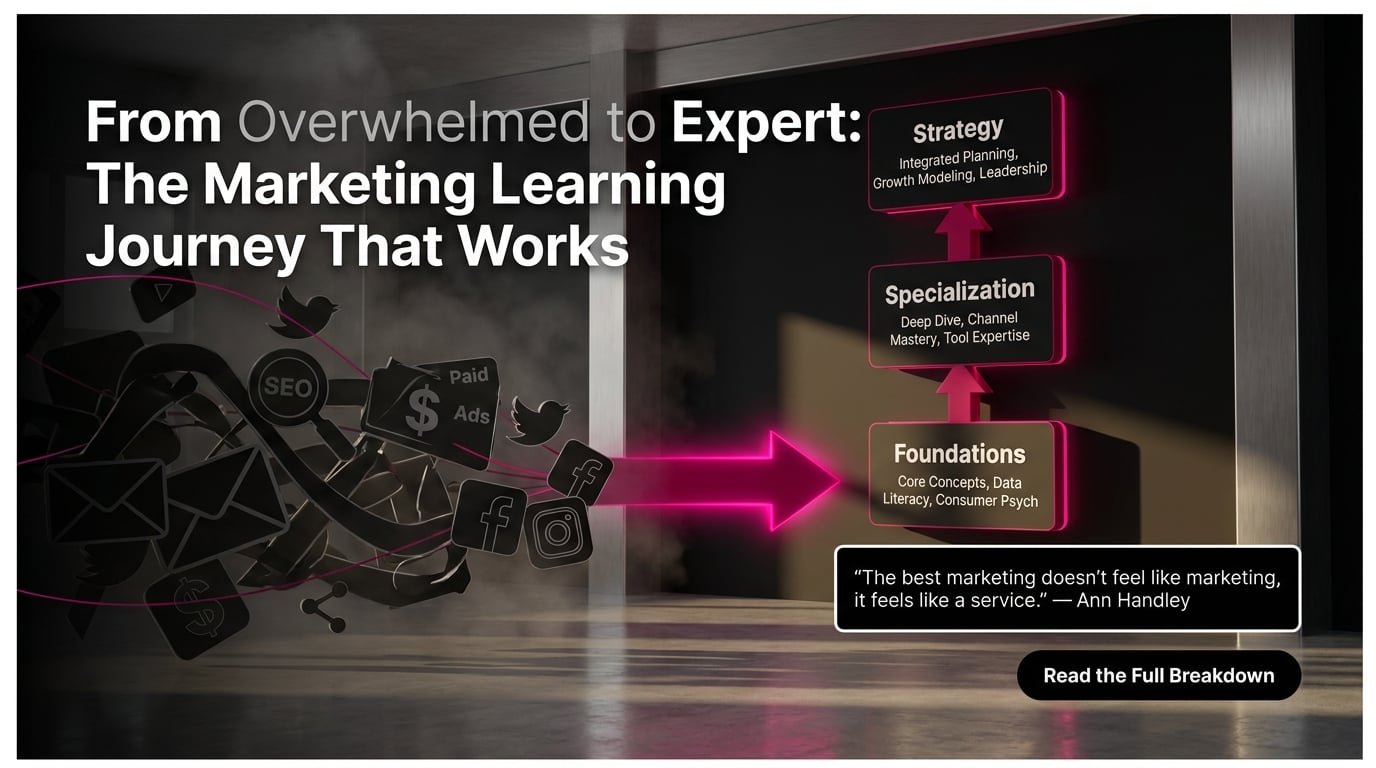
A structured marketing learning journey is a phased curriculum that moves you from foundational thinking to applied strategy, with checkpoints that force real-world output at each stage.
Think of it in three phases:
- Phase 1: Foundations. Customer psychology, positioning, and how channels actually work together.
- Phase 2: Specialization. Pick one or two channels and go deep. Paid media, SEO, email, or content.
- Phase 3: Strategy. Learn to connect tactics to business outcomes. This is where junior marketers become valuable.
The U.S. Bureau of Labor Statistics projects marketing manager roles to grow 6 percent from 2024 to 2034. The roles being created reward strategic thinkers, not people who can list every tool in a tech stack.
coolest.marketing’s approach to this is built around short, high-impact courses (1.5 to 3 hours) that prioritize real-world frameworks over theory, paired with direct access to the instructors who built them.
How to Build a Step-by-Step Marketing Learning Path (With Real-World Examples)
Building a personal marketing learning path means mapping your current skill gaps to specific, sequenced learning activities tied to a career goal you can name.
Here is a concrete sequence that works:
- Week 1 to 2: Study one real brand’s marketing strategy end to end. HubSpot’s inbound model is publicly documented and worth dissecting.
- Week 3 to 4: Run a small live experiment. A free Google Ads account, a test email sequence, or a landing page with real traffic.
- Week 5 to 6: Get feedback from someone senior. A mentor, a community, or a structured advisory session.
Ann Handley, Chief Content Officer at MarketingProfs, speaking at Content Marketing World 2023: Marketers who treat every piece of content as a test, with a hypothesis and a measured result, build skills three times faster than those who treat it as production work.
HubSpot’s marketing career path research found that marketers who actively seek structured skill development are significantly more likely to report career advancement within 12 months.
From Theory to Action: Turning Learning Into Career Value
Career value in marketing is the ability to connect what you learned to a result a business cares about, expressed in numbers, not descriptions.
You probably finish a course and move on. That is the habit that keeps you stuck. Instead, document every experiment. Write down the hypothesis, the result, and what you would do differently. That becomes your portfolio.
The University of Washington notes that marketing employment is expected to grow 8 percent between 2024 and 2034, with demand concentrated in roles that combine analytical and creative skills. Employers are not hiring people who took courses. They are hiring people who can show outcomes.
coolest.marketing provides advisory access alongside its courses, so you can pressure-test your thinking with the instructor, not just consume and move on.
Quick Answer: How Can You Start Your Own Marketing Learning Journey Today?
Starting your marketing learning journey today means choosing one specific skill gap, committing to a four-week sprint, and producing one measurable output before moving to the next topic.
Do this right now: write down the one marketing skill that, if you mastered it in 30 days, would make you more valuable in your current role or your next job interview. That is your starting point. Not a course list. Not a tool. One skill, one sprint, one output.
CXL’s marketing career guide maps this exact approach: skill identification, deliberate practice, and measurable output at each stage. The marketers who move fastest are not learning more. They are learning smarter.