Why the Future of Marketing Education Is a Community, Not a Course
Most marketers finish a course and still can’t make a better decision. That’s the future of marketing education problem nobody wants to name: we built a content industry, not a learning one. The gap between finishing and doing is where careers stall, and no library ever closed it.
Key Takeaways
- Retention jumps from 28% to 69% when learning happens socially instead of solo, according to Docebo’s research on community-based learning, so isolated video courses are fighting biology, not just boredom.
- Hands-on, instructor-led formats push retention up to 75%, per Absorb LMS, yet most marketing platforms still sell one-directional video.
- Ecosystems beat libraries because they add access, continuity, and AI on top of content, not instead of it.
- The judgment gap, not the information gap, is what’s actually holding marketers back from better decisions.
- Four forces (trust, creator economics, AI, and judgment demand) make this shift inevitable, not optional, in the next two years.
Why Content Libraries Are a Dead End for Serious Marketers
A content library is a one-way shelf of videos optimized for completion, not for whether you actually make a smarter call afterward. That’s the quiet scam of the model: it measures finishing, never thinking.
Here’s the tell. Social, community-based learning lifts knowledge retention from 28% to 69%, according to Docebo. That’s not a small edge. That’s the difference between remembering a framework and forgetting it by Friday.
Libraries can’t produce that lift because there’s no one to argue with, no group to test your logic against, no instructor to catch the flaw in your plan. You watch, you nod, you close the tab.
We see marketers finish dozens of courses a year and still can’t answer basic questions under pressure: what channel mix, what budget split, what to kill. That’s not a knowledge gap. That’s a decision-making gap, and no playlist fixes it.
Instructor-led formats push retention as high as 75%, per Absorb LMS, precisely because a live person adapts to your confusion in real time. Content libraries can’t adapt. They just play.
You’ve probably felt this: certificate earned, confidence unchanged. That’s the model working exactly as designed, and exactly wrong for what you actually needed.
What a Real Marketing Learning Ecosystem Looks Like
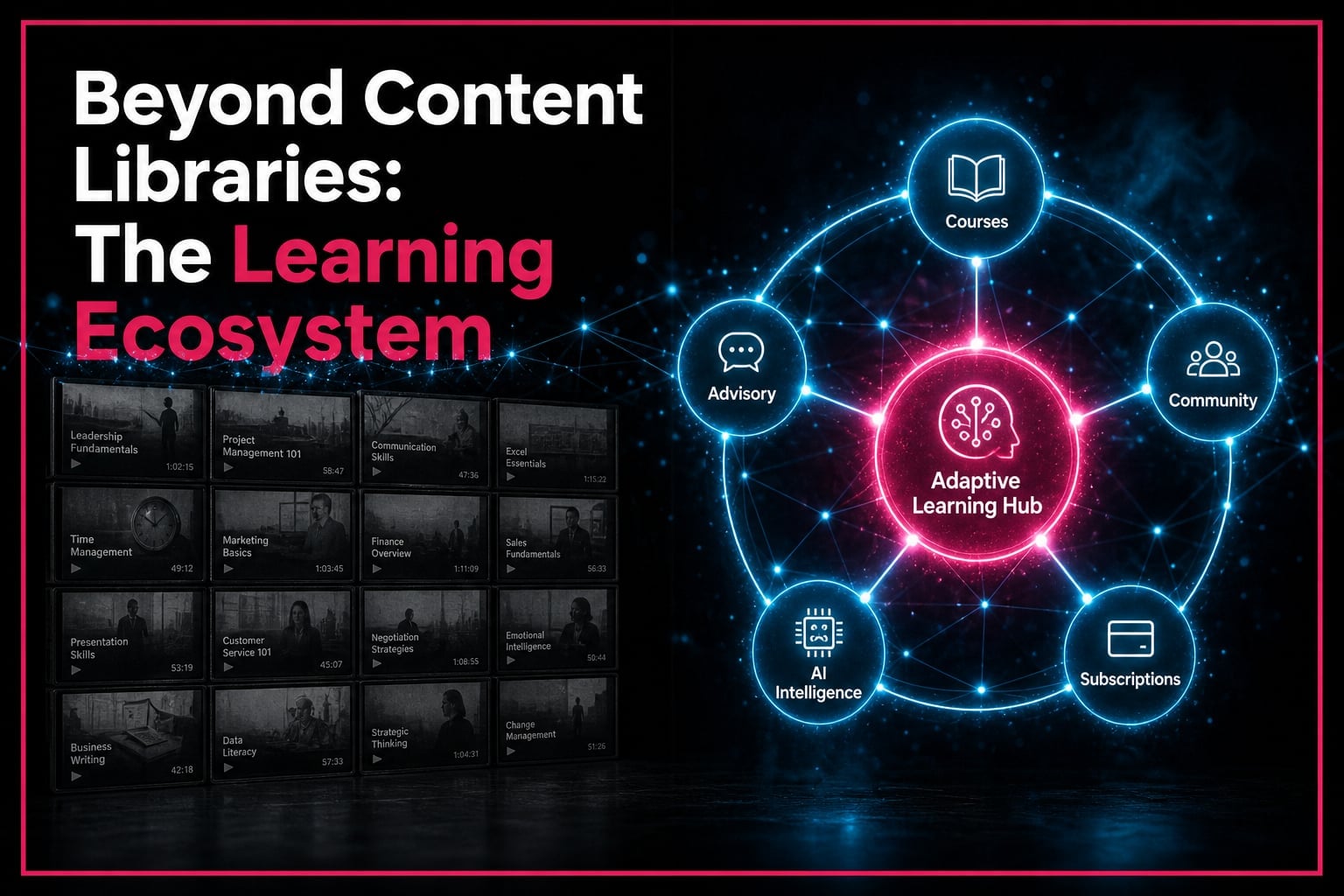
A marketing learning ecosystem is a connected structure of courses, advisory access, instructor subscriptions, and AI support that keeps compounding instead of expiring after one watch-through. Think less “shelf,” more “living network you keep returning to.”
Compare that to a library and the contrast is stark. A library gives you content and stops there. An ecosystem gives you content, then a way to act on it.
Four pillars make this work, and each solves a specific failure of the old model:
- Content: courses that teach the framework, same as before, but now it’s the entry point, not the destination.
- Access: direct advisory time with the instructor who taught it, so your specific problem gets a specific answer.
- Continuity: ongoing subscriptions to an instructor’s thinking, turning a one-time purchase into a relationship.
- Scale: AI support trained on that instructor’s methodology, available between sessions when you’re stuck at 11pm.
This isn’t theoretical. JPMorganChase’s Ignite program scaled peer-led communities of practice across engineering teams, proving that grassroots, expert-anchored learning scales inside serious organizations, not just startups.
The signal is showing up elsewhere too. Techerati calls peer-to-peer, community-led knowledge sharing “the new architecture of learning,” on par with AI infrastructure itself.
That’s the real shift: learning stops being something you finish and becomes something you stay inside of.
Four Forces Making Community-Powered Learning Unavoidable
Four forces (trust erosion, creator economics, AI-driven personalization, and a growing judgment gap) are converging to make the old library model obsolete within two years, not twenty. Ignore any one of them and you’re planning for a market that’s already gone.
Picture a VP of Marketing in 2027, evaluating course platforms for her team. She skips anything that ends at “content delivered” because her team already tried that, twice, and nothing changed on Monday morning.
First, trust in generic institutional content is falling as buyers demand named operators over anonymous slide decks. Second, creator economics have matured enough that top instructors can build direct, ongoing relationships instead of one-time content drops.
Third, AI makes personalized guidance scalable for the first time. An instructor’s AI assistant can now reflect their actual thinking, not a generic chatbot script, closing the gap between one expert and thousands of learners.
Fourth, and biggest: marketers don’t need more information. AACSB notes that firms embracing co-creation with their audience see a 20% lift in satisfaction and loyalty, a reminder that judgment about people, not just data fluency, is the scarce skill now.
Marketing education research backs the direction. Grewal’s 2025 study on the future of marketing and marketing education argues educators must adapt teaching toward technology-augmented, applied judgment, not static theory.
Here’s our prediction for the next two years: platforms that stay one-directional will keep losing serious professionals to models built on access, not just content. The marketers who win won’t be the ones who finished the most courses. They’ll be the ones who stayed close to the people who actually know.
We’ve watched this play out building in the space ourselves. What we’ve learned is simple: clarity comes from proximity to real operators, not from another module.
Where do you land on this? Follow along as we keep building the case for what marketing education should actually look like, and tell us where you think we’re wrong.