The RACE Marketing Framework Isn’t a Plan. It’s a Diagnosis You’ve Been Ignoring.
Your campaign has traffic. It has clicks. It still doesn’t have revenue, and nobody on your team can tell you why. The RACE marketing framework fixes that, not by giving you another four-box diagram, but by showing you exactly which stage is bleeding your budget before you spend another dollar guessing.
Key Takeaways
- Most leaks happen at Act, not Reach. Traffic looks fine while intent quietly dies between the click and the decision to commit.
- Reverse-diagnosis beats forward-planning. Start at Engage and work backward to find your leak in one sitting, not one quarter.
- Stage objectives should be specific and numeric. Vague goals like “improve Reach” hide the real problem instead of exposing it.
- Ethical execution compounds. The manipulative shortcut at any stage costs you trust you can’t easily rebuild later.
Why Every Funnel Seems to Break in the Exact Same Place
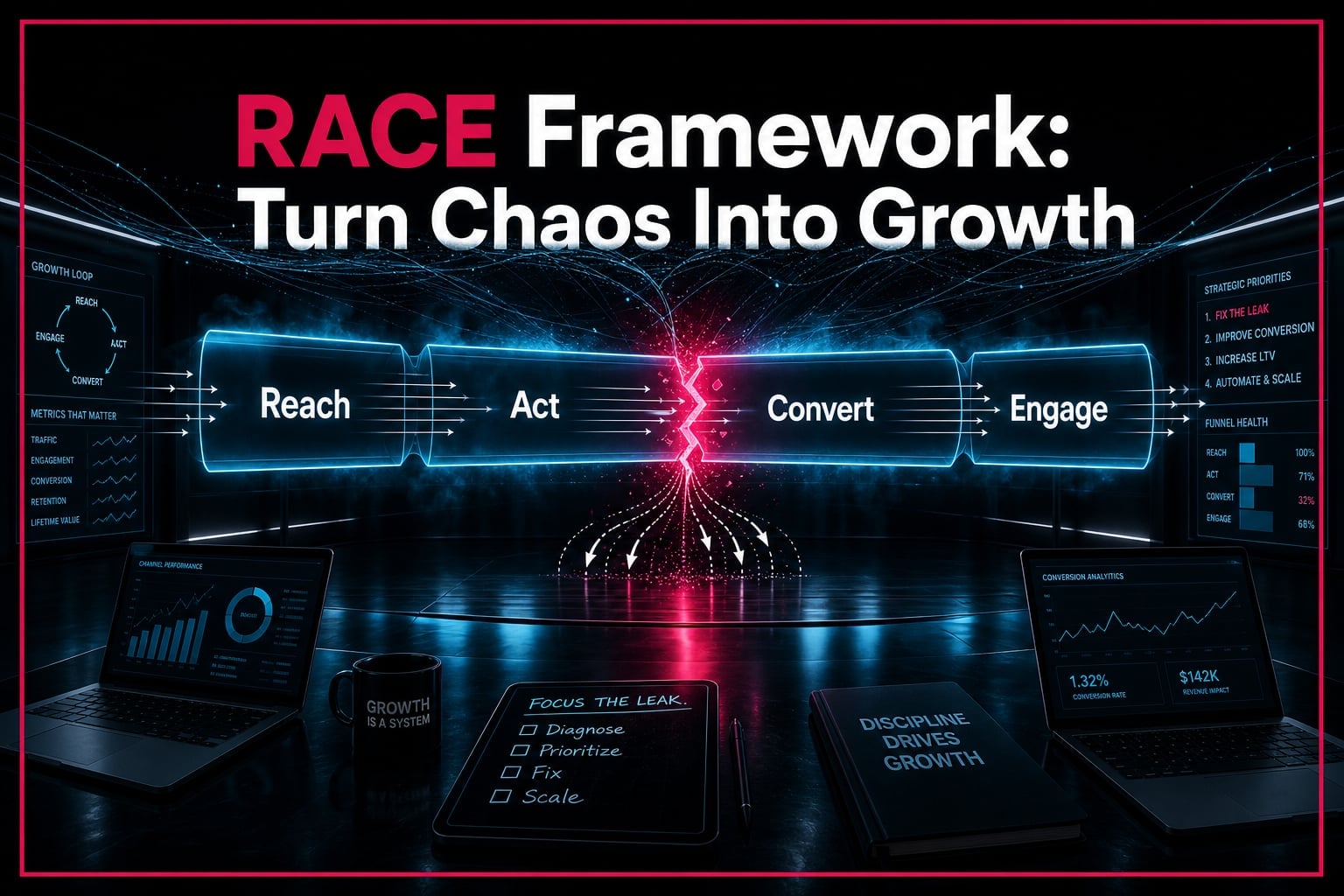
The Act stage, the gap between someone clicking and someone actually engaging with intent, is where most campaigns quietly collapse. Reach numbers look healthy. Dashboards look fine. Then revenue never shows up, and nobody knows which stage to blame.
Here’s the uncomfortable part: teams that treat RACE stages as isolated silos almost always misdiagnose the problem. Umbrex notes that clear stage-specific targets, like lifting add-to-cart rates by 200 basis points at the Act stage, are what separate teams who fix the right thing from teams who guess.
You’re probably watching Reach metrics climb while conversion stays flat. That’s not a Reach problem. That’s an Act problem wearing a Reach costume, and it’s exactly the disconnect the Smart Insights RACE framework was built to expose.
This isn’t a planning failure. It’s a visibility failure. RACE fixes visibility first, then fixes the campaign.
Run the Stages Backward and Find Your Leak in 30 Minutes
A reverse diagnostic means walking RACE from Engage back to Reach, asking one hard question at each stage, instead of building forward from a media plan. Most strategists run it forward. That’s why they miss the leak sitting in plain sight.
Forward planning assumes each stage is healthy until proven otherwise. Reverse diagnosis assumes something is already broken and hunts for it. The contrast matters: one approach confirms your plan, the other interrogates your results.
| Stage |
Common Symptom |
Diagnostic Question |
Fix Direction |
| Engage |
Customers buy once, never return |
What happens in week one after purchase? |
Build a lifecycle trigger, not another discount |
| Convert |
Cart adds don’t become sales |
Where exactly does checkout stall? |
Remove friction, not add urgency |
| Act |
Clicks arrive, intent never forms |
Does the landing page match the ad’s promise? |
Rebuild message match before touching design |
| Reach |
Traffic is high, quality is low |
Are we buying attention or buying the wrong audience? |
Shift budget toward qualified channels |
Set numeric targets at each stop, not vague hopes. Growth Method’s guidance is blunt: “increase organic sessions by 30% in Q3” beats “improve Reach” every time, because vague goals can’t be diagnosed.
This table is your pressure test. Run it before your next planning meeting, not after the campaign fails.
The Ethical Fork Hiding Inside Every RACE Stage
Ethical RACE application means choosing the transparent version of each stage’s tactics over the manipulative one, even when the manipulative one converts faster short-term. It takes longer to build. It compounds far harder over time.
Take Act. The exploitative move is a fake urgency timer. The ethical move is clarity about why someone sees your ad at all, what Baruch Spinoza’s rational ethics would call replacing confusion with understanding, a principle we unpack in building a values framework that makes your strategy unbreakable.
Ethical marketing means creating campaigns that are transparent, defensible, and aligned with both brand values and consumer expectations.
You’ve felt the shortcut’s pull. Dark patterns convert this week and cost you retention every week after. Recycled manipulation tactics fail for the same reason recycled strategy fails, a pattern we mapped out in why recycled tactics keep failing even smart marketers.
Half of companies still run digital budgets without a clear strategy, per Smart Insights research cited by Promodo, and vague strategy is where manipulation sneaks in fastest.
Diagnostic clarity, the kind we built in the table above, is also what surfaces blind spots you can’t Google your way out of. See the blind spots no framework can show you alone and how high-performers break out of decision paralysis for the next layer down. coolest.marketing publishes practitioner breakdowns like these for marketers who want the mechanism, not the glossary entry.
Want the full diagnostic walkthrough with worked examples? Explore the complete RACE guide and run the reverse test on your own funnel this week.