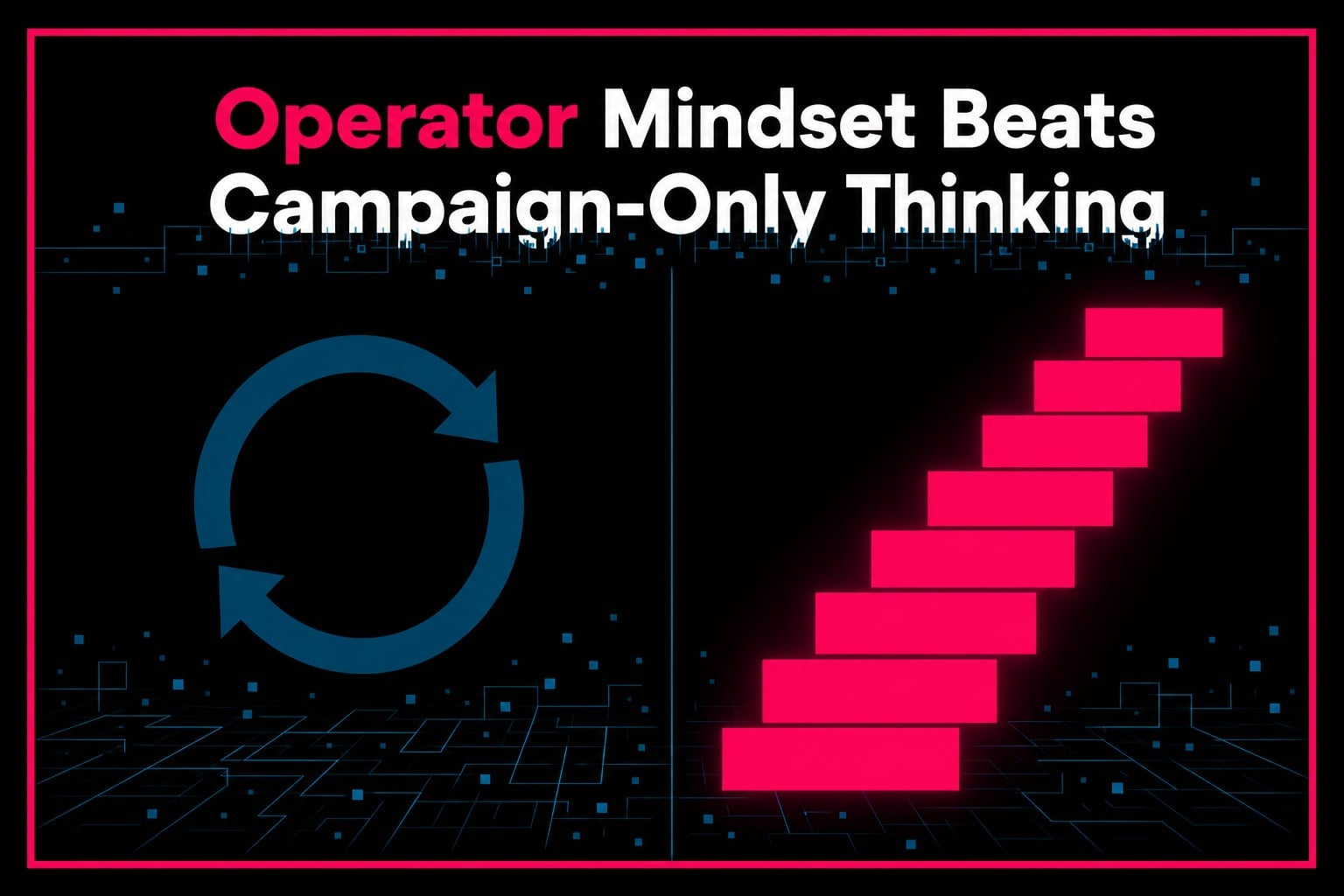
Operator Mindset for Marketers: How to Stop Executing Campaigns and Start Driving Real Growth
Most marketing advice tells you to run better campaigns. This article argues that campaigns are not your problem. Your mental model is. The operator mindset for marketers is the shift from asking “what should we launch next?” to “what system produces growth reliably?” That single reframe changes every decision you make, every week.
Key Takeaways
- Campaign mode creates bursts. Operator thinking creates compounding systems.
- The shift is not about working more. It is about deciding differently.
- Operators document, delegate, and design for repeatability.
- Real operators treat problems as routine, not crises.
- The fastest way to start: audit whether your growth depends on you or on a system.
What Is the Operator Mindset for Marketers and Why Does It Matter?
The operator mindset for marketers is the practice of building repeatable systems, clear processes, and decision frameworks that produce growth independent of any single campaign or person.
Here is what nobody says out loud: most marketers are not underperforming because they lack skills. They are underperforming because they are solving the wrong problem. They optimize the campaign when they should be designing the machine that runs campaigns.
Research from Next Level Catapult puts it plainly: operators work through a lens of task execution and short-term goals, while owners see through the lens of impact. Marketers stuck in campaign mode are permanently in operator-as-executor mode. The shift we are describing moves you into operator-as-architect mode.
Why does it matter right now? Because 87% of marketers say data is their company’s most under-utilized asset, per Invoca’s 2025 report. That is not a tools problem. It is a systems-thinking problem. You cannot use data well if you have no system for turning it into decisions.
The operator mindset is not a personality type. It is a set of habits: document everything, delegate outcomes (not just tasks), and ask “will this still work when I am not in the room?” If the answer is no, you are still in campaign mode.
A huge factor that can separate you from other business owners is having the proper operator mindset. Operators accept problems as a normal part of business. If you just operate from the belief that ‘this is simple to fix,’ it solves 80% of problems.
Andre Haykal Jr., Founder and CEO, ABH Acquisitions, via LinkedIn post, 2024
How the Operator Mindset for Marketers Outperforms Campaign-Only Thinking
Marketing campaign mode is a project-based approach where each initiative starts from scratch, success depends on individual effort, and growth resets when the campaign ends.
Campaign mode feels productive. You are always launching something. But here is the trap: demand gen teams often spend 80% of their time wrestling with execution logistics, per Knak’s 2025 analysis. That is 80% of your week on the hamster wheel, leaving 20% for the thinking that actually moves the business forward.
Operator thinking breaks that ratio. Instead of rebuilding every campaign from zero, operators create reusable templates, documented workflows, and clear decision rules. The second campaign costs half as much to produce. The fifth costs almost nothing.
The contrast is concrete:
- Campaign mode: “How do we get this out by Tuesday?”
- Operator mode: “How do we build the infrastructure so every Tuesday launch takes two hours, not two days?”
coolest.marketing’s approach to this distinction is grounded in one of Israel’s sharpest marketing communities: the idea that clarity over chaos is not a philosophy, it is a competitive advantage. When your systems are documented and delegated, you stop guessing and start compounding.
Dave Schoenbeck’s framework is useful here: if more than 60% of your week is reactive, you are still executing, not leading. Marketers who want a seat at the strategy table need to prove they can build something that runs without them.
Real-World Shifts: Frameworks and Examples for the Operator Mindset for Marketers
Becoming a marketing operator means adopting three concrete practices: system documentation, outcome-based delegation, and data-driven decision loops that run continuously, not just post-campaign.
Netflix is the clearest example. In the early 2010s, Netflix did not just run better content campaigns. They built a data system that told them exactly what to create, for whom, and when. Their decision to release full seasons at once came directly from behavioral data showing users binge-watched. That is operator thinking: the data loop informed the product decision, which drove the marketing outcome.
You do not need Netflix’s budget to apply this. Here is a three-part framework we call the OSR Loop:
- O: Observe. Set up always-on measurement before any campaign launches. Know your baseline.
- S: Systematize. Document what worked. Build templates. Remove yourself as the single point of failure.
- R: Repeat with refinement. Run the next campaign faster, cheaper, and with a clear hypothesis to test.
Note that 41% of marketers admit they are uncomfortable collecting and analyzing data, per the Marketing Data State of Play 2023. That discomfort is the gap between campaign executors and marketing operators. Operators are not data scientists. They just refuse to make decisions without a feedback loop.
coolest.marketing offers courses built specifically for marketers navigating the AI era, where the operator mindset is not optional. When AI handles execution, your value is your judgment, your systems, and your frameworks.
Your next step: Take one campaign you ran in the last 90 days. Write down every step it took to produce. Circle every step that only you could do. That circle is your bottleneck. Eliminate one item from it this week. That is how operators are built: one documented process at a time.