AI Personas for Creative Campaigns: How Advanced Teams Pressure-Test Ideas and Actually Win Clarity
Most teams build AI personas to describe their audience. Advanced teams build them to attack their own work. Used correctly, AI personas for creative campaigns act as adversarial critics, surfacing blind spots before a single dollar goes to media. The gap between those two approaches is where campaigns are won or lost.
Check out Elad Gaon‘s “AI Persona Simulation” free workshop, as you will learn to create 3 AI tools that can change the way you understand AI personality.
-
AI personas go beyond demographics. Forensic profiling and psychological archetypes reveal how a real human brain reacts, not just who they are on paper.
-
Pressure-testing is a structured process. It is not a vibe check. It follows a repeatable workshop format.
-
AI persona accuracy is surprisingly high. Research validation studies show correlation rates between AI persona responses and actual consumer responses as high as 90% or more.
-
The real risk is sameness. Without deliberate protection of original thinking, AI-assisted campaigns converge into the same safe, forgettable territory.
How Do Advanced Teams Build AI Personas for Creative Campaigns That Go Beyond Demographics?
Building AI personas for creative campaigns means constructing a behaviorally rich, psychologically grounded simulation of a real audience member, not a demographic summary with a stock photo attached.
Here is the problem with standard persona templates: they describe who someone is, not how they think under pressure. Age, income, and job title tell you nothing about why a person scrolls past your ad in 0.8 seconds.
Advanced teams start with what we call forensic profiling. The idea comes from the Locard Exchange Principle in criminal forensics: every contact leaves a trace. A user’s digital footprint, their entry point, scroll speed, content history, is a forensic scene. You read it like evidence, not like a survey response.
From that evidence, you build a 3D narrative. Not “millennial female, urban, fitness-interested.” Instead: “She distrusts brands that perform wellness without substance. She forgives imperfection but never inauthenticity. She is the first to call out a campaign that feels like it was written by committee.”
That is a persona you can argue with. C+R Research notes that properly constructed AI personas combine demographic data with psychographic insights, behavior patterns, and linguistic nuances. That combination is what makes them useful for pressure-testing, not just planning.
coolest.marketing’s approach to persona building draws on this forensic logic, treating every digital signal as a clue about a customer’s true decision-making process, not just their stated preferences. It reflects what serious marketing education in the AI era looks like when it moves from theory to field practice.
The goal is a persona that can push back. If your AI persona only validates your ideas, you built a mirror, not a critic.
What Does Pressure-Testing a Creative Campaign With AI Personas Actually Look Like?
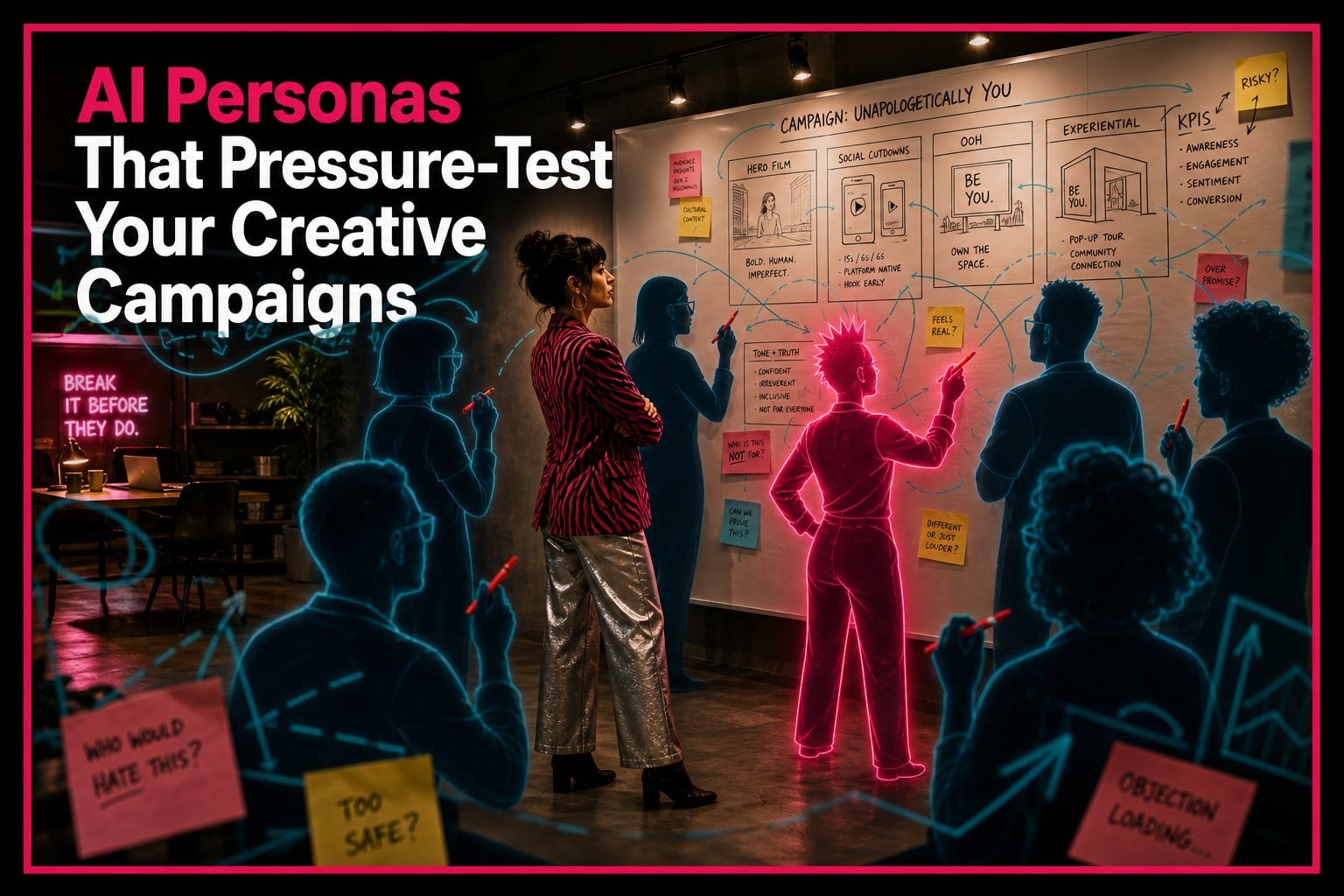
Pressure-testing a creative campaign with AI personas is a structured workshop process where each persona is prompted to actively challenge the campaign’s core assumptions, not just react to its surface.
Here is how it runs in practice, in four moves:
-
Brief the persona, not the campaign. Give the AI persona the campaign brief, not the finished creative. Ask: “What would make you immediately distrust this brand?” You want the objection before the execution.
-
Run the hostile interview. Prompt the persona to play the most skeptical version of your audience. Ask it to find the three biggest reasons the campaign would fail for someone exactly like them.
-
Test the headline in isolation. Strip the visual. Read only the copy. Ask the persona: “What does this make you feel, and what does it make you do?” If the answer is “nothing,” the copy is not working.
-
Check for sameness. Ask the persona: “Have you seen this campaign before?” If the answer is yes, you have an AI-driven sameness problem. This is the most underused prompt in the process.
Yabble’s research shows that AI personas allow teams to test creative and messaging before committing to media spend, identifying what resonates while changes are still quick and inexpensive to make.
The workshop format matters. This is not a solo exercise. Run it with your creative director, a strategist, and someone who did not write the brief. The persona is the stress-test instrument. The team is the one that has to hear the results and act on them.
How Do Psychological Archetypes and Forensic Profiling Supercharge AI Personas for Creative Campaigns?
Psychological archetypes in marketing are universal character patterns, the Rebel, the Caregiver, the Explorer, that predict how a person processes meaning, threat, and desire, independent of their demographic profile.
This is where most AI persona guides stop short. They tell you to add psychographics. They do not tell you to assign an archetype and then use it as a creative filter.
Here is what that looks like in practice. If your target audience maps primarily to the Rebel archetype, your campaign’s tone of authority will actively repel them. The Rebel does not want to be told what to do. They want to feel like they discovered something. A campaign that lectures them is dead on arrival, no matter how good the visual is.
Assign one primary archetype per persona. Then ask: “Does our campaign speak to this archetype’s core desire, or does it accidentally trigger their core fear?” That single question has killed more bad campaigns in workshop than any other prompt we use.
The biggest mistake brands make is building personas that confirm their strategy instead of challenging it. A well-constructed AI persona should make your creative team uncomfortable, because that discomfort is where the real insight lives.
Andy Crestodina, Co-founder and Chief Marketing Officer, Orbit Media Studios, via Orbit Media Studios blog
Forensic profiling adds the longitudinal layer. Archetypes tell you the pattern. Forensic data tells you how that pattern has evolved over time through real behavior. Together, they give you a persona that is both psychologically coherent and behaviorally grounded.
McKinsey research cited by M1-Project shows personalized customer experience can increase revenue by up to 15%, and 65% of consumers expect brands to tailor communications to their needs. Archetypes are how you get to that level of personalization without guessing.
coolest.marketing integrates archetype mapping directly into its marketing courses for practitioners working in the AI era, because knowing your audience’s archetype is not a branding exercise. It is a pressure-testing tool.
Run Your First AI Persona Pressure-Test This Week
Pick one live campaign brief. Build one forensic persona using behavioral data, not a template. Assign it an archetype. Then run the four-step hostile interview above. Write down every objection the persona raises. Bring those objections to your next creative review. That is the whole process. Start there.