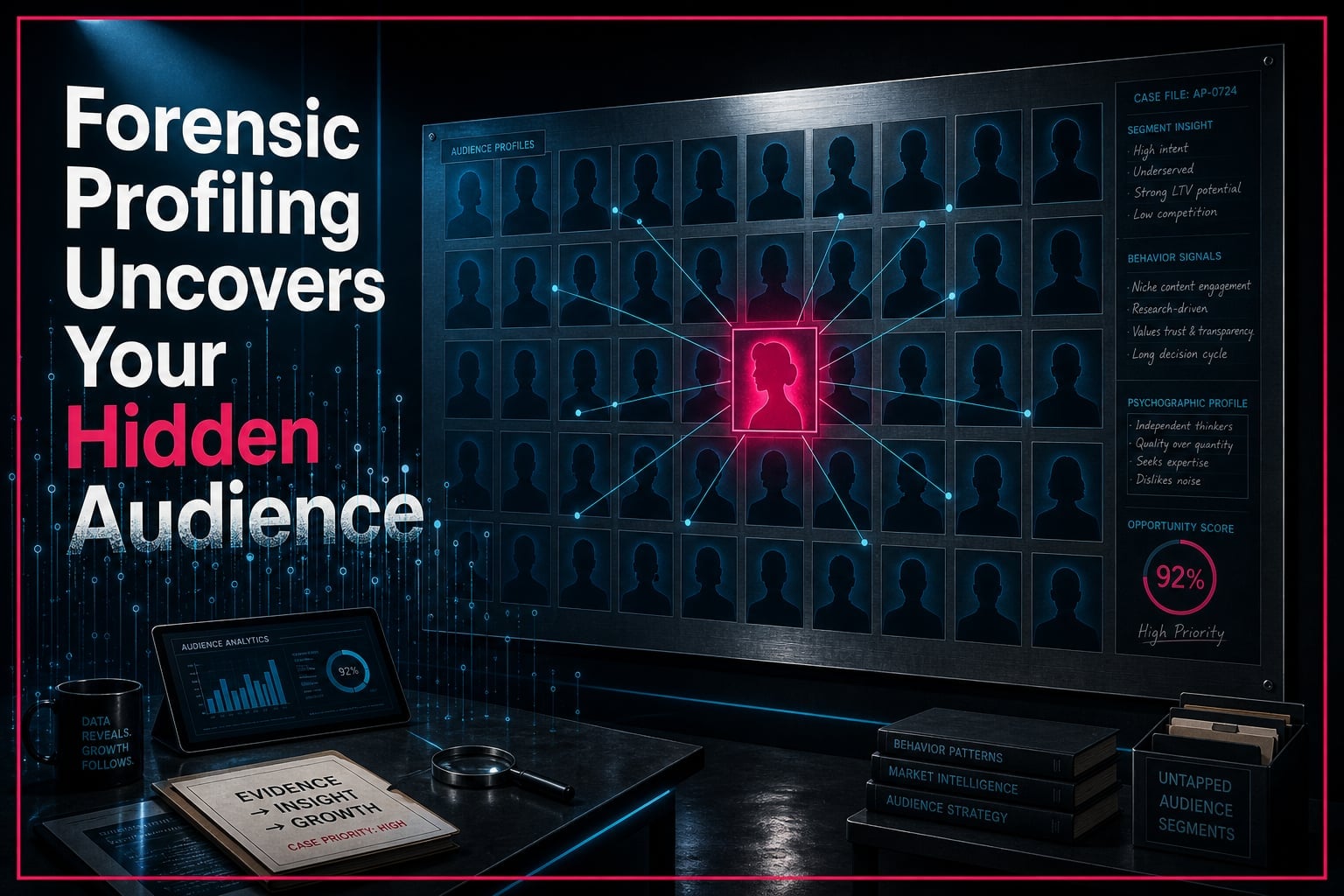
How Forensic Digital Profiling Uncovers Untapped Audience Segments in Digital Marketing
Forensic digital profiling applies investigative logic to digital behavior data, reading the traces users leave online the way a detective reads a crime scene. Most marketing articles stop at psychographics. This one goes further: we argue that the real untapped segments hide not in who your audience is, but in why they behave the way they do online, and that behavioral traces reveal those motives before any survey ever could.
Key Takeaways: What Is Forensic Digital Profiling and Why Should Marketers Care?
Forensic digital profiling is the practice of collecting and analyzing a person’s digital traces, including browsing patterns, content engagement, and platform behavior, to build a psychologically accurate picture of their motives and identity. Think of it as upgrading from a blurry snapshot to a full case file.
Traditional demographics tell you someone is a 34-year-old woman in Chicago. Forensic profiling tells you she reads long-form articles at midnight, shares content about career pivots, and skips past anything that looks like a sales pitch. Those are actionable signals. Age and zip code are not.
Digital profiling, per TechTarget, is the process of gathering and analyzing information about an individual that exists online. Forensic digital profiling takes that a step further by applying structured investigative frameworks to find patterns that standard analytics miss entirely.
How Does Forensic Digital Profiling Go Beyond Traditional Demographics?
Moving beyond demographics means shifting from static attributes like age and gender to dynamic behavioral signals that reveal personality, motivation, and decision-making style. Demographics describe a person. Forensic profiling explains them.
The Locard Exchange Principle from criminal forensics states that every contact leaves a trace. Applied to marketing: every click, scroll depth, and re-visit is evidence. A user who reads three articles about a problem but never visits a pricing page is telling you something specific about their buying stage and trust level.
You are probably segmenting on demographics right now. Here is what that costs you: low-income consumers are 38% more likely than high earners to feel underrepresented in advertising, per Anchor Computer’s 2025 research. That is a massive segment feeling ignored, not because they lack buying intent, but because demographic filters keep missing them.
coolest.marketing’s approach to this problem draws on both criminal profiling methodology and commercial marketing frameworks, treating the digital footprint as a longitudinal record of authentic behavior rather than a snapshot survey.
What Real Digital Footprints Reveal About Audience Motives and Personality
A digital footprint is the cumulative record of a person’s online activity: the content they consume, the platforms they use, the times they engage, and the paths they take through digital spaces. Analyzed over time, it becomes a personality signature.
Consider three signals that most marketers ignore completely. First: time of engagement. Late-night readers skew toward anxiety-driven decision-making and research-heavy buying cycles. Second: content format preference. People who watch videos to completion rather than skim articles tend toward visual, emotionally-driven choices. Third: re-visit frequency. Someone who returns to the same page three times without converting is not uninterested; they are uncertain and need social proof, not a discount.
Analyzing digital footprints can reveal behavioral tendencies and thinking patterns that correspond with certain personality traits, giving marketers a richer, more predictive view of buyer intent than any demographic filter alone.
Katherine Barchetti, Retail Strategy Consultant, speaking on consumer profiling methodology via Indeed Career Advice
How Can Marketers Use Forensic Digital Profiling to Find Untapped Audience Segments?
Forensic digital profiling for audience discovery means applying a structured three-step investigation to your existing data before spending a single dollar on new acquisition. The segments are already there. You just have not looked at the right evidence.
The 3D Profiling Framework works like this. Start with Who and Where (Google Analytics, platform data). Layer in What and When (content type, session timing, device). Then investigate Why (re-visit patterns, exit points, micro-conversion gaps). That third dimension is where untapped segments live.
When immi, a healthy instant ramen brand, used AI-driven audience targeting, they uncovered extreme sports enthusiasts as a high-performing segment nobody had targeted intentionally. Brands using enriched behavioral data have seen 15-20% lifts in ROAS within the first 24 hours, per Pixis’s 2025 benchmark data.
Case Study: Uncovering a Hidden Segment With Forensic Profiling Techniques
A forensic profiling case study documents how behavioral trace analysis, not demographic expansion, revealed a converting audience segment that standard targeting had completely ignored.
Rural consumers represent 15% of the global online population but are dramatically underserved. Only 5% of consumers in Montana feel acknowledged by advertising, compared to 13% in New York, and 53% of rural consumers prefer online shopping due to limited local retail. That is a high-intent, low-competition segment hiding in plain sight.
The forensic signal that reveals them: long session durations, high return visit rates, and strong email engagement, all pointing to buyers who research carefully before committing. Demographic filters labeled them “low-value.” Behavioral forensics labeled them “ready to buy.”
What Tools and Next Steps Make Forensic Digital Profiling Actionable for Your Team?
Actionable forensic profiling tools are platforms and frameworks that translate raw behavioral data into psychologically grounded audience profiles your creative and media teams can actually use. The profile must drive a brief, or it is just an interesting document.
Start with what you already have: GA4 behavioral flow reports, heatmap tools like Hotjar, and email engagement segmentation by time and content type. Layer in psychographic profiling frameworks from HubSpot to connect behavioral signals to values and motivations. coolest.marketing offers structured courses that train marketers to apply these profiling frameworks in the AI era, combining criminal profiling logic with modern digital analytics.
Your next step is immediate: pull your last 90 days of session data and filter for users with three or more visits who never converted. That is your first forensic segment. Investigate their content path. Build a profile. Then write one piece of content specifically for them. That is forensic digital profiling in practice.