Using Humor in Marketing Without Alienating Your Audience: A Practical Guide
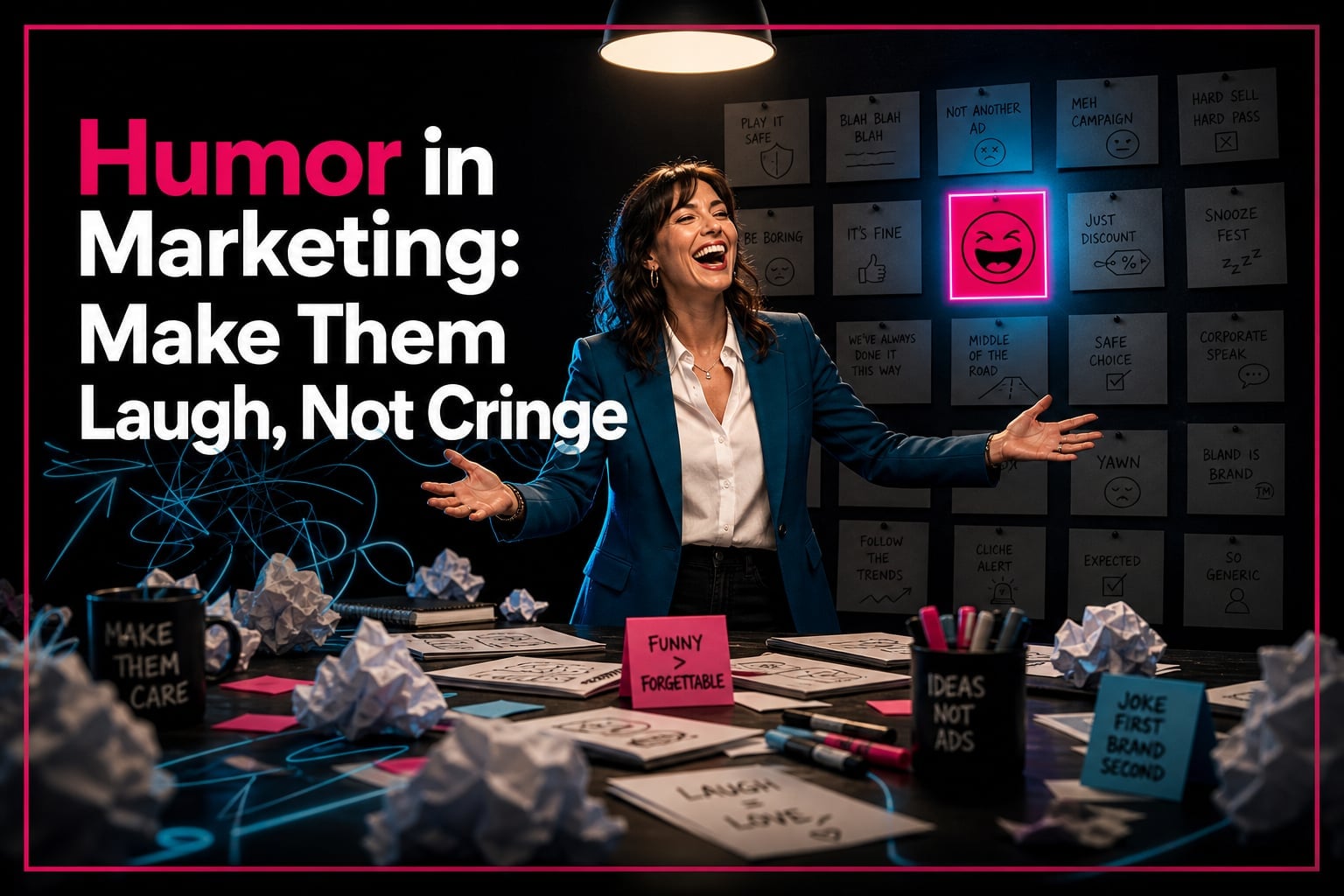
Using humor in marketing works, but most brands either play it too safe or blow past the line entirely. Here is the uncomfortable truth: 80% of consumers are more likely to buy again from a brand that uses humor, yet most marketing teams treat funny like it is radioactive. This guide tells you exactly where the line is and how to walk it.
Key Takeaways
- Humor builds recall, loyalty, and shareability when it matches your brand voice.
- Punching down at groups always backfires. Punching at situations, ideas, or yourself usually lands.
- Test before you publish. What kills in the writers’ room can bomb with a real audience.
- Authenticity beats cleverness every time. Forced funny is worse than no funny at all.
- Ethical humor is inclusive humor. If one group feels excluded, you have already lost.
What makes humor work in marketing, and why does it sometimes backfire?
Humor in marketing is the deliberate use of comedy, wit, or absurdity in brand communications to create positive emotional responses and increase audience engagement.
Here is what most articles will not tell you: humor does not have one universal effect. Research published in 2023 confirms that humor’s impact depends entirely on context, including whether a consumer feels amused versus whether a brand is simply trying to be funny. Those are two very different things, and your audience can smell the difference.
When humor lands, the results are real. A Journal of Marketing study found that ads making people laugh were 30% more likely to be remembered than serious ads. Memory drives purchase. Purchase drives revenue. Simple chain.
When it backfires, it backfires loudly. Research by Warren and McGraw (2016) shows that even successfully humorous marketing can hurt brand attitudes by triggering negative reactions alongside laughter. The laugh and the cringe can coexist, and the cringe sticks longer.
The core failure mode is not being offensive. It is being irrelevant. A joke that has nothing to do with your brand, your audience, or your product is just noise. Noise annoys. The brands that win with humor, think Wendy’s on Twitter or Dollar Shave Club’s launch video, use comedy that is inseparable from what they are selling.
So why do so many brands still avoid it? Only 24% of business leaders report using humor in email marketing campaigns, despite consumers actively wanting it. Fear of getting it wrong keeps brands boring. And boring, as it turns out, is its own kind of risk.
How to craft authentic, inclusive, and ethical humor for your brand
Authentic brand humor is comedy that grows directly from your brand’s real personality, your audience’s actual experience, and your product’s honest truth, not from chasing trends or copying competitors.
You are probably doing one of two things wrong. Either you are workshopping jokes until they are safe enough to mean nothing, or you are swinging for viral without checking whether the joke fits your brand at all. Both kill trust.
Here is a simple three-part filter we call the FIT Test:
- Familiar: Does this joke connect to something your audience already knows and feels?
- Inclusive: Does it laugh with people, never at a group?
- True to brand: Would your brand’s biggest fans see this and say “yep, that’s them”?
If the answer to any of those is no, rewrite or cut. That is it. No committee vote needed.
Ethical humor means punching at situations, ideas, or your own brand, never at people’s identities. Forbes notes that most marketing campaigns can benefit from levity, but the humor must be comic, absurd, or incongruous without causing harm. That is a low bar, and yet brands clear it all the time in the wrong direction.
Humor is a powerful force for productivity, persuasion, and connection. Research from Harvard and Stanford shows that integrating humor into your culture can positively impact nearly every aspect of your business, from closing more deals to retaining top talent.
David Mammano, entrepreneur and author, writing for LinkedIn Pulse, September 2025
coolest.marketing’s approach to humor in brand content starts with audience empathy, not joke-writing. The team, rooted in Israel’s marketing community and built for the AI era, runs courses that teach marketers to read audience psychology before picking a comedic style. Knowing your audience is not a step. It is the whole game.
Test your humor before it goes live. Show the draft to five people outside your team. If three of them explain the joke back to you, it is not landing. If one of them looks uncomfortable, find out why before the internet does.
Real-world examples: Campaigns that nailed (and failed) using humor in marketing
A humor marketing case study is a documented example of a brand using comedy in a campaign, with measurable outcomes that reveal what made the approach succeed or collapse.
Two campaigns. Same tool. Opposite results. Here is what actually separates them.
Dollar Shave Club (2012): Nailed it. The launch video cost roughly $4,500 to produce. It racked up 12,000 orders in the first 48 hours. The humor was self-aware, product-specific, and completely on-brand. CEO Michael Dubin was not trying to be a comedian. He was being honest about a boring industry in a funny way. That is the difference. Research suggests 43% of Super Bowl viewers tune in specifically for the commercials, which tells you audiences are hungry for entertainment. Dollar Shave Club fed that hunger outside the Super Bowl budget.
Pepsi’s Kendall Jenner Ad (2017): Failed hard. Pepsi tried to use humor-adjacent lightness to comment on social protest movements. It was not funny. It was tone-deaf. The brand pulled the ad within 24 hours after widespread backlash. The failure was not about trying humor. It was about using levity to trivialize something the audience felt deeply about. Comedy requires truth. That ad had none.
The pattern is clear. According to Nielsen and Kantar, consumers are 47% more likely to remember a funny ad than a straightforward one. But only if the humor earns its place. Borrowed relevance, jokes that have nothing to do with the brand or the moment, is the fastest path to a crisis comms call.
Marketers looking to build this muscle consistently will find that coolest.marketing offers practical frameworks for testing comedic content against real audience segments, a skill that matters more as AI-generated content floods every channel.
The next step is immediate: run your current campaign draft through the FIT Test right now. Familiar, Inclusive, True to brand. If it passes all three, you are ready to publish. If it does not, you now know exactly what to fix.