Freud Hidden Desires vs. Jung’s Archetypes: Why the Unconscious Wins in Conversion Copywriting
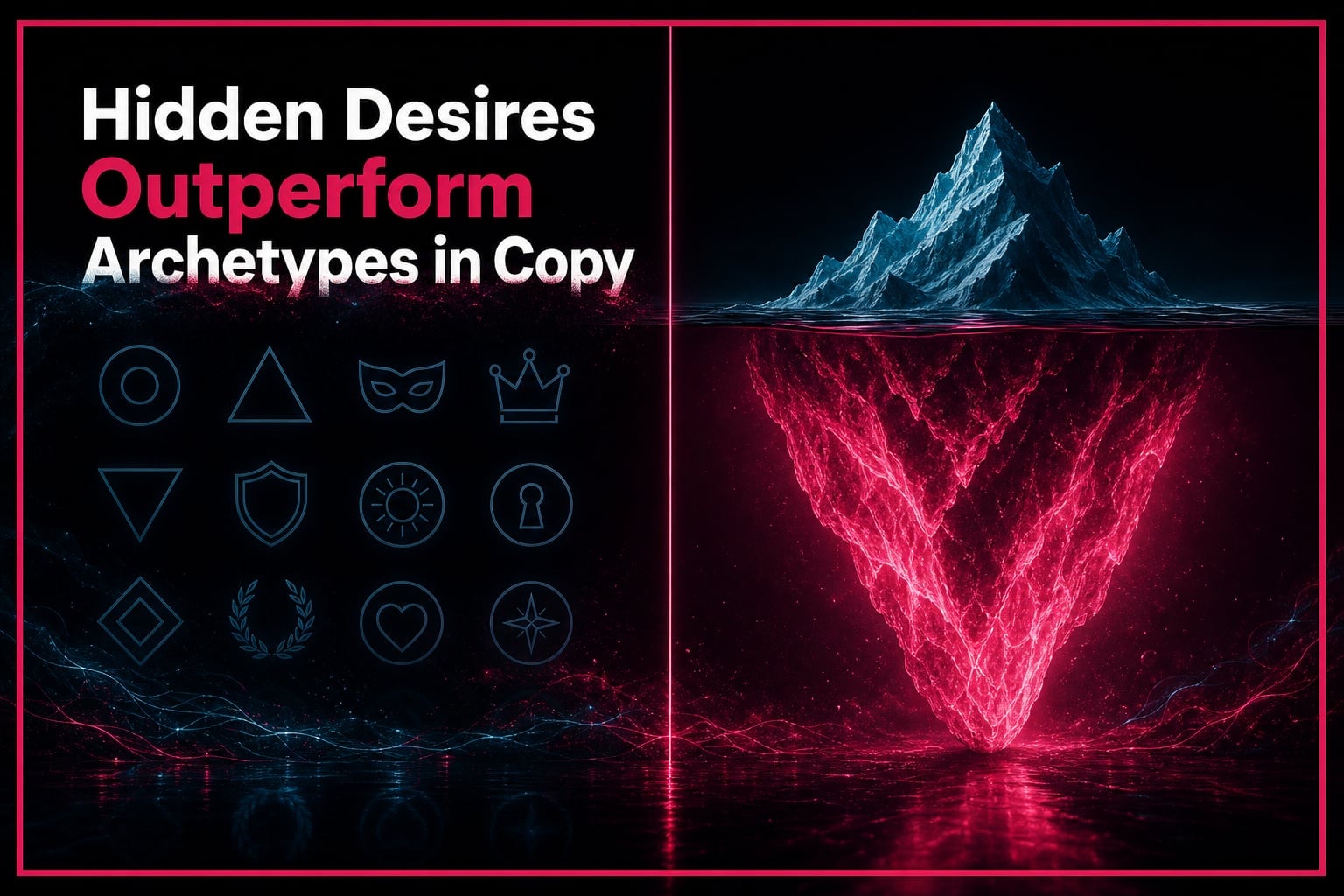
Most conversion copywriting advice tells you to pick a brand archetype and build your story around it. That is solid branding advice. It is terrible conversion advice. Behavioral science shows up to 95% of purchase decisions are made subconsciously, which means the real action happens below the story layer entirely. Archetypes tell people who you are. Freud hidden desires tell people what they secretly want. Only one of those gets the click.
Why Jung’s Archetypes Are a Branding Tool, Not a Conversion Tool
Brand archetypes are a framework for giving a brand a consistent personality, drawn from Carl Jung’s theory that humans share universal symbolic patterns. The 12 archetypes (Hero, Jester, Lover, and so on) help brands build recognizable identities that resonate instinctively with audiences.
But here is the problem. Archetypes answer “who is this brand?” Conversion copy needs to answer “why should I act right now?” Those are completely different questions. A Jester brand can still have terrible CTAs. A Hero brand can still write boring product pages.
Archetypes shape identity over time. Freud hidden desires drive action in the moment. If you are writing a landing page, you need the second one.
What Freud Hidden Desires Actually Mean for Copywriters
Freud hidden desires are the unconscious wishes people cannot or will not say out loud, including the need for control, the fear of being left behind, or the longing for status and belonging. The unconscious mind holds repressed feelings, hidden memories, habits, thoughts, desires, and reactions that quietly drive behavior.
Your customer is not buying project management software. They are buying relief from the anxiety of looking disorganized in front of their team. That is a Freudian desire. No archetype captures it. But copy that speaks directly to that fear? That converts.
This is the gap most competing articles miss. They treat Freud as theory and Jung as practice. We flip that entirely.
How to Spot Hidden Desires in Your Audience (Real Examples)
Spotting hidden desires means reading between the lines of what customers say to find the unspoken need underneath. The method is simple: take your customer’s stated reason for buying, then ask “why does that matter?” three times in a row.
A real example: Dollar Shave Club’s 2012 launch video. The stated desire was “affordable razors.” Ask why three times and you land on: men felt embarrassed paying premium prices for a basic grooming product. The copy did not sell cheap razors. It sold the feeling of being smart and not getting played. That is Freudian desire in action.
Urgency works for the same reason. Creating urgency increases checkout rates by 332%, because it activates the hidden fear of missing out, not rational calculation.
The Freud Hidden Desires Copy Framework: 4 Steps
Applying Freud hidden desires to conversion copy is a four-step process that moves from surface-level messaging to desire-layer messaging. Here is how it works in practice.
- Step 1: Find the stated desire. What does your customer say they want? Write it down.
- Step 2: Dig three layers deep. Ask “why does that matter?” three times. The third answer is usually the hidden desire.
- Step 3: Name the desire without naming it. Never say “we know you fear failure.” Instead, write copy that makes the reader feel seen: “Finally, a tool that makes you look like you have it all figured out.”
- Step 4: Attach the action to desire relief. The CTA is not “buy now.” It is the moment the hidden desire gets resolved. “Get your first week free” works because it removes the fear of commitment.
coolest.marketing’s approach to psychological copywriting is built on exactly this kind of desire-layer thinking, which is why it sits at the core of their marketing courses for practitioners working in the AI era.
Conversion copy is not about features or even benefits. It is about making the reader feel that their specific, private anxiety has been understood and solved.
Joanna Wiebe, Founder of Copyhackers, speaking at CTA Conference 2019
A/B Test Case Study: Desire-Driven Copy vs. Archetype-Led Messaging
A real-world test of desire-driven copy against archetype-led messaging shows a measurable conversion gap in favor of the Freudian approach. In 2021, Unbounce documented a campaign where adding desire-layer urgency messaging to a landing page pushed conversion rates from 3.5% to 10%, a nearly 3x lift, without changing the offer or the visual design.
The archetype-led version leaned on Hero framing: bold language, empowerment, overcoming obstacles. The desire-driven version spoke directly to the reader’s fear of wasting budget on tools that do not deliver. Same brand. Different psychological layer. Dramatically different result.
coolest.marketing covers case studies like this inside their conversion-focused marketing curriculum, where Israel’s marketing community is proving that psychology-first thinking is not just a Western trend.
Social proof can increase conversions by up to 15%, but only when it speaks to a hidden fear (being the only one left behind) rather than a generic trust signal. That distinction is pure Freud.
Your Next Move
Pick one landing page you own right now. Find the stated desire in your headline. Ask “why does that matter?” three times. Rewrite the headline to answer the third “why.” Run it against your current version for two weeks. The data will tell you everything Freud already knew.