Early Stage Marketing Strategy vs. Scaling: Stop Guessing, Start Growing
Quick Answer: What Is the Core Difference?
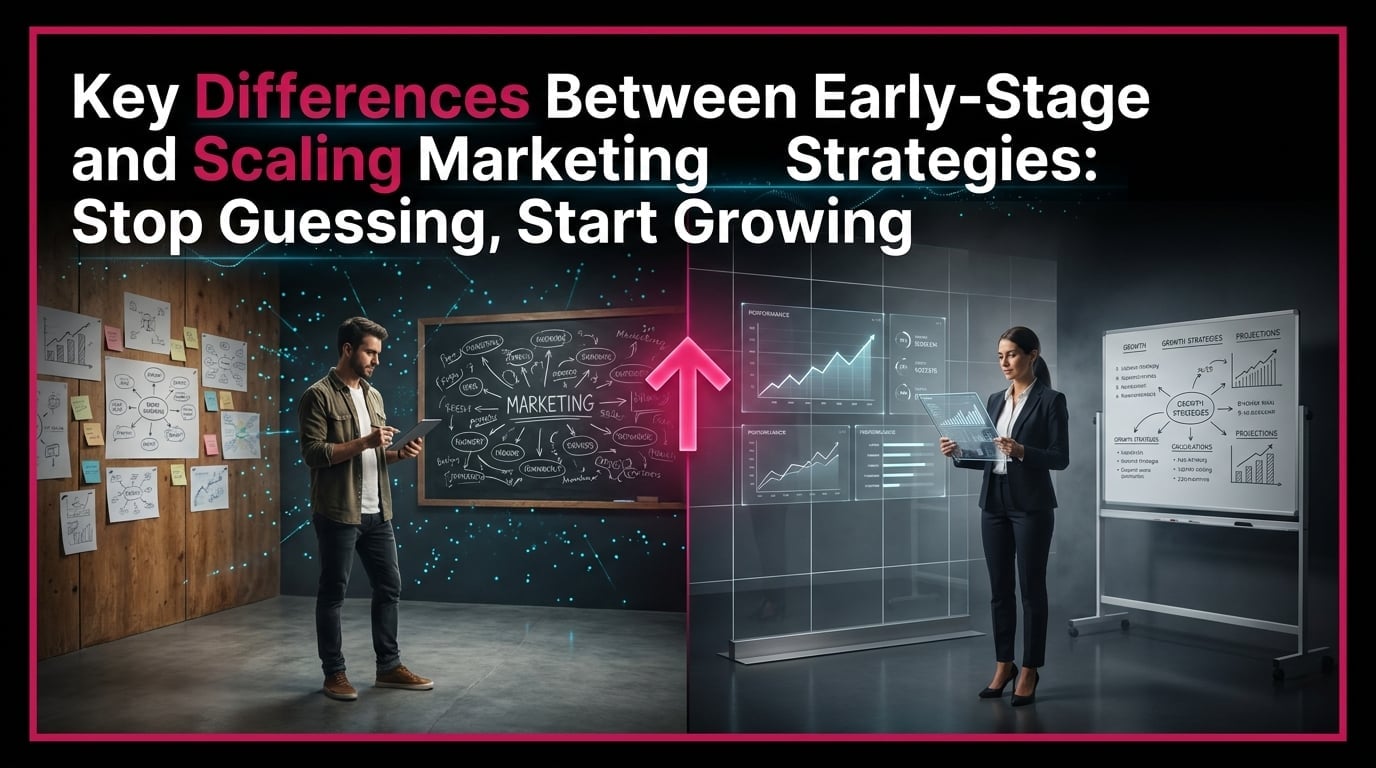
An early stage marketing strategy is a fast, low-cost effort to find what works. A scaling strategy is a system built to repeat and amplify what already works. One is exploration. The other is execution.
Here is the part most articles skip: the tactics that get you to $1M in revenue will actively hurt you at $10M. Not slow you down. Hurt you. That gap is what this article is about.
Why Your Early Stage Marketing Strategy Feels Like Controlled Chaos
Early stage marketing is the practice of running fast, cheap experiments to discover which message, channel, and audience combination produces real customers. It is inherently messy because you are buying information, not results.
You are probably treating every channel as equally worth testing. That costs you focus. Microsoft’s startup blog puts it plainly: before any tactic, you need a customer-centric foundation. Most founders skip that step and wonder why nothing sticks.
The chaos is not a bug. It is the point. You need the chaos to find the signal. The mistake is staying in chaos mode after you have found it.
What Changes When You Shift to a Scaling Marketing Strategy
A scaling marketing strategy is a repeatable system that grows output without proportionally growing cost or effort. It replaces gut feel with documented processes and replaces experiments with optimized channels.
The mindset shift is the hardest part. Early stage rewards speed and improvisation. Scaling rewards consistency and measurement. Franklin Madison describes it well: a scalable strategy allocates resources efficiently and uses data-driven insights to maintain or improve performance as volume grows.
coolest.marketing’s approach to this transition focuses on one core idea: stop consuming tactics, start understanding systems. That shift from reactive to structural thinking is where real growth lives.
Optimizely’s 2025 marketing data shows that 93% of online interactions start with a search engine. Early stage brands ignore SEO because it is slow. Scaling brands invest in it because compounding returns are the whole game.
Real-World Examples: Early Stage Tactics vs. Scaling Strategies
The contrast between early stage and scaling is not theoretical. It shows up in specific decisions made by real companies at real inflection points.
Airbnb’s early stage strategy was manual and scrappy: founders personally photographed listings and cold-emailed Craigslist hosts. That got them to product-market fit. Their scaling strategy became automated onboarding, SEO-driven content, and referral loops. Stripe’s startup marketing guide highlights this pattern: early tactics are about learning, scaling tactics are about leverage.
The trap most teams fall into is scaling tactics before the learning is done. They hire a content team before they know which message converts. They run paid ads before they know their customer acquisition cost. They build before they validate.
Rand Fishkin, founder of SparkToro and Moz, speaking at MozCon 2019: The biggest mistake I see startups make is investing in channels that require scale to work before they have the audience to support them. You cannot SEO your way to product-market fit.
How to Make the Shift: Actionable Steps for Your Early Stage Marketing Strategy
Making the shift from early stage to scaling requires three structural moves, not a mindset poster on the wall.
- Document what worked. Before you scale anything, write down exactly why your best customers converted. Channel, message, offer. If you cannot explain it, you cannot replicate it.
- Kill the experiments that did not win. Scaling means focus. Price Weber’s scaling framework identifies five growth levers: reach, frequency, engagement, conversion, and retention. Pick two. Not five.
- Build feedback loops, not funnels. Bundl’s scaleup guide makes a sharp point: growth loops compound, funnels do not. A referral loop or content loop that feeds itself is worth ten paid campaigns.
coolest.marketing offers frameworks built specifically for marketers navigating this transition in the AI era, where the tools change fast but the strategic logic does not.
Key Takeaways: How to Stop Guessing and Start Growing
The difference between early stage and scaling is not budget or headcount. It is the question you are trying to answer. Early stage asks: what works? Scaling asks: how do we do more of it, reliably?
If you are still running five channels with no clear winner, you are in early stage mode whether you like it or not. 81% of marketers agree that interactive content is a low-cost, high-impact strategy. But only if you already know your audience. Without that, it is just noise.
Your next step: audit your last 90 days of marketing. Find the one channel that produced the most qualified leads. Cut everything else for 30 days. That is not scaling yet. That is getting ready to scale.