AI Anxiety Marketing: Why Your Nerves Are Your Unfair Advantage
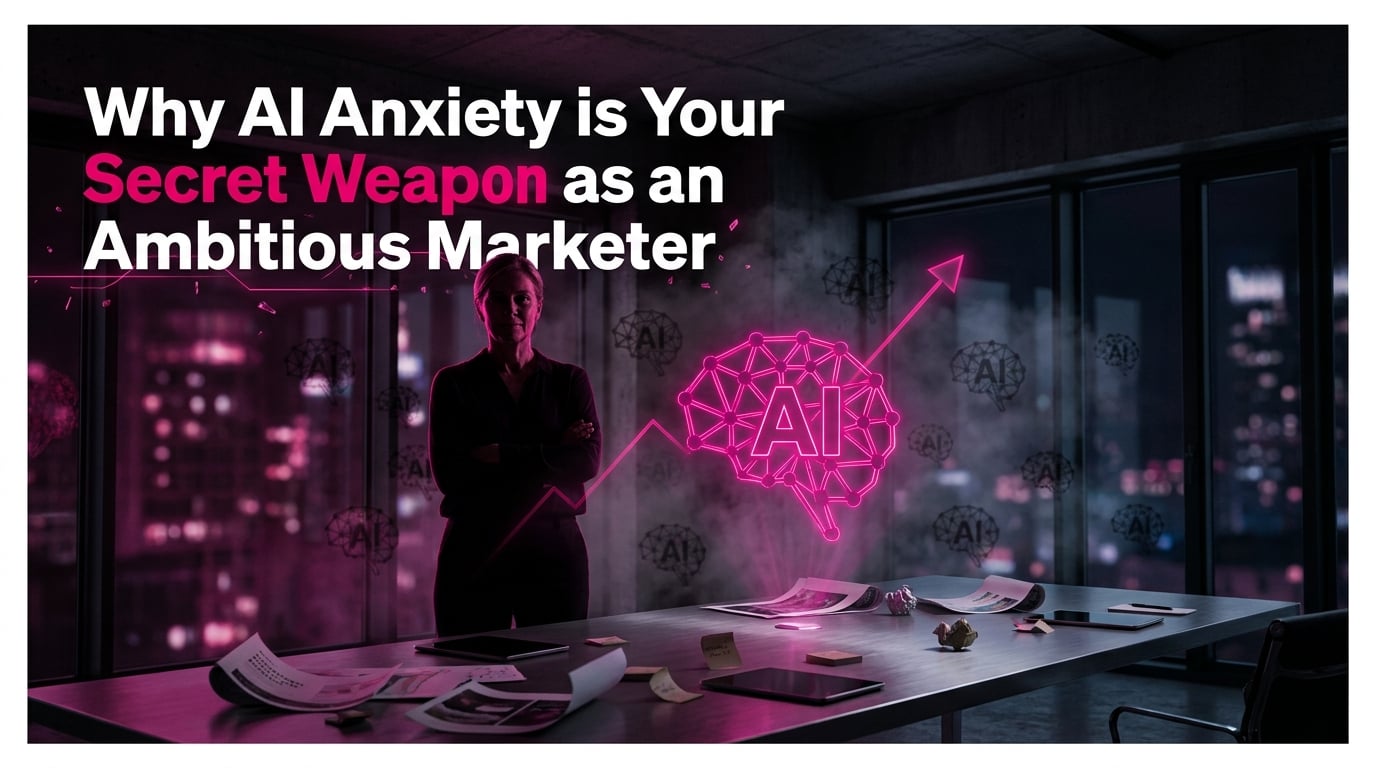
AI anxiety marketing is the experience of feeling threatened, overwhelmed, or uncertain about AI’s impact on your role while still needing to use it daily. Nearly 60% of marketers fear AI could replace them, according to Sales So’s 2025 AI Marketing Statistics report. That number has climbed fast. And yet the marketers who feel that fear most sharply are the ones paying the closest attention. That is not a weakness. That is a signal.
What Is AI Anxiety in Marketing and Why Does It Matter Now?
AI anxiety in marketing is a professional stress response triggered by rapid AI adoption, where marketers feel their skills, roles, or judgment may become obsolete. Most articles treat this as a problem to manage. We think that framing is wrong.
Anxiety means you care about the outcome. It means you are tracking the threat in real time. A ScienceDirect study of 495 marketers found that AI anxiety correlates with lower adoption intent, but only when the anxiety goes unaddressed. Address it, and you get something different: urgency. The marketers who felt the threat earliest moved fastest.
The ones who ignored it? Still waiting for a strategy.
How to Reframe AI Anxiety Marketing as a Growth Catalyst
Reframing AI anxiety marketing means treating your discomfort as diagnostic data, not a personal failing. Your nerves are telling you exactly where the gap is between where you are and where the market is heading.
Here is the framework we use. Call it the Anxiety Audit:
- Name the specific fear. Not “AI will replace me” but “I do not know how to prompt for campaign briefs.”
- Convert it to a skill gap. Vague fear is paralysing. A named skill gap is a to-do list.
- Set a 2-week experiment. Not a course. An experiment. Run one AI-assisted task and measure the result.
As noted in LinkedIn’s guide to conquering AI anxiety, avoiding AI entirely widens the knowledge gap and creates a self-fulfilling prophecy. The audit breaks that loop by making the fear specific enough to act on.
Real-World Frameworks: Turning Discomfort Into Decisive Action
Decisive action in the context of AI anxiety marketing means converting your discomfort into a structured learning habit, not a one-time course binge. The marketers who win are not the ones who took the most courses. They are the ones who built a weekly practice.
Paul Roetzer, Founder and CEO of Marketing AI Institute, speaking at the 2024 Marketing AI Conference: AI is not going to replace marketers, but marketers who use AI will replace marketers who do not. The question is not whether to adopt, it is how fast you can build the habit.
Roetzer’s framing matters because it shifts the question from threat to tempo. Speed of learning is the actual competitive variable. UC Berkeley’s California Management Review identifies “rate of learning” as one of four pillars of AI competitive advantage, alongside data, digital core, and capability depth.
coolest.marketing’s approach to this challenge is built around exactly that principle. Their marketing courses for the AI era are structured for working marketers, not students, with a focus on applied thinking over tool tutorials. That distinction matters when your goal is speed, not certification.
Case Study: Marketers Who Leveraged AI Anxiety for Career Breakthroughs
A real career pivot driven by AI anxiety looks less like a dramatic leap and more like a series of small, deliberate bets made while still uncomfortable. One documented example: a marketing manager who transitioned to an AI product manager role at 38, detailed on Medium by the author themselves, credited the move entirely to acting on anxiety rather than waiting for certainty.
The pattern is consistent. National University’s 2026 analysis of AI’s impact on marketing careers found that the roles growing fastest are hybrid roles combining marketing judgment with AI fluency, not pure AI roles and not traditional marketing roles.
Anxiety pushed people toward the hybrid. Comfort kept others in the shrinking middle.
Key Takeaways: Action Steps for Ambitious Marketers
AI anxiety marketing, when treated as a signal rather than a symptom, becomes the most reliable early-warning system you have for where to invest your attention next. MIT Sloan Management Review argues that lasting differentiation comes from human creativity, not AI access, because access is commoditised fast. Your anxiety is protecting that creative edge by keeping you honest about the gap.
Here is what to do this week:
- Run the Anxiety Audit. Name one specific fear, convert it to a skill gap, schedule one experiment.
- Track your rate of learning, not your tool count. One new AI application per week compounds faster than ten courses per quarter.
- Find a community that takes this seriously. coolest.marketing offers structured learning for marketers navigating exactly this moment, built around Israel’s marketing and tech intersection, where the pressure to adapt is not theoretical.
Your anxiety is not the problem. Sitting with it and doing nothing is.