How Hyper-Personalization is Transforming Inbound Marketing Frameworks: Strategies, Tools, and Actionable Steps for 2026
Key Takeaways: What Marketers Need to Know About Hyper-Personalization in Inbound Marketing
- Hyper-personalization uses real-time data, AI, and behavioral signals to deliver 1:1 experiences at scale, going far beyond basic segmentation.
- Brands using advanced personalization generate 40% more revenue than those relying on standard approaches, according to McKinsey & Company.
- Traditional inbound frameworks (Attract, Engage, Delight) need a data layer and AI integration to stay effective in 2026.
- The right tech stack, clean data, and a clear measurement plan are non-negotiable starting points.
- Privacy compliance is not optional. GDPR and CCPA requirements shape every personalization decision you make.
What Is Hyper-Personalization in Inbound Marketing and Why Does It Matter?
Hyper-personalization in inbound marketing is the practice of using real-time behavioral data, AI-driven insights, and dynamic content to deliver individually tailored experiences across every touchpoint in the customer journey. It goes beyond using a first name in an email subject line.
Standard personalization groups people into segments. Hyper-personalization treats each visitor as a segment of one. It factors in browsing history, purchase behavior, content consumption patterns, CRM data, and live session signals to serve the right message at the exact right moment.
Why does this matter right now? Because buyers expect it. Salesforce’s State of the Connected Customer report found that 73% of customers expect companies to understand their unique needs and expectations. Generic content no longer converts the way it once did.
For inbound marketers, this shift is significant. Your framework was built to attract, engage, and delight. Hyper-personalization doesn’t replace that model. It supercharges it with a data and AI layer that makes every interaction feel intentional.
How Are Inbound Marketing Frameworks Evolving with Hyper-Personalization?
The inbound marketing framework is evolving from a linear funnel model into a dynamic, data-responsive loop where every stage adapts in real time based on individual user signals. The classic Attract-Engage-Delight flywheel still applies, but the engine powering it has changed.
Here is how each stage is being reshaped:
Attract: From Broad Audiences to Intent-Based Targeting
Traditional inbound attracts traffic through SEO, social, and content. Hyper-personalized inbound layers in predictive intent data. Tools like Bombora and G2 Buyer Intent identify which companies are actively researching your category right now. You serve targeted content before they even land on your site.
Engage: From Static Pages to Dynamic Experiences
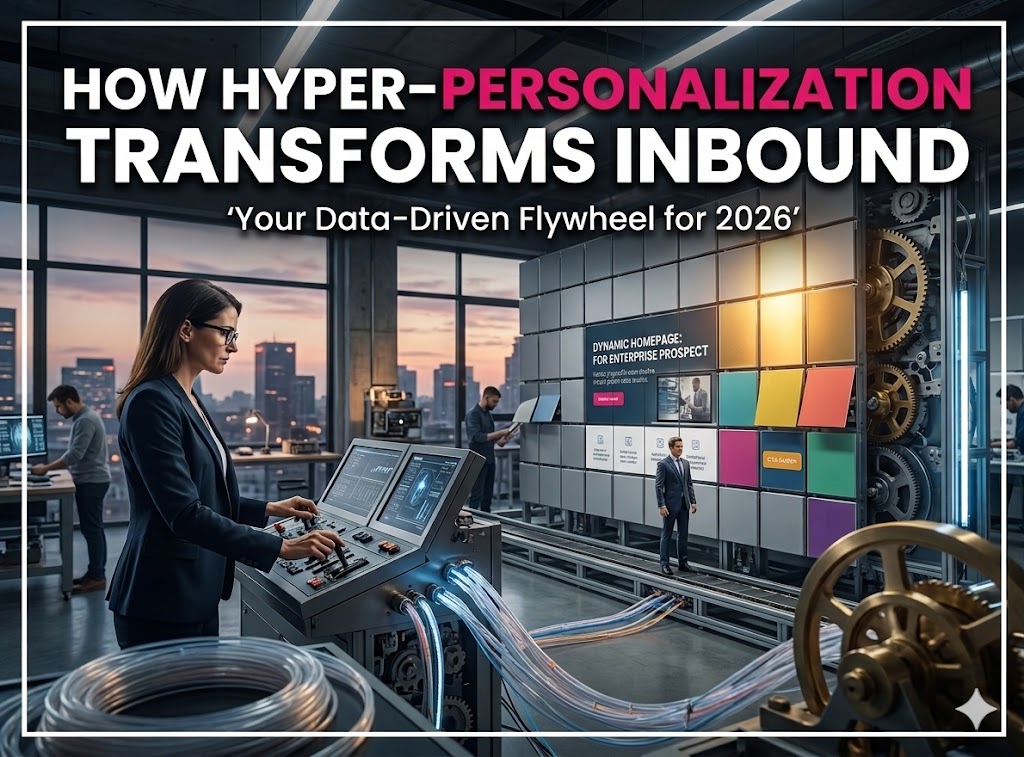
Your website homepage should not look the same to a first-time visitor as it does to a returning enterprise prospect. Dynamic content platforms swap out headlines, CTAs, and offers based on firmographic data, past behavior, or CRM stage. HubSpot Research reports that personalized CTAs convert 202% better than default versions.
Delight: From Generic Nurture to Predictive Lifecycle Marketing
Post-purchase delight used to mean a thank-you email sequence. Now it means AI-driven recommendations, proactive support triggers, and loyalty content that predicts what a customer needs before they ask. This is where customer journey personalization creates measurable retention gains.
Which Technologies and Tools Enable Hyper-Personalized Inbound Marketing Today?
The technology stack for hyper-personalization in inbound marketing includes four core layers: data collection, AI analysis, content delivery, and measurement. Each layer must connect cleanly to the others for the system to work.
Data and CDP Layer
A Customer Data Platform (CDP) unifies first-party data from your CRM, website, email platform, and ad channels into a single customer profile. Platforms like Twilio Segment and Adobe Real-Time CDP make this possible without a data engineering team. Without a unified data layer, personalization is guesswork.
AI and Predictive Analytics
AI marketing automation tools analyze behavioral patterns and predict the next best action for each contact. Platforms like Salesforce Einstein, Marketo Engage, and HubSpot’s AI tools now offer predictive lead scoring, churn risk flags, and content recommendations built into their core products.
Dynamic Content and Personalization Engines
Tools like Optimizely, Mutiny, and HubSpot Smart Content let you swap website copy, images, and CTAs based on visitor attributes in real time. These platforms connect directly to your CDP or CRM so personalization rules fire automatically. No developer needed for most use cases.
Conversational AI and Chat
AI-powered chat tools like Drift and Intercom now route conversations, qualify leads, and serve contextual content based on a visitor’s CRM history and current page behavior. A returning prospect who read your pricing page twice gets a different chat experience than a cold first-time visitor.
How to Adapt Your Inbound Marketing Framework for Hyper-Personalization: Step-by-Step Guide
Adapting your inbound marketing framework for hyper-personalization starts with a data audit, not a technology purchase. Most teams buy tools before fixing their data, which guarantees poor results.
Follow these six steps to build a working personalized marketing strategy:
- Audit your first-party data. Map every data source you own: CRM, email platform, website analytics, support tickets, purchase history. Identify gaps and inconsistencies before connecting anything to a personalization engine.
- Define your personalization signals. Decide which data points will trigger different experiences. Common signals include: industry, company size, lifecycle stage, pages visited, content downloaded, and time since last purchase.
- Segment by intent, not just demographics. Build behavioral segments based on what people do, not just who they are. A VP of Marketing who visited your pricing page three times this week is a different segment than one who read a single blog post six months ago.
- Map personalized content to each journey stage. For each segment and stage, define the specific content, CTA, and offer that will be served. Build a content matrix. This step reveals content gaps before you go live.
- Implement incrementally. Start with one high-traffic page or one email nurture sequence. Prove the model works before scaling. Teams that try to personalize everything at once typically personalize nothing well.
- Connect your measurement framework first. Define your KPIs before you launch. If you cannot measure it, you cannot improve it. Set baseline conversion rates now so you have a clear before-and-after comparison.
Real-World Case Studies: Successful Hyper-Personalization in Action
Real-world hyper-personalization results prove that this approach drives measurable revenue gains, not just engagement metrics. These two examples show what is possible with the right framework in place.
Case Study 1: SaaS Company Reduces Churn by 28% with Predictive Lifecycle Emails
A mid-market SaaS company integrated their product usage data with HubSpot to trigger personalized email sequences based on in-app behavior. Users who had not used a key feature within 14 days of signup received a tailored onboarding sequence tied to their specific use case. Churn dropped 28% in 90 days. The key was connecting product data to the marketing platform, something most teams never do.
Case Study 2: B2B Manufacturer Increases Lead-to-MQL Rate by 34% with Dynamic Landing Pages
A B2B industrial manufacturer used Mutiny to serve industry-specific landing page versions to traffic from paid campaigns. Visitors from the healthcare sector saw healthcare-specific case studies and compliance messaging. Visitors from manufacturing saw ROI calculators and uptime data. Lead-to-MQL conversion improved by 34% within 60 days of launch. No new ad spend required.
Measuring Success: Key KPIs and Metrics for Hyper-Personalized Inbound Campaigns
Measuring hyper-personalization in inbound marketing requires tracking both engagement signals and downstream revenue impact. Vanity metrics like page views tell you nothing about whether personalization is working.
Track these KPIs across your personalized marketing strategy:
- Segment-specific conversion rates: Are personalized segments converting at higher rates than your baseline? This is your primary proof point.
- Time to conversion: Hyper-personalization should shorten the sales cycle. Track days from first touch to MQL, SQL, and closed-won by segment.
- Content engagement depth: Scroll depth, video completion rate, and return visit frequency tell you whether personalized content is resonating.
- Email engagement by segment: Open rate and click-to-open rate by behavioral segment, not just by list. A 22% open rate average hides the fact that one segment converts at 45% and another at 8%.
- Customer lifetime value (CLV) by personalization tier: Are customers who received hyper-personalized experiences worth more over time? Harvard Business Review research consistently links personalization investment to CLV growth.
- Attribution by touchpoint: Use multi-touch attribution to understand which personalized interactions drove pipeline, not just the last click.
Gartner research shows that brands with mature personalization programs see up to 15% more efficient marketing spend compared to those using basic segmentation. That efficiency shows up in your cost-per-acquisition numbers within one to two quarters.
Expert Insights: Tips and Common Pitfalls When Implementing Hyper-Personalization
The biggest mistake marketers make with hyper-personalization is treating it as a technology project instead of a strategy project. The tools are the easy part. The hard part is deciding what to personalize, for whom, and why.
“Hyper-personalization fails when teams focus on what the technology can do rather than what the customer actually needs. Start with the customer problem you are solving, then find the data and tools that address it. Reverse-engineering from a tool purchase almost always produces noise, not signal.”
Rand Fishkin, Co-Founder, SparkToro
Tip 1: Start with Zero-Party Data
Zero-party data is information customers voluntarily share with you: quiz answers, preference centers, onboarding surveys. It is the highest-quality personalization signal you can get and carries zero privacy risk. Build preference collection into your onboarding flow before investing in complex behavioral tracking.
Tip 2: Avoid the Creepy Line
Personalization becomes a liability when it feels like surveillance. Pew Research Center found that 79% of Americans are concerned about how companies use their data. Use personalization to be helpful, not to demonstrate how much you know. There is a meaningful difference between “Here is a resource on the topic you researched” and “We noticed you visited our pricing page at 11pm on Tuesday.”
Tip 3: Don’t Skip the Privacy Compliance Checklist
Every personalization decision has a compliance dimension. GDPR requires lawful basis for processing. CCPA requires opt-out mechanisms for data sales. Build your consent and data governance framework before you build your personalization rules. A compliance failure can cost more than your entire personalization program budget.
Common Pitfall: Personalizing Without Enough Data
Personalizing a segment of 12 contacts is not statistically meaningful. You need sufficient volume in each segment to draw conclusions and run valid A/B tests. As a rule of thumb, aim for at least 500 contacts per segment before treating conversion data as reliable. Small segments produce misleading results that send you in the wrong direction.
Quick Answer: How Can Marketers Future-Proof Their Inbound Strategies with Hyper-Personalization?
Future-proofing your inbound marketing framework with hyper-personalization means building on first-party data, investing in AI tools that integrate with your existing stack, and treating personalization as an ongoing program, not a one-time campaign.
Third-party cookies are gone. Paid reach is more expensive every year. The marketers who win in 2024 and beyond are the ones who own their audience data and use it to create experiences that earn attention rather than buying it.
Three actions to take right now:
- Audit your first-party data this week. You cannot personalize what you do not know. Pull a report from your CRM and identify the top five data fields that are incomplete or inconsistent.
- Pick one high-traffic page and run a dynamic content test. Use HubSpot Smart Content, Mutiny, or a similar tool to serve two different versions based on a single signal (new vs. returning visitor, or industry). Run it for 30 days and measure conversion rate by version.
- Build a preference center into your next email campaign. Ask subscribers what topics they care about and what cadence they prefer. Use those answers to segment your list immediately. This is the fastest way to improve email performance without new technology.
Hyper-personalization in inbound marketing is not a future trend. It is the current standard for teams that want to grow efficiently. The framework is available to you today. The only question is how quickly you build it.