Why Failure Stories in Course Design Hook Non-Beginner Learners Instantly
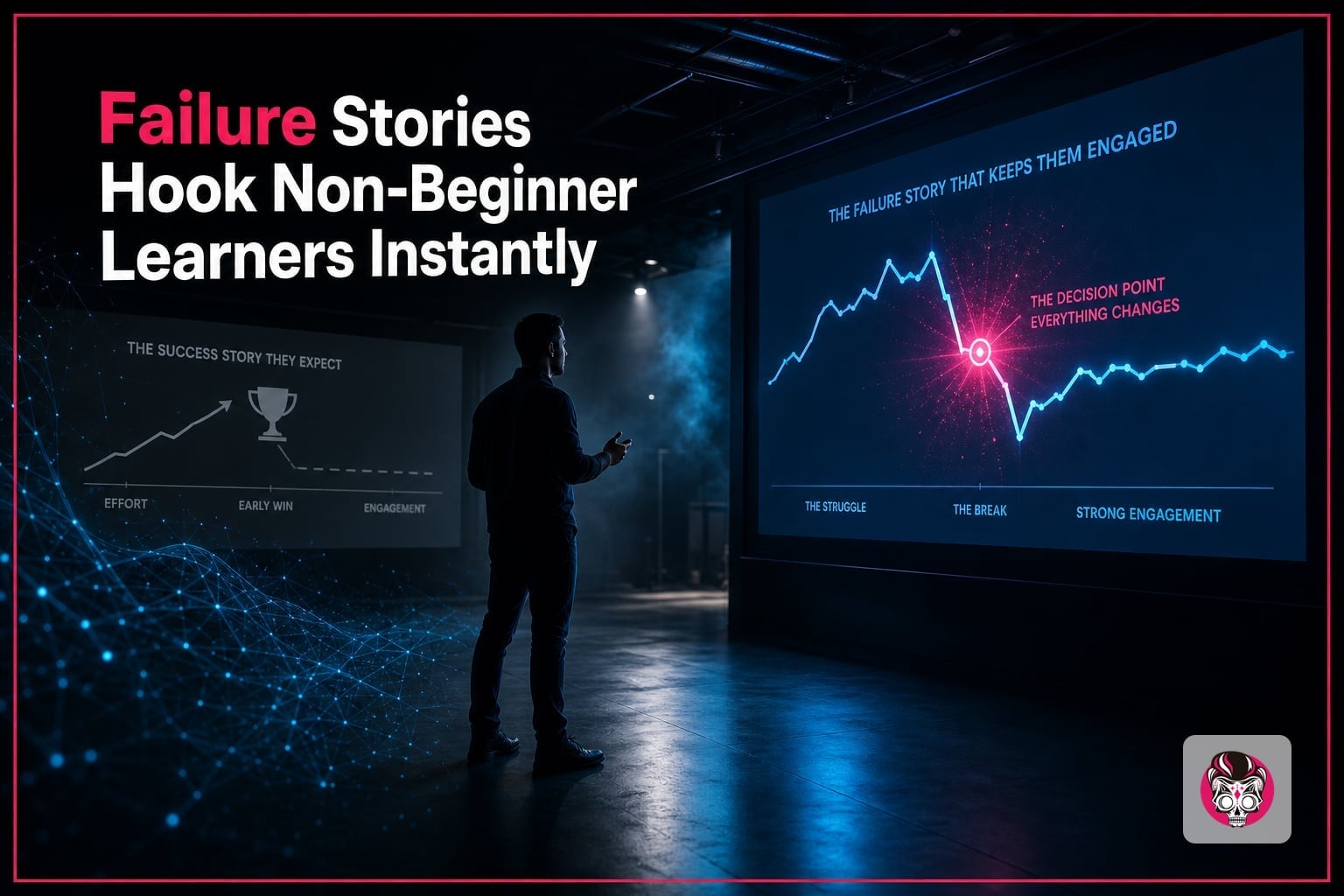
Failure stories in course design are not motivational decoration. For experienced learners, they are a credibility signal. Open with a polished success framework and you lose them in the first five minutes. Open with a real, specific failure and you earn their attention for the rest of the course.
Key Takeaways
- Advanced learners disengage from success-story openers because they have already seen them.
- A failure story in the first five minutes shifts learners from passive observers to active problem-solvers.
- The failure must connect directly to a decision point the learner will actually face.
- Structure matters: Opening Hook, Failure Story, Decision Point Bridge.
- Failure stories signal content quality before a single concept is taught.
Why Non-Beginners Tune Out (and What Failure Stories Fix)
Non-beginner course disengagement happens when experienced learners recognize recycled content within the first few minutes and mentally check out, often permanently. Failure stories break that pattern by presenting a situation the learner has not already solved.
You have probably opened your course with a win. A case study where everything worked. A framework that delivered results. Here is the problem: your advanced learner has heard that story before. They have lived a version of it. It does not create tension. It creates boredom.
Inside Higher Ed documented a professor who made 5% of students’ final grades dependent on their “quality of failure.” The result: students took more risks and engaged more deeply in discussions. That is not a coincidence. Failure creates the cognitive friction that keeps experienced minds switched on.
We can learn from our missteps if we put our failures in context, learn how to pivot, and encourage sharing our failures with others.
John Inazu, Professor of Law and Religion, Washington University in St. Louis, writing in Learning from Failure on Substack
Non-beginners are not looking for inspiration. They are looking for proof that you understand the real terrain. A failure story delivers that proof instantly.
Failure Stories in Course Design: The Structural Opening That Changes Everything
Failure stories in course design function as a structural reframe: placing a specific, real failure in the first five minutes repositions the learner from passive observer to active problem-solver before a single concept is introduced.
Here is the contrast that matters. A beginner course can open with a destination: “Here is what success looks like.” An advanced course cannot. Your learner already knows what success looks like. What they do not know is why smart people still fail to get there. That gap is where your failure story lives.
The framework is three moves:
- Opening Hook: A specific, named situation that went wrong.
- Failure Story: What decision was made, why it seemed reasonable, and what broke.
- Decision Point Bridge: “You will face this exact moment in Module 3. Now you know what not to do.”
Dr. Luke Hobson documented a scenario-based learning failure at a university where the problem type was so generic it “went against everything that makes SBL great.” His analysis showed that vague, low-stakes scenarios produce disengagement. Real failure stories do the opposite because they carry authentic stakes.
coolest.marketing’s approach to advanced course design is built on this principle: experienced learners in the AI era need operator-level frameworks, not polished narratives. The failure story is the fastest way to prove you are operating at that level.
From Story to Action: Turning Failure Stories in Course Design into a Learning Engine
A failure narrative earns its place in course design only when it connects directly to a decision the learner will face. Without that link, it is entertainment, not instruction.
Picture this: You are three minutes into an advanced marketing course. The instructor describes a real product launch, names the brand, and walks through exactly why the campaign collapsed despite a strong strategy. Then they say: “In Module 4, you will build a launch plan. This is the decision point where most experienced marketers make the same mistake.”
That is a learning engine. The failure story is no longer an anecdote. It is a thread that pulls the learner forward.
Victor Lombardi’s “Why We Fail” makes the case that examining failure in design produces faster, deeper learning than studying success alone. The mechanism is simple: failure forces the learner to ask “why was that wrong?” and that question drives new insight.
According to Passion.io’s retention benchmarks, education app retention drops to just 2-3% by Day 30. Courses that create forward tension from minute one retain learners longer because each module feels like a continuation, not a restart.
coolest.marketing courses are structured around this active implementation model: every failure story opens a loop that the learner closes through their own work, with ongoing instructor access to course-correct in real time.
See How Real Operators Build Courses Experienced Learners Actually Finish
Explore coolest.marketing’s course design approach and discover how failure-first structure, real operator frameworks, and continuous instructor access combine into courses your advanced learners will not abandon by week two.