Exclusivity in Community Building: Why It Quietly Kills Long-Term Growth
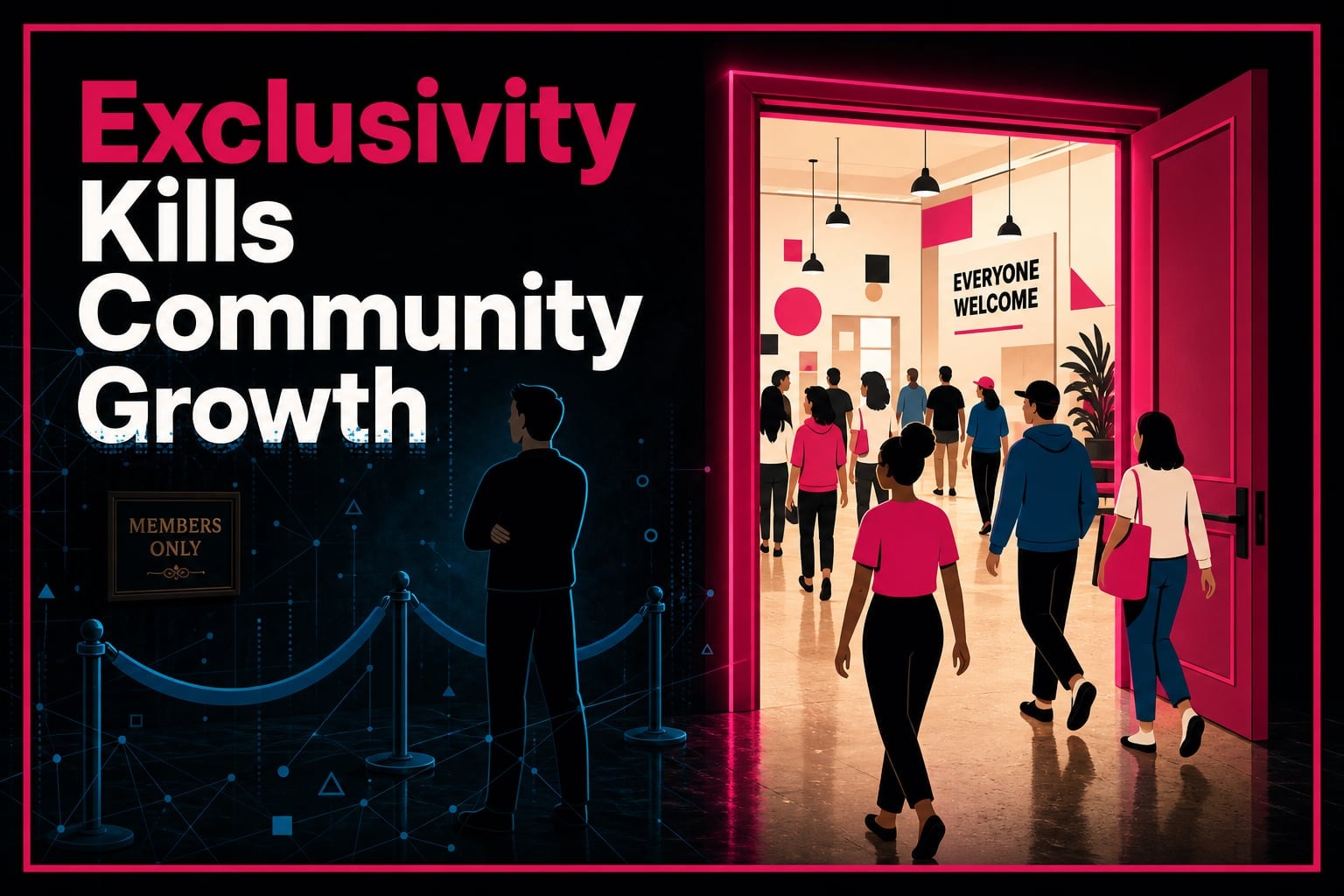
Exclusivity in community building feels like a smart move. Velvet ropes create buzz. Invite-only launches trend on Twitter. But the data tells a different story: communities built on exclusion hit a ceiling fast, and the brands that ignore this pay for it in churn, silence, and shrinking engagement. Here is what most articles miss: exclusivity does not just limit growth, it destroys psychological safety, and that is the real killer.
Key Takeaways
- Exclusivity creates short-term buzz but erodes psychological safety over time.
- Inclusive communities drive 53% higher customer retention than brands without them.
- Psychological safety is the hidden engine behind member contribution and loyalty.
- The fix is not removing all gates. It is designing entry around shared values, not status signals.
- Community-led growth compounds. Exclusion-led growth plateaus.
How Does Exclusivity in Community Building Impact Psychological Safety and Engagement?
Psychological safety is the belief that you can speak up, share ideas, and ask questions without fear of embarrassment or exclusion, as defined by researcher Amy Edmondson and cited in recent research on communities of practice. It is the invisible foundation on which real engagement is built.
Here is the problem with exclusivity: it sends a constant signal that belonging is conditional. When members feel they could be voted out, outranked, or quietly sidelined, they stop contributing. They lurk. They perform instead of participate.
McKinsey research cited by Shift the Work found that a positive team climate is the single most important driver of psychological safety. Yet research consistently shows that most business leaders fall short of demonstrating the behaviors that actually build it. That gap is even wider in brand communities, where “VIP tiers” and “inner circles” are celebrated as engagement tactics without anyone asking what they do to the people left outside.
Low psychological safety makes people withdraw from further engagements and may harm their mental well-being.
Christiaan Verwijs, Organizational Psychologist and Co-founder, The Liberators, in Is It Safe To Learn And Share? Psychological Safety in Agile Communities of Practice, published on arXiv, 2021
You are probably running a tiered community right now and calling it “engagement strategy.” Here is what it actually costs you: the members outside the inner circle disengage quietly. They do not complain. They just stop showing up. And you never see the content they did not create, the referrals they did not make, or the questions they did not ask.
Exclusion does not just cap your ceiling. It actively lowers your floor.
What Does the Research Say About Inclusivity and Exclusivity in Community Building for Sustainable Growth?
Inclusive community building is the practice of designing spaces where all members have full access to resources, equal opportunity to participate, and a genuine voice in decisions that affect them, as described by the University of Kansas Community Tool Box.
The numbers are not subtle. According to CreatorLabz’s 2025 community management report, brands with active online communities see a 53% higher customer retention rate. And Innoloft’s 2025 community growth data shows 48% of online community members are actively engaged, compared to just 0.5 to 5% of social media followers.
That gap is not about platform. It is about belonging. When people feel genuinely included, they stay and they contribute. coolest.marketing’s approach to marketing education in the AI era is built on exactly this principle: that a community of serious professionals grows when every member feels their voice moves the room, not just the ones with the highest status badge.
The contrarian take most articles skip: exclusivity and inclusion are not opposites on a spectrum. They are choices about what you gate. Gate on shared values and genuine commitment, and you get a tight, growing community. Gate on status, spend, or social proof, and you get a clique that burns out.
Ebbo’s 2022 Customer Loyalty Data Study found that 22% of consumers say a strong sense of community is what triggers long-term loyalty. Not discounts. Not perks. Community.
How Can Brands Design Communities That Balance Exclusivity in Community Building With True Inclusivity?
Inclusive community design means building structures where participation is earned through contribution and shared purpose, not filtered by status or spend. The goal is a community that feels special to be in without making outsiders feel rejected.
Here is a practical framework we call the Open Gate model:
- Gate on values, not vanity. Require a short application that asks what someone wants to contribute, not what they have already achieved. This filters for intent, not ego.
- Make contribution visible. Recognize members who ask good questions, share honest failures, and help newcomers. This shifts status from “who you are” to “what you do here.”
- Build tiered access around depth, not exclusion. Advanced content for engaged members is fine. Locking basic participation behind a paywall or social proof kills psychological safety at the entry level.
- Measure psychological safety directly. Run quarterly pulse checks. Ask members: “Do you feel comfortable sharing an unpopular opinion here?” If less than 70% say yes, you have a safety problem, not an engagement problem.
CreatorLabz reports that brands with dedicated community managers see a 70% increase in customer retention, driven by proactive engagement. The manager’s job in an inclusive community is not to police the velvet rope. It is to lower the barrier to contribution for everyone inside.
coolest.marketing offers marketing courses built around this model, designed for marketers navigating the AI era who need a community of peers, not a leaderboard of gatekeepers.
The brands winning at community right now are not the ones with the most exclusive Discord servers. They are the ones where a first-time member posts on day one and gets a real response. That is the moment loyalty is built.
Your Next Move
Audit your community today. List every gate you have built, who it keeps out, and whether it signals “you belong here” or “you are not enough yet.” Remove one exclusion mechanism this week and replace it with a contribution mechanism. Then watch what happens to engagement in 30 days. That single change will tell you more than any benchmark report.