Why Doing More Is the Trap That Keeps Executional Marketers Stuck
Here’s the uncomfortable truth: the strategic vs executional marketing gap is why some marketers get promoted and others just get busier. You’re launching more campaigns, testing more channels, shipping more content. Yet the needle barely moves, and you’re not sure why.
Key Takeaways
- Busier isn’t better: more campaigns without direction just spends budget faster, it doesn’t compound results.
- The real shift is a question, not a title: strategic marketers ask “should we?” before “how do we?”
- Three questions change everything: who exactly, why now, and what would prove success, answered before execution starts.
- This is learnable now: you don’t need a new job title or ten more years to think this way.
Why Busier Marketers Rarely Get Better Results
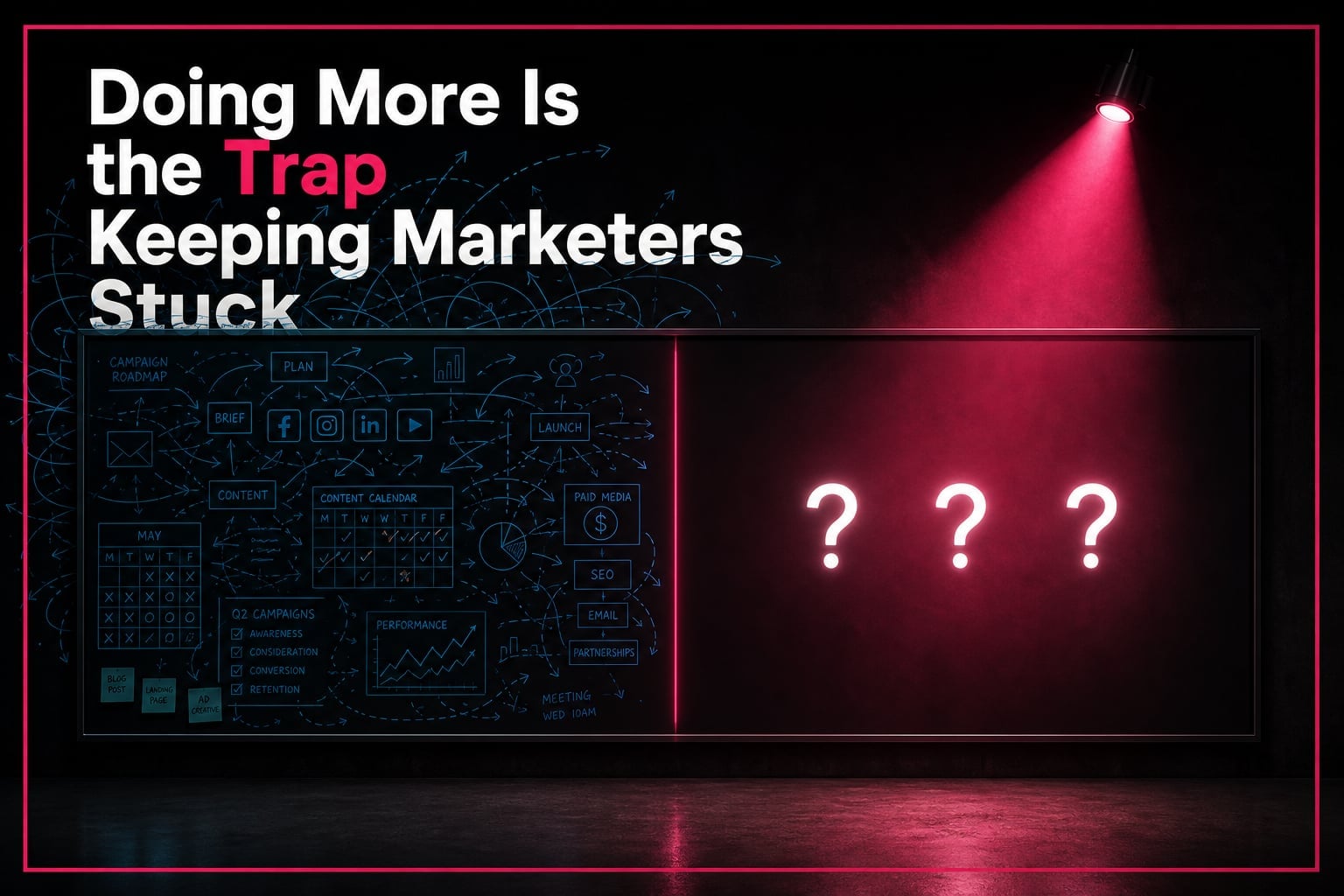
The executional trap is doing more marketing activity (more campaigns, channels, content) without a strategic filter for which of those actions is worth doing. Output goes up. Outcomes don’t follow.
You know this feeling. You add a channel because a competitor is on it. You launch a campaign because the calendar says it’s time, not because a customer insight demands it. Each move feels productive. None of them compound.
This isn’t just a vibe. Budget efficiency data from Gartner’s CMO Spend Survey shows marketing leaders are under constant pressure to prove ROI on every dollar, and volume without direction is exactly where that proof falls apart. More activity just means more places for waste to hide.
Here’s the part that stings: doing more without a strategic filter doesn’t just fail to help. It actively burns the budget you’d need for the thing that actually works. Every hour spent executing the wrong tactic is an hour not spent finding the right one. That’s the trap. It looks like progress. It’s actually a treadmill.
What Strategic Marketers Do Instead of Just Executing
Strategic marketers spend more time deciding whether to act than deciding how to act, and that single habit changes every decision downstream. Executional marketers ask “how do we run this campaign?” Strategic marketers ask “should this campaign exist at all?”
That’s not a subtle difference, and it’s worth sitting with for a second.
Picture two marketers given the same brief: launch a new product line. The executional marketer opens a project tracker and starts assigning channels. The strategic marketer opens a blank page and asks who this product is really for, why now, and what would have to be true for it to work.
Only 22% of marketers say their strategy and execution are fully integrated, according to SeoProfy’s 2026 digital marketing statistics. That gap is the whole problem. It’s why teams ship a lot and still feel lost. If you’ve ever felt stuck picking between three equally “fine” campaign ideas with no real way to choose, that’s not a creativity problem, that’s a framework problem, and it’s covered in depth in why high-performing marketers get stuck on decisions.
Strategic thinking isn’t smarter people having better ideas. It’s a sequence: define the problem, question the assumption, then execute. Skip step one and step three eats your whole calendar for nothing.
How to Switch Modes Before You Launch Your Next Campaign
Making the shift to strategic marketing means answering three questions before any execution begins: who exactly, why now, and what would prove success. You don’t need a promotion to start. You need five minutes before your next brief.
Picture this: your team wants to launch a Q3 campaign. Old habit: pick a channel, write the brief, book the budget. New habit: stop and answer three things first.
Who exactly is this for? Not “small business owners.” Which ones, doing what, feeling what friction, right now?
Why now? What changed that makes this the right moment, not three months ago or three months from now?
What would success prove? Not “more leads.” What number, by when, that tells you this was worth doing at all?
If you can’t answer all three in under ten minutes, you’re not ready to execute yet, and that’s fine. That’s the whole point. It’s cheaper to sit with the question for ten minutes than to run a campaign for six weeks on a guess. This is doubly true now: AI tools can help you draft the campaign, but they can’t answer these three questions for you, which is exactly the strategic clarity gap AI can’t close.
Stop guessing. Start understanding. That’s the mode switch, and it’s learnable in one planning cycle, not one career.
Want a second opinion on where your own marketing sits on the strategic vs executional line? coolest.marketing offers expert sessions built around exactly that question. Explore the guide and see where your next campaign actually stands before you build it.