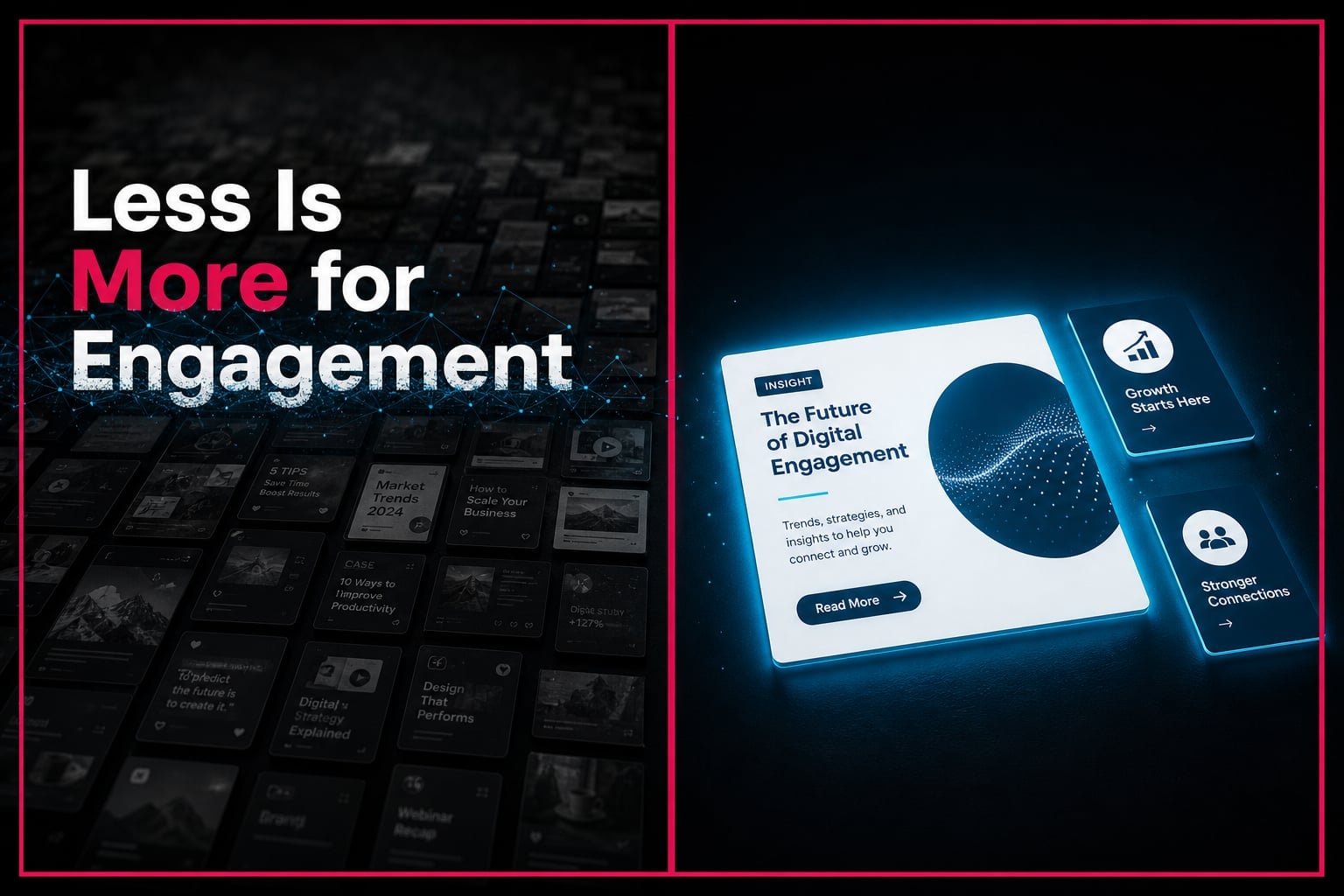
Paradox of Choice Content Strategy: Why Less Is More for Engagement
More content is not the same as better content. The paradox of choice content problem is real: when you give your audience too many options, they stop choosing altogether. The fix is not a bigger content calendar. It is a sharper one. Fewer pieces, stronger focus, deeper engagement. That is the whole argument.
Key Takeaways
- Too many content options trigger decision fatigue and reduce audience engagement.
- Behavioral science backs this: consumers shown 6 jam options bought at a 40% rate vs. 3% for 24 options.
- Metro cut articles by 45% and saw a 35% increase in overall traffic.
- The solution is a content filter, not a content factory.
- Fewer, sharper pieces build more trust than a bloated library.
How the Paradox of Choice Content Problem Actually Works
The paradox of choice is a concept introduced by psychologist Barry Schwartz: the more options people face, the less satisfied they feel with any decision they make, because more choice demands more cognitive effort and generates more regret. You are probably thinking this applies to product pages, not content. That is where most strategies go wrong.
Your audience is making a micro-decision every time they land on your blog, your feed, or your resource hub. Ten articles on the same topic. Three newsletters this week. Fifteen videos in a playlist. The brain reads that as noise, not value.
Learning to choose is hard. Learning to choose well is harder. And learning to choose well in a world of unlimited possibilities is harder still, perhaps too hard.
Barry Schwartz, Professor of Psychology, Swarthmore College, from his book The Paradox of Choice: Why More Is Less
The behavioral data is unambiguous. In a classic jam study, consumers were more likely to buy when offered 6 jams (40% conversion) versus 24 jams (3% conversion). A 13x difference. The same cognitive mechanic plays out when your audience faces a wall of content and quietly bounces.
The gap no one else is naming: most content strategy advice focuses on producing more. More formats, more platforms, more frequency. But the paradox of choice shows that abundance limits freedom rather than expanding it. More content can actively cost you the engagement you are chasing.
What Real Brands Learn From Paradox of Choice Content Reduction
Reducing content volume means deliberately publishing less so each piece carries more weight, earns more attention, and builds more trust than a high-frequency library ever could.
This is not theory. Metro, the media brand, was publishing an average of nine to ten articles per person daily, and roughly 50% of that content was not being read at all, according to WordPress VIP’s analysis of the publisher’s strategy shift. They cut their article count by 45%. The result: a 35% increase in overall traffic.
Fewer pieces meant readers could actually find what mattered. The signal got louder when the noise got quieter.
This is where coolest.marketing’s approach stands out. Rather than building content libraries for marketers to scroll through, the platform combines courses, advisory access, and community in one focused experience. The philosophy: curated ecosystems of people, knowledge, and interaction outperform endless content dumps every time.
Optimizing existing content compounds the effect. A Moz case study found that 41.46% of re-optimized articles received more URL clicks for their target keyword, and McKinsey research cited in the same source found that improving content relevance and engagement increases B2B revenue by 5% to 10%.
The lesson: you do not need more. You need better, and you need less of it.
How to Build a Fewer-but-Better Content Strategy That Drives Engagement
A fewer-but-better content strategy is a deliberate framework for cutting content volume while increasing the quality, relevance, and specificity of every piece you publish, so each one earns attention rather than competing for it.
Here is how to run it in four steps.
1. Audit with ruthlessness. Pull your last 12 months of content. Flag everything with below-average engagement or traffic. Those pieces are noise. Archive them or consolidate them into one strong piece.
2. Pick one core question per content cycle. What is the single thing your audience most needs to understand right now? Write one great piece on that. Not five average ones.
3. Match format to context. A deep-dive article serves search intent. A short video serves social. Do not post the same thing everywhere and call it strategy. Platform-specific content consistently outperforms content posted identically across all channels, because each platform rewards different behaviors.
4. Measure depth, not volume. Time on page, return visits, replies, and direct messages tell you more than raw impressions. Those are the signals that show real engagement.
Marketers using this approach at coolest.marketing focus on fewer, sharper content moves built for the AI era, where clarity and curation beat volume every time.
Research shows 43% of employees miss important information due to sheer content volume. Your audience faces the same problem. Give them less to ignore.
Your next step is simple. Open your content analytics right now. Find the bottom 30% of pieces by engagement. Cut or consolidate. Then write one thing this week that answers one specific question better than anything else online. That is not a smaller strategy. That is a smarter one. Start there.