What Synthetic Influencers Really Cost Your Brand’s Voice
Synthetic influencers risks show up quietly: lower production bills today, a flatter, less trusted brand voice tomorrow. The market is projected to grow at a 39.4% CAGR, per market.us, so more brands will feel this trade-off soon. We’ve watched the ROI slide. It never shows what you’re quietly giving up.
Key Takeaways
- 76% of brands now worry about fake influencers, up from 67% a year earlier, per Sci-Tech Today, and that suspicion bleeds onto every synthetic persona you run.
- One in three brands has unknowingly paid a fully AI-fabricated influencer, per Sci-Tech Today, a trust tax that never appears on your invoice.
- Homogenized AI aesthetics erase distinctiveness at scale, the real category-wide cost nobody’s pricing in yet.
- Dialogue, not broadcast, is what compounds into loyalty. Synthetic personas can talk at your audience, not with them.
Why Synthetic Influencers Feel Like a Shortcut (and Act Like a Slow Leak)
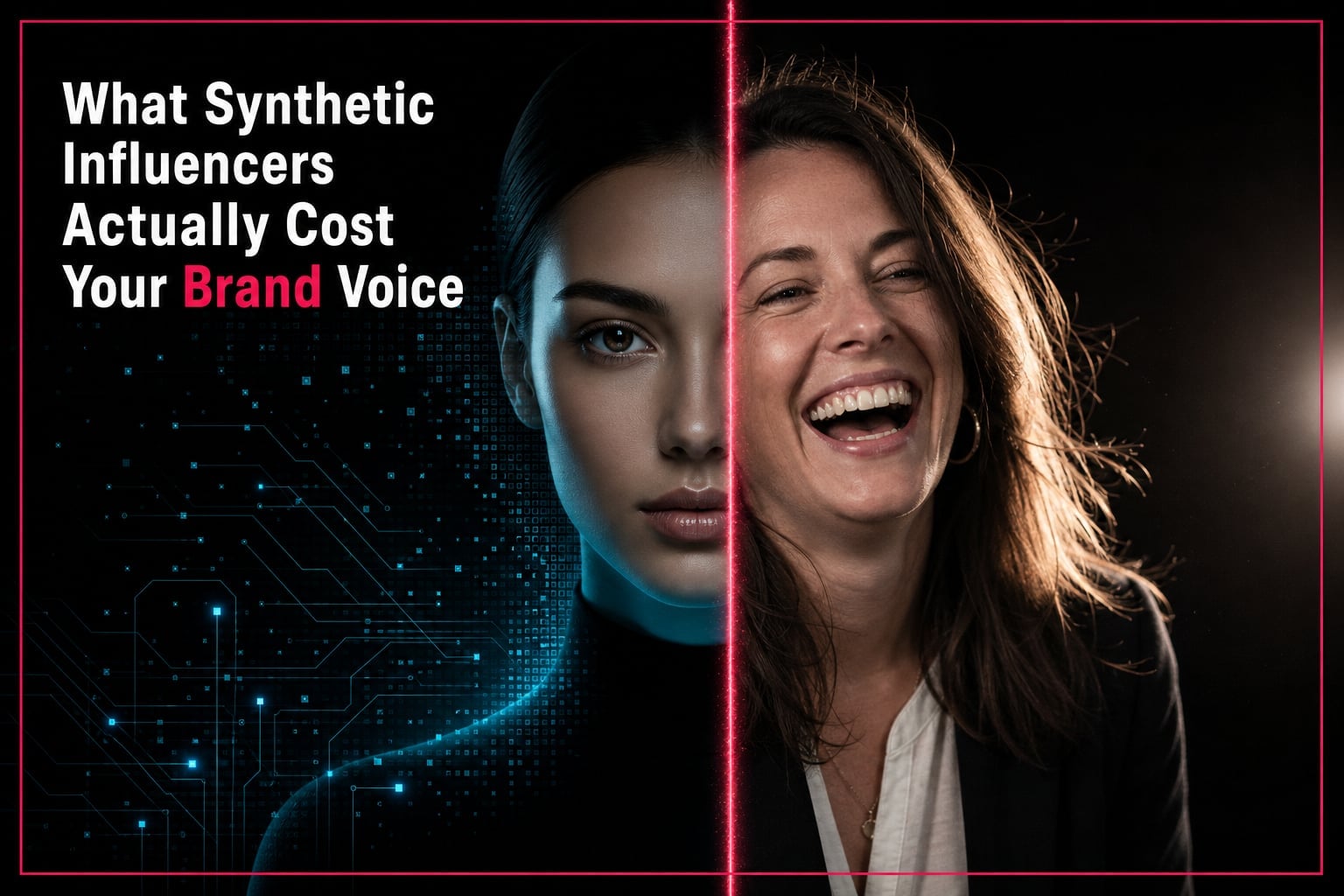
Synthetic influencers cut production costs and eliminate talent risk, but they also remove the unpredictability that makes brand content feel human and worth trusting. That trade looks great on a Monday budget review. It looks a lot worse a year in.
Here’s the number that should stop you mid-scroll: 76% of brands are now worried about fake influencers, up from 67% the year before, according to Sci-Tech Today’s 2026 report. That’s not a fringe anxiety. That’s most of your competitive set, nervous about the exact tactic you’re testing.
Legal scholarship backs this up from another angle. Hufstedler’s 2025 analysis in the Hastings Communications and Entertainment Law Journal shows synthetic personas can trigger real feelings and real liability, even without a human behind them.
You save on the shoot. You spend later on trust repair. The metrics that look healthy in month one are often the same ones quietly wrecking your brand by month twelve, a pattern we broke down in metrics that look healthy and quietly wreck your brand. Efficiency isn’t the enemy. Mistaking it for trust is.
When Every Brand Sounds the Same, Nobody Wins
When brands pull from the same AI model pool to build their synthetic personas, they converge on the same voice, aesthetic, and cadence, and brand distinctiveness disappears at scale. Picture your next three competitors, each running an avatar built on the same underlying tools. Same lighting. Same cadence. Same face, basically.
This is the part nobody’s pricing in. Individual brand risk is one thing. A whole category flattening at once is a different problem entirely, and it’s happening faster than most marketing teams realize.
Concern over fake influencers has escalated to 76%, driven by a 91% year-over-year surge in AI-generated synthetic influencer profiles, according to a Kantar and IZEA joint study covering 3,800 brand managers, cited by amraandelma.com. That surge is exactly how sameness spreads.
Coolest.marketing’s approach treats this as a strategy problem, not a tooling problem: pairing AI-era tactics with a human strategist who decides where the brand still needs a distinct voice. That’s the pairing we cover in AI only works when human judgment leads. Skip that human call, and your “unique” avatar is just everyone else’s avatar with a different logo.
We call this the Dual-Brain problem: the machine brain scales output, but only the human brain can decide what’s actually worth saying. Lose that second brain and every brand starts sounding like the same brain, over and over. That’s not innovation. It’s echo, and the rules that used to protect distinctiveness aren’t built for it, a gap we mapped in marketing rules that are killing your results in 2026.
The Real Dialogue You Trade Away When You Automate Your Voice
Brand voice isn’t a content format. It’s a two-way relationship, and synthetic influencers can broadcast, but they can’t genuinely listen, respond, or co-create meaning with an audience. That’s the deepest cost here, and it’s the one nobody puts on a slide.
Compare Dove’s Real Beauty campaign to a typical avatar post. Dove asked women to reflect on their own experience with self-image. It sparked years of real conversation, not a single scripted broadcast.
Lego Ideas works the same way: fans submit designs, vote, and winners become real products with real creator credit. That’s a loop. A synthetic avatar can post a caption. It cannot take your customer’s idea and hand back something real.
Most current examples of digital personas are static and unresponsive; they broadcast their messages and cannot adapt to users’ changing needs.
That line comes from MIT Sloan Management Review’s research on digital personas, and it’s the whole argument in one sentence. Fraud losses tied to influencer marketing already hit $4.8 billion in 2026, a 269% jump from $1.3 billion in 2019, per Sci-Tech Today. Erased dialogue is how that number keeps climbing.
Protecting human originality isn’t sentimental, it’s strategic; the skill of knowing when to step in is exactly what separates a strategist from an operator, the shift we unpack in the decision-making shift that turns marketers into strategists. The strategic clarity gap AI prompts cannot close is where your real voice still lives, a gap explored further in the strategic clarity gap AI prompts cannot close.
So: has your team run a synthetic influencer experiment? We’d genuinely like to know what you found. Drop your take in the comments, or send this to a marketer who’s about to make the call, and see how a human-led approach actually plays out before you commit your voice to a machine.