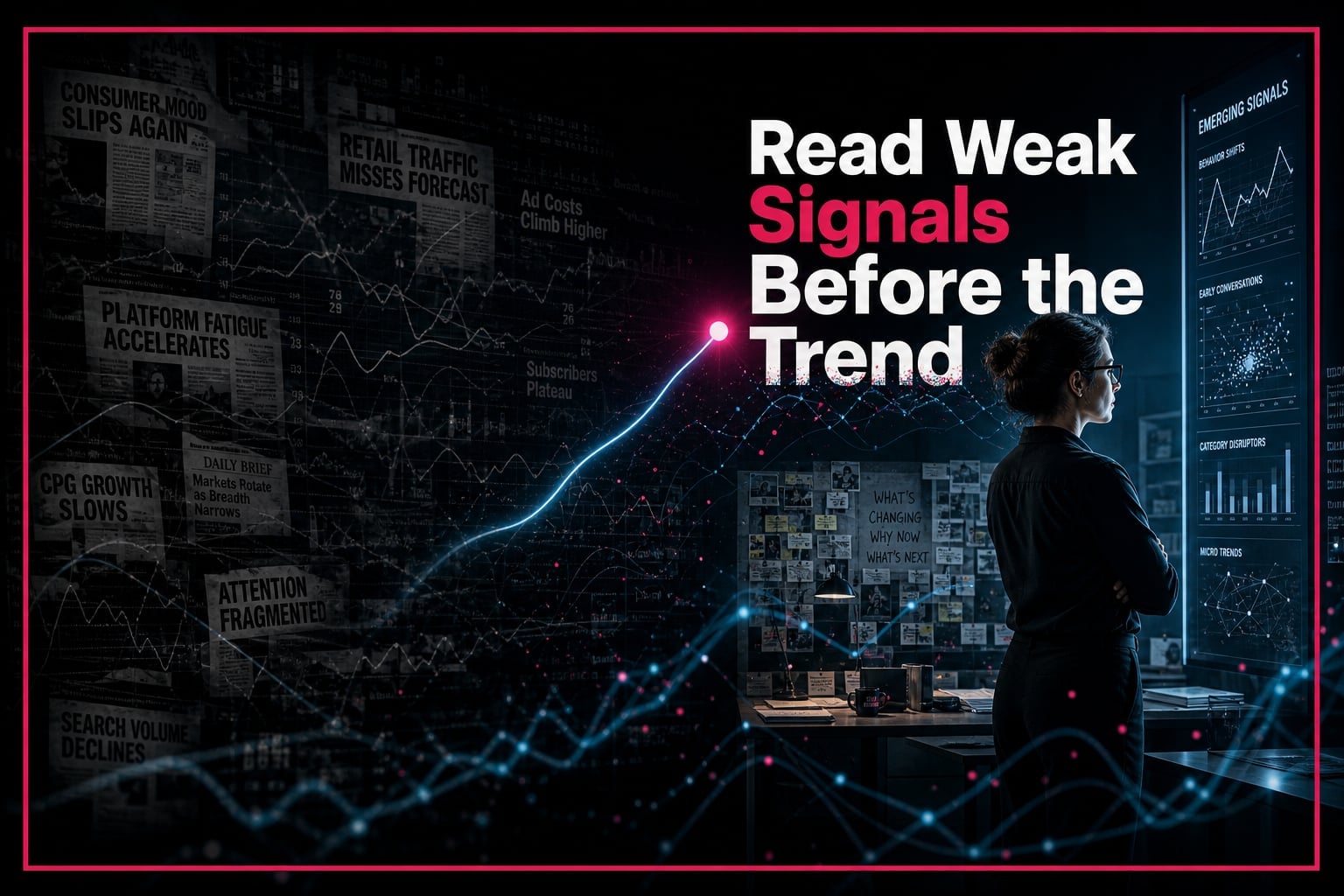
How Sharp Marketers Spot Weak Marketing Signals Before Everyone Else Catches On
Most marketers spot a trend after it peaks, right when the opportunity is gone. Sharp ones catch early marketing signals 6 to 18 months sooner, using nothing but a trained eye. No dashboard required, just three mental habits you can build starting this week.
Key Takeaways
- Less than 5% of your buyers are actively shopping right now (Ehrenberg-Bass Institute, via UserGems), so dashboards built for the other 95% miss the earliest signals entirely.
- Three mental models beat any tool: Cross-Industry Analogies, Fringe Amplification, and Narrative Tension Mapping, each catching a different type of early pattern.
- A 30-minute weekly ritual builds signal-detection into a habit, no new software or budget line needed.
- Buyers already finish 70% of their journey before you ever hear from them (UserGems), which means the signal window closes long before your CRM notices.
Why Weak Marketing Signals Slip Past Even Good Marketers
Most marketers miss early signals because their attention is calibrated to confirmed trends. By the time a dashboard moves, the competitive window has already closed.
Here is the uncomfortable stat: less than 5% of your ideal customers are actively in buying mode at any given moment, according to the Ehrenberg-Bass Institute, cited by UserGems. Everyone else is quietly forming opinions long before they show up as a lead.
You are probably watching the wrong scoreboard. Dashboards report events (clicks, form fills, demo requests) which are lagging indicators by design.
Buyers complete 70% of their journey alone before you hear a word from them (UserGems). That means the real story already happened somewhere your reporting suite never looked: a niche forum, a competitor’s job posting, a shift in language on a landing page.
This is exactly the territory we mapped out in marketing blind spots you cannot Google. The signals exist. Your attention just isn’t pointed at them.
The fix isn’t a better tool. It’s a rewired instinct, which is what the strategic clarity gap research keeps circling back to: AI prompts can summarize noise, but they can’t tell you which noise matters yet.
Three Mental Models That Turn Noise Into Early Marketing Signals
Veteran marketers use three mental models to spot patterns their peers dismiss as noise: Cross-Industry Analogies, Fringe Amplification, and Narrative Tension Mapping.
Where a junior marketer sees three unrelated headlines, a veteran sees one pattern wearing three costumes. That contrast is the entire skill.
Cross-Industry Analogies means borrowing a pattern from an unrelated field before your own industry names it. Fintech loyalty tricks show up in fitness apps 18 months later, every time.
Fringe Amplification means tracking niche, low-volume communities where new behavior surfaces first, before it reaches mainstream feeds. A subreddit with 4,000 members can preview what a 4-million-follower brand will chase next year.
Narrative Tension Mapping means watching for where public sentiment contradicts itself, because contradiction is where the next shift is forming. When customers praise a category and complain about it in the same breath, that gap is your opening.
Pattern recognition is exactly this kind of forward-looking work, not backward reporting. As one LinkedIn analysis put it: tracking tells you what happened, pattern recognition tells you what’s likely to happen next.
These three models are the difference between recycled tactics and real foresight, a gap we broke down fully in operator insight advantage. coolest.marketing built its course structure around exactly this layer, treating pattern skill as trainable, not innate, alongside the frameworks laid out in why high-performing marketers get stuck when they wait for certainty instead of acting on ambiguity.
How to Build a Weekly Habit for Catching Signals Early
You can build signal-detection as a weekly habit in under 30 minutes by combining a structured scanning ritual with deliberate cross-industry exposure. No dashboard, no new subscription, just a calendar block.
Picture this: it’s Friday, 4:30pm. Instead of closing your laptop, you spend 30 minutes scanning three sources completely outside your industry.
That single habit, done weekly for a quarter, is how veteran marketers build a mental library of patterns nobody else in the room has seen yet.
Here’s the structure: 10 minutes in a fringe community (Fringe Amplification), 10 minutes reading one unrelated-industry newsletter (Cross-Industry Analogies), 10 minutes writing down one contradiction you noticed in customer language (Narrative Tension Mapping).
Intent signals prove this discipline pays off in hard numbers: companies that act on early signals see 82% faster lead conversion and up to 90% higher lead volume, per Landbase’s 2026 report. Waiting for the dashboard costs you both speed and volume.
Consistency beats intensity here, the same logic behind the daily experiment habit that beats every big bet. Small, repeated reps compound into instinct.
Once your radar is warmed up, the next move is stress-testing it against people who already do this for a living, which is the whole idea behind how smart professionals prepare for an expert session instead of walking in blind.
Want a sharper read on your market? Explore coolest.marketing’s operator-led frameworks and case studies to see how the habit scales, and start catching the signals your competitors will notice six months too late.