Why Expert-Led Learning Accelerates Mastery When Content Libraries Fall Short
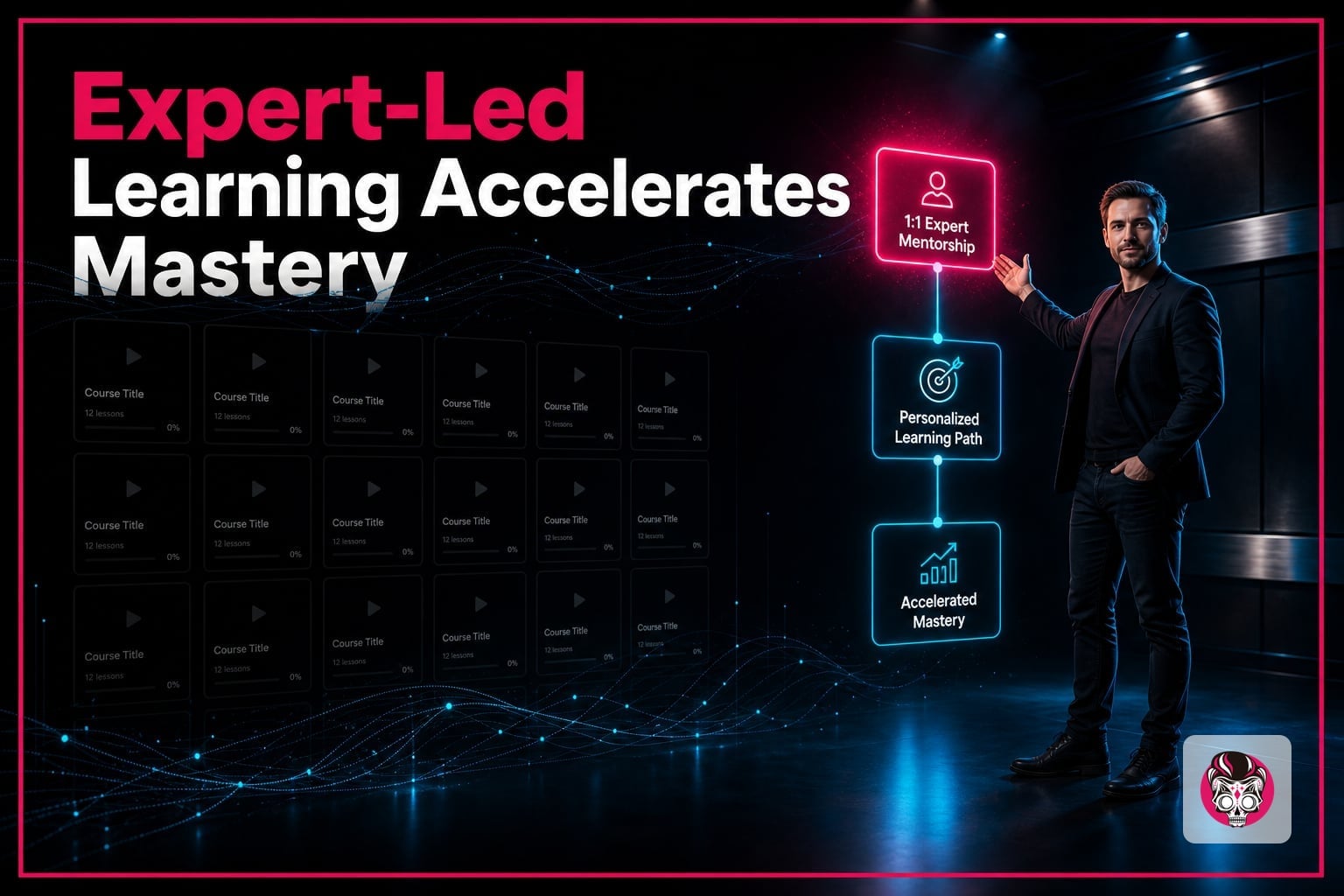
Passive content libraries create the illusion of progress. You finish a course, feel productive, and change nothing about how you work. Expert-led learning breaks that cycle by pairing curated frameworks with real operator access, live feedback, and AI-powered continuity, turning information into decisions you can actually make.
Key Takeaways
- Content libraries optimize for volume. Mastery requires feedback.
- Expert-led learning delivers three things video libraries cannot: a framework, a feedback loop, and accountability.
- AI instructor assistants extend learning beyond the course window, keeping you moving between sessions.
- The gap between knowing and doing closes through access, not content.
Why Content Libraries Create the Illusion of Learning
Content libraries are built for storage and breadth — and that structural choice is exactly why they cannot produce behavior change.
Here is the uncomfortable truth: access is not learning. Most off-the-shelf content libraries fail because they are designed around storage and scale, not around how people actually develop skills at work. You get 500 courses. You finish three. You feel behind.
The numbers back this up. LinkedIn Learning reported a 3x increase in time spent learning in early 2020 (LinkedIn 2020 Workplace Learning Report), yet organizations still report that durable skill change is rare. More time in a library does not equal more capability on the job.
The structural problem is passive consumption. Watching a video triggers a feeling of progress without requiring you to apply, decide, or be held accountable for anything. That feeling is the illusion. You are not learning. You are browsing.
You are probably logging completions and calling it development. Here is what that costs you: the gap between what your team knows and what they can execute keeps widening, quietly, one finished module at a time.
How Expert-Led Learning Closes the Gap Between Knowledge and Action
Expert-led learning is a model where practitioners with real operational experience deliver structured instruction, live interaction, and context-specific frameworks, replacing passive content consumption with active skill transfer.
Compare that to what a content library gives you: a celebrity founder’s highlight reel or a generic framework built for no industry in particular. Expert-led learning gives you an operator who has run the play you are trying to run, explaining exactly how and why.
The mechanism has three parts. First, a curated framework: not a survey of ideas, but a specific decision model you can apply Monday morning. Second, a feedback loop: someone who can tell you where your thinking breaks down. Third, accountability: a reason to implement, not just absorb.
Google’s internal g2g program routes roughly 80% of employee training through peer experts, not external content vendors. Engineers teach engineers. Product specialists train sales teams. The result is contextual knowledge that generic libraries structurally cannot replicate.
coolest.marketing’s approach is built on exactly this logic: only selected operators are invited to teach, no topic is duplicated, and every course reflects differentiated thinking from someone who has done the work, not just studied it.
The AI and Advisory Layer That Makes Expert-Led Learning Stick
The reason most expert-led courses still fail to change behavior is the gap between sessions — and AI instructor assistants paired with live advisory close that gap by keeping you moving and accountable long after the video ends.
Picture this: you finish a session on paid acquisition strategy. Two days later, you are building a campaign and hit a decision point your notes do not cover. Without continuity, you guess. With an AI assistant trained on your instructor’s methodology, you get a specific, contextual answer in seconds, and you keep moving.
That is the scenario most platforms ignore entirely. Mobile learning boosts productivity by 43% and helps employees retain 45% more information than desktop learners. Continuity and context drive that gap, not the content format itself.
coolest.marketing pairs each instructor with a custom AI assistant that reflects their thinking and methodology, then extends that into 1:1 advisory sessions and group workshops. The model shifts learning from a one-time purchase into an ongoing relationship.
This is the layer competitors miss completely. A content library ends when the video ends. An ecosystem keeps working after the session closes.
Expertise alone does not guarantee learning. Just because someone knows something deeply does not automatically mean they can transfer that knowledge effectively to others.
Lifelong Learner, Expert-Led Training: From Expertise to Impact in Organizations, published March 2026
The fix is not a better library. It is a system: content, access, and continuity working together, each layer reinforcing the next.
See how a curated ecosystem of real operators, live advisory, and AI-powered continuity reaches the outcomes a content library never could.