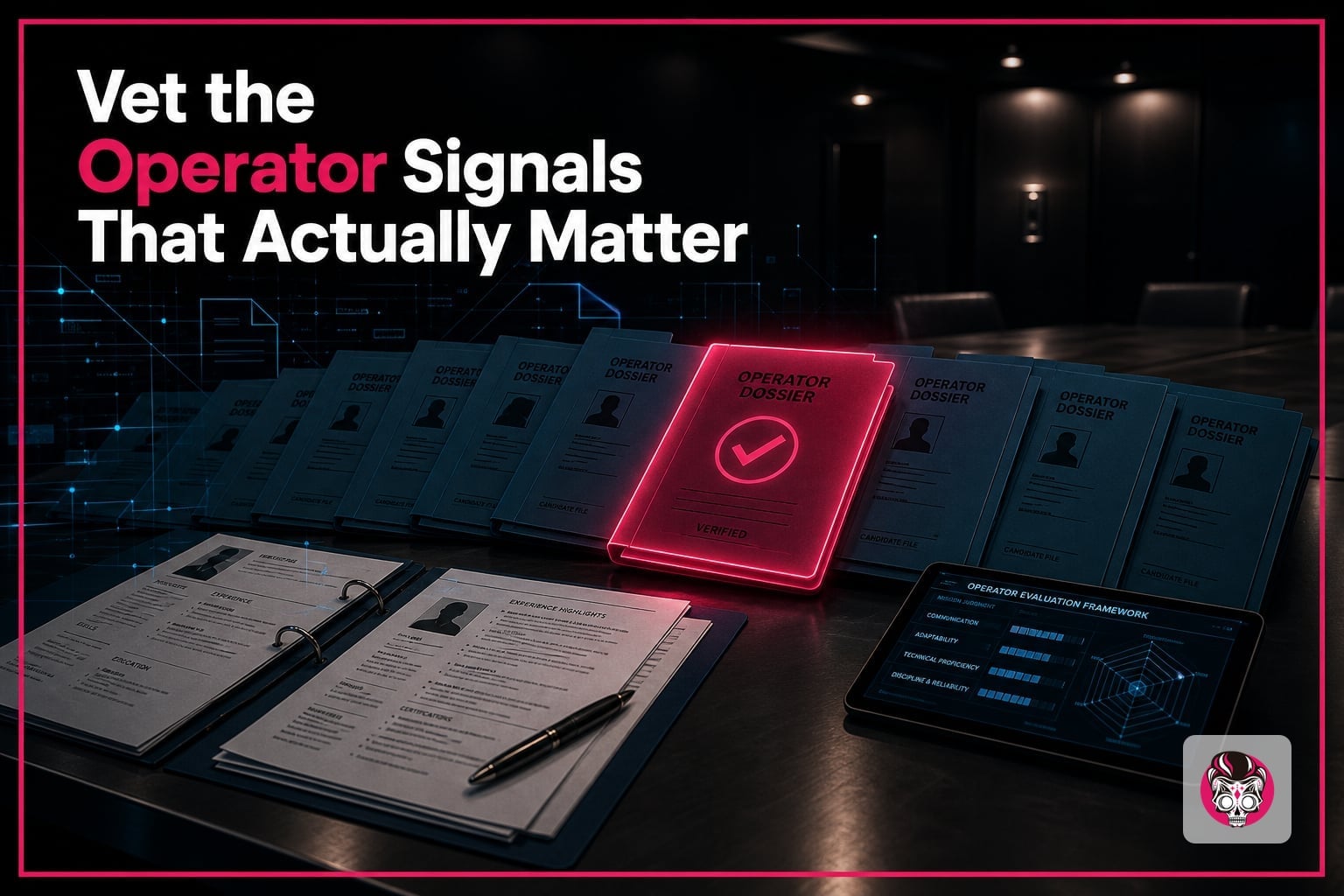
How to Vet Industry Experts Before Hiring: The Operator Signals That Actually Matter
Knowing how to vet industry experts is not about checking credentials. It is about knowing which questions surface real operational depth in under ten minutes. Polished bios and follower counts are easy to manufacture. The unglamorous details, failed campaigns, team friction, unit economics gone sideways, are not.
Key Takeaways
- Standard credentials measure visibility, not operational depth.
- Real operators recall specific failure details on demand. Storytellers cannot.
- Three pressure-test questions reveal the gap in a single conversation.
- Behavioral signals, not résumés, are the reliable vetting tool.
- A structured 10-minute conversation beats any reference check.
Why Standard Credentials Fail as Vetting Tools When You Need to Know How to Vet Industry Experts
Certifications, follower counts, and speaker bios are easy to manufacture. They measure visibility, not operational depth. You are probably using these as your first filter. That is exactly why you keep hiring storytellers.
The credential market is flooded. According to Forbes Coaches Council, one of the clearest signs of a fake expert is that they focus relentlessly on their own brand rather than their field. That is a behavioral tell, not a credential problem. Yet most hiring checklists never ask about behavior.
Speaker slots, LinkedIn endorsements, and course sales are all downstream of marketing skill, not domain skill. A great storyteller can accumulate all three without ever running a real campaign, managing a real team, or absorbing a real loss.
The r/expertnetworks community notes that useful experts tend to fall into specific operational categories: former employees, customers, vendors, or competitors. Not “thought leaders.” The distinction matters because operational categories imply skin-in-the-game experience, while thought leadership implies observation from a safe distance.
Credentials are a starting filter, not a finish line. The moment you treat them as the answer, you have already lost the vetting game.
The Underrated Operator Signals Most Hiring Guides Miss
True operators leave behind specific, unglamorous details: failure modes, team friction, unit economics, things storytellers simply cannot fabricate convincingly.
Here is the contrast that exposes everything. A storyteller describes a campaign that “drove significant growth.” An operator tells you the CAC was $47 in month one, ballooned to $134 by month three when the creative fatigued, and they had to kill the channel entirely. One answer is a highlight reel. The other is a post-mortem.
The behavioral signals to watch for:
- Specific numbers they did not need to look up. Real operators carry the unit economics in their heads because those numbers kept them up at night.
- Named failures with named causes. Not “we pivoted.” Exactly what broke, who called it, and what it cost.
- Disagreement with conventional wisdom in their field. Operators who have actually done the work have opinions that diverge from the consensus. Storytellers repeat the consensus.
- Discomfort with vague questions. Ask a real operator “what drives growth in this space?” and they will immediately ask you to narrow the context. A guru will launch into a framework.
As Guidepoint’s expert research team points out, a well-rounded expert pool should include practitioners who challenge conventional thinking, not just those who validate it. The ones who push back are usually the ones who have been burned by the conventional approach.
Serious operators use standard language. When someone defaults to jargon and frameworks before answering a direct question, that is a signal they are performing expertise rather than holding it.
Andre Nilsen, Business Coach and Operator, via LinkedIn
coolest.marketing’s approach to expert curation is built around exactly this distinction: practitioners who can name what broke, not just what worked.
How to Run a 10-Minute Vetting Conversation That Reveals How to Vet Industry Experts Accurately
A short, structured conversation built around three pressure-test questions will expose operational depth, or the absence of it, faster than any reference check.
Picture this: you have a 30-minute intro call with an expert who has a strong LinkedIn profile and two podcast appearances. You spend 20 minutes on pleasantries and their backstory. You leave with no useful signal. Sound familiar?
Here is the three-question vetting flow instead:
Question 1: “Tell me about a specific time this approach failed for you.”
Operators answer with a specific situation. Storytellers generalize or pivot to a success story. If they cannot name a real failure in their claimed domain, stop there.
Question 2: “What number surprised you most, and why?”
This surfaces whether they were close enough to the work to be surprised by data. Operators have an answer in seconds. Gurus stall and reframe.
Question 3: “Where does the standard advice in your field get it wrong?”
Real operators have earned contrarian views through experience. If the answer sounds like a blog post, it probably is one.
According to Silverlight Research’s expert network selection guide, quality of experts is determined by the depth of their direct experience, not their public profile. This three-question structure operationalizes exactly that test.
coolest.marketing provides marketing practitioners in the AI era with access to vetted operator-level thinking, built for professionals who are done paying for polished decks.
Your Next Move
Run these three questions on the next expert you are evaluating. If they cannot answer Question 1 with a specific failure and a specific number, you have your answer before the call ends. See how we apply these exact criteria inside our operator-vetted expert community: a space built for practitioners who are done paying for polished decks.