Psychological Models Marketing: When Lab Predictions Meet the Messy Real World
Psychological models in marketing are frameworks drawn from behavioral science that predict how people make decisions, respond to messaging, and form brand loyalty. They work beautifully in controlled conditions. The problem: your customers do not live in a lab. Real campaigns are noisy, emotional, and shaped by forces no model fully captures. Community feedback and live data close the gap that theory leaves open.
Key Takeaways
- Psychological models give you a starting hypothesis, not a guarantee.
- Real campaigns expose model blind spots fast. Feedback loops are your early warning system.
- Community engagement produces signals no focus group can replicate.
- The brands that win adapt in real time, not after the post-mortem.
- Misattribution from flawed models costs businesses an average of $12.9 million per year.
Why Psychological Models Marketing Often Misses the Mark
Psychological models marketing is the practice of applying behavioral science frameworks, such as loss aversion, social proof, and anchoring, to predict and shape consumer decisions. In a classroom, these models are elegant. In a live campaign, they are a starting point, not a script.
Here is the uncomfortable truth most marketing courses skip: models are built on averages. They describe populations, not people. Your audience in Tel Aviv behaves differently from your audience in Toronto, even if both score identically on a psychographic survey.
Marketing mix models tend to make numerous assumptions, and a 10% investment does not always lead to a 10% increase in conversions. That non-linear reality is exactly where textbook predictions fall apart.
The deeper issue is what researchers call the “say-do gap.” People tell you one thing in research settings and do something else entirely when they open their wallets. Traditional research methods struggle to capture quality data that accurately predicts how consumers will actually behave, according to Jordan Neve, Client Strategy and Insights Manager at Orchard.
coolest.marketing’s approach to this problem starts here: treat every model as a hypothesis to be tested, not a blueprint to be executed. That mindset shift changes everything downstream.
How Real-World Campaigns Expose the Limits of Psychological Models Marketing
Real-world campaign failure is what happens when a model-driven strategy collides with actual human behavior: the predictions do not match the outcomes, and brands scramble to explain why.
Consider Dove’s “Real Beauty” campaign, launched in 2004. Unilever’s research showed only 2% of women considered themselves beautiful. The model said: challenge that stat, and women will respond. What the model could not predict was the cultural timing, the emotional resonance, and the earned media that turned a billboard into a movement. The campaign worked, but not because the model was precise. It worked because the team listened and adapted in real time.
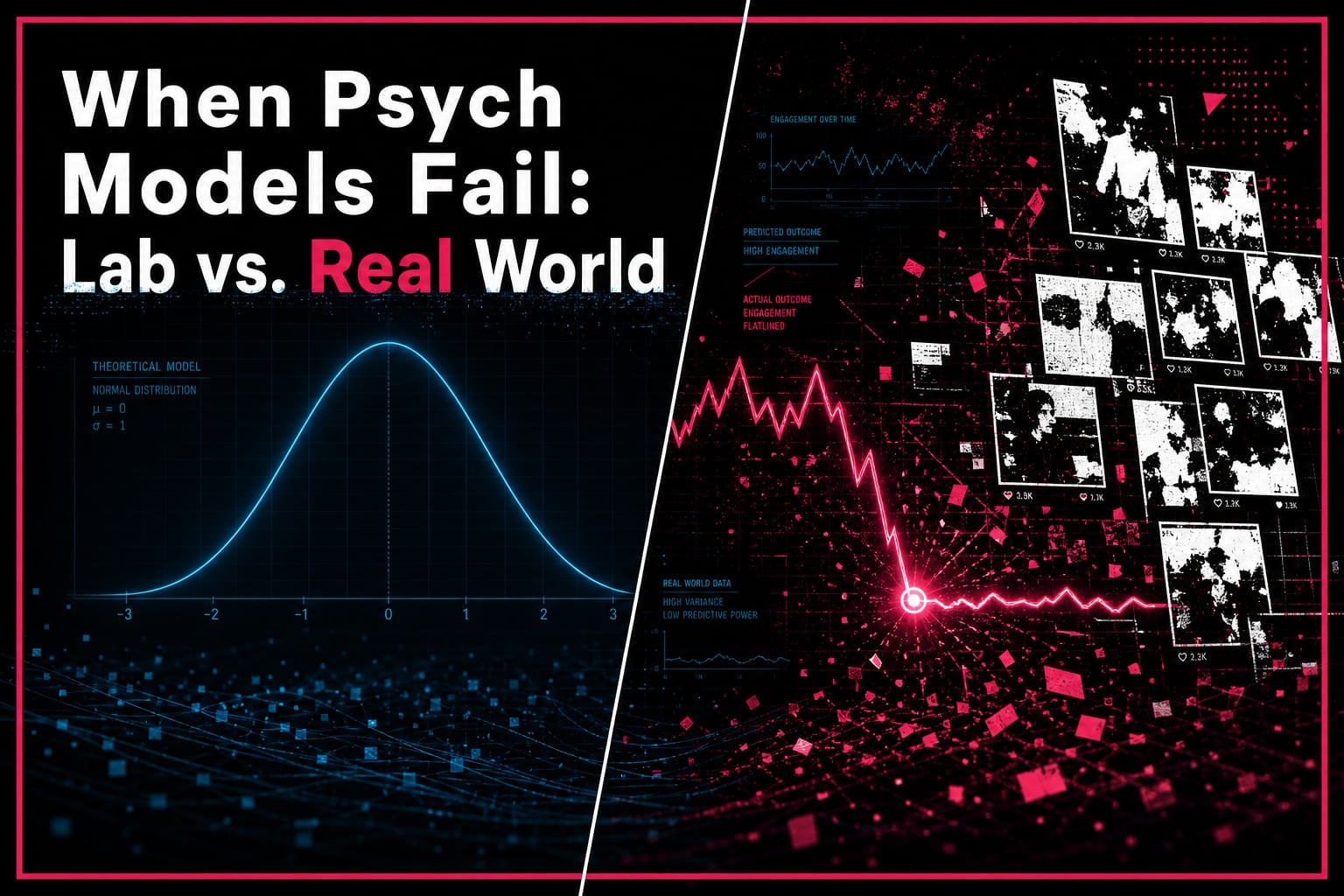
Contrast that with the average brand running a loss-aversion ad sequence that tests well in focus groups, then watches click-through rates flatline on launch day. The model was not wrong. The context was just different from the lab.
The say-do gap is one of the most persistent problems in marketing research. What consumers report in surveys and what they actually do in the real world can be dramatically different, and that gap is where campaigns go to die.
Wendy Gordon, Founder, Acacia Avenue, speaking at the Market Research Society Annual Conference
Social marketing experts with a combined 137 years of experience consistently flag the gap between designed interventions and real-world behavior change as the field’s central unsolved problem.
The fix is not to abandon models. It is to build feedback loops that catch the divergence early, before you have burned the budget.
Community Engagement: The Secret Weapon When Psychological Models Marketing Falls Short
Community engagement in marketing is the ongoing practice of involving your audience in conversations, co-creation, and feedback loops so their real behavior shapes your strategy rather than just validating it after the fact.
This is what models cannot replicate: the unfiltered signal from people who actually care. 79% of people say user-generated content highly impacts their purchasing decisions. That number is not a psychological model. It is your community doing the work for you.
Apple’s #ShotOniPhone campaign is the clearest proof of this. Instead of crafting a psychologically optimized ad sequence, Apple handed the camera to its users. The result was millions of authentic images that no creative brief could have predicted or manufactured. The community generated the signal; Apple amplified it.
Artisan, an AI-driven outreach platform, took a different but equally community-aware approach. They ran billboards in San Francisco with the provocative message “Stop Hiring Humans.” The campaign drove $2M in new ARR, according to HubSpot, not because a psychological model prescribed it, but because it sparked a real conversation people could not ignore.
The pattern is consistent: brands that treat their audience as a living research lab, not a passive target, outperform brands that trust the model and walk away. coolest.marketing’s marketing courses for the AI era are built around this exact principle: real signals beat theoretical predictions every time.
Your community is already talking. The question is whether you are listening fast enough to act on it.
Start Here: One Action You Can Take Today
Pick one live campaign. Find the community where your audience actually talks about it, whether that is a subreddit, a brand Discord, or your own comment section. Spend 30 minutes reading, not posting. Write down three things the model did not predict. That list is your next campaign brief. Want a framework for turning those signals into strategy? Explore what coolest.marketing offers for modern marketers navigating exactly this challenge.