Why Continuous Learning is the Ultimate Competitive Edge for Ambitious Marketers
Most marketers are consuming more content than ever and feeling less confident than ever. The problem is not a shortage of information. It is a shortage of systems. Continuous learning, done right, is not about adding another newsletter to your inbox. It is about building a feedback loop that upgrades how you think, decide, and lead.
Quick Answer: How Does Continuous Learning Give Marketers a Competitive Edge?
Continuous learning is the ongoing process of building new skills and knowledge so your thinking stays sharp as conditions change. But here is the part most articles skip: knowledge alone is not the edge. The edge comes from connecting what you learn to real decisions, real feedback, and real people who have solved the problems you are facing right now.
Marketers who treat learning as a system, not an event, move faster, make fewer expensive guesses, and get promoted ahead of peers with similar experience. According to Training Industry, 94% of employees say they would stay at a company longer if it invested in their career development. Retention is a signal. It means learning-driven environments produce people worth keeping.
What Is Continuous Learning, and Why Do Most Marketers Get It Wrong?
Continuous learning is the habit of consistently acquiring new knowledge and skills, rather than treating learning as a one-time event tied to a course or certification.
You are probably treating it like a binge-watch. You find a great course, finish it, feel good, then go back to executing the same way you always did. That is not learning. That is content consumption with extra steps.
Real continuous learning requires application and feedback. You try something, get a result, reflect, adjust. Without that loop, according to eduMe, talent developers spend just 15% of their time promoting actual engagement with learning, which means most learning programs are broadcasting, not building.
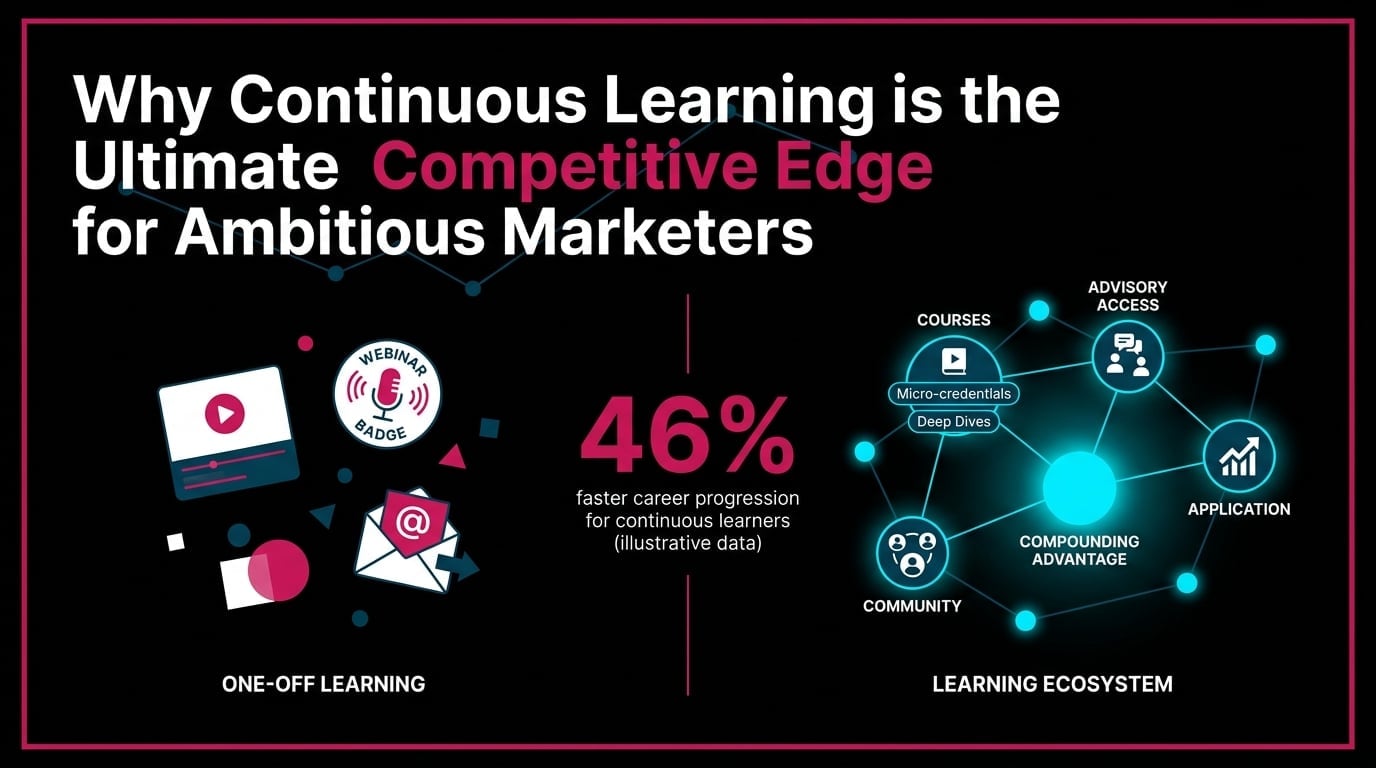
How an Ongoing Learning Ecosystem Beats One-Off Events
A learning ecosystem is the full network of content, people, tools, and interactions that shape how someone grows over time, not just one course or one mentor.
Think of it this way. A single podcast episode gives you an idea. An ecosystem gives you a framework, a community to pressure-test it with, and an expert to tell you where it breaks. That combination is where real confidence comes from.
A Deloitte study found that organizations with strong learning cultures are 92% more likely to innovate than their peers. Isolated courses cannot build a culture. Connected ecosystems can. coolest.marketing’s approach combines courses, advisory access, and ongoing interaction into one structure because each element reinforces the others.
Josh Bersin, HR industry analyst and founder of The Josh Bersin Company, writing in his 2023 industry report: The companies outperforming in talent development are not buying more content. They are building environments where learning happens in the flow of work, through conversation and application, not just through scheduled training.
What Separates Marketers Who Grow From Those Who Stall
Marketing career growth is the progression from executing tactics to making strategic decisions, driven by accumulated judgment, not just accumulated titles.
The U.S. Bureau of Labor Statistics projects marketing manager roles to grow 6% through 2034, faster than average. But growth in job numbers does not mean growth for you specifically. The marketers moving up are the ones who can explain why something works, not just that it worked.
That shift from executor to strategist does not come from consuming more content. It comes from deliberate reflection, expert challenge, and repeated application across different contexts.
How to Build Your Own Continuous Learning System Today
A personal continuous learning system is a structured, repeatable set of habits that consistently expose you to new thinking, apply it to real problems, and close the loop with feedback.
Start with three moves this week:
- Pick one concept, not one course. Go deep on customer segmentation or pricing psychology for 30 days. Breadth is for browsing. Depth is for growth.
- Get a feedback source. A peer, a community, or an advisor. Something that tells you where your thinking has gaps before those gaps cost you.
- Apply before you finish. Take one idea from what you are learning and use it in your current work this week. Application is the only proof that learning happened.
coolest.marketing offers structured marketing programs built specifically for the AI era, combining frameworks from real operators with advisory access so you are not just learning in theory.
Stop watching courses. Start building a system. That is your next move.