Daily Habits for Creative Breakthroughs: What Our Experts Actually Use (And Why They’re Weird)
Most articles on creative routines catalog dead artists. Beethoven’s walks. Hemingway’s dawn typing. Useful? Barely. The gap nobody fills is this: what do living practitioners actually do, and what is the cognitive mechanism behind each habit? The answer involves deliberate friction, not comfort. And that changes everything.
Key Takeaways
- Deliberate friction, not comfort, activates the divergent thinking AI cannot replicate.
- The brain’s default mode network fires during “useless” activities like boredom and handwriting nonsense.
- Artificial Challenges are intentional exercises that preserve creative intelligence as AI automates routine cognition.
- You build your own challenge stack by targeting your personal cognitive comfort zones, not copying someone else’s quirks.
Why “Weird” Routines Are Actually Brain Science (And Daily Habits for Creative Breakthroughs)
Unusual habits create cognitive friction that activates divergent thinking: the exact neural mode AI cannot replicate and your brain needs to stay sharp.
Here is the rebuttal to every productivity guru alive: optimizing for comfort is optimizing for mediocrity. Research shows that around 65% of everyday behaviors are triggered automatically by habit rather than conscious choice. When everything runs on autopilot, your brain stops generating genuinely new connections.
The neuroscience is direct. Your brain’s default mode network (DMN) is the engine of non-linear, associative thought. It fires hardest when you are not on task. Boredom, physical friction, and deliberate strangeness all activate it. Frictionless AI-assisted workflows suppress it.
The creative brain is not a single network but a dynamic interaction between the default mode network and executive control systems. What we call a creative breakthrough is often the result of the DMN generating novel associations that the executive system then selects and refines.
Roger Beaty, Director of the Cognitive Neuroscience of Creativity Lab, Penn State University, writing in PMC / The Creative Brain, 2020
This is the core of what we call Artificial Challenges: intentional exercises in writing and complex communication designed to preserve the creative muscles AI has made seemingly obsolete. The weirder the habit feels, the more likely it is doing real cognitive work.
Daily Habits for Creative Breakthroughs: What Our Experts Really Do
Our experts’ most productive creative habits look strange on the surface: handwriting nonsense, arguing with themselves, embracing deliberate boredom. That strangeness is the whole point.
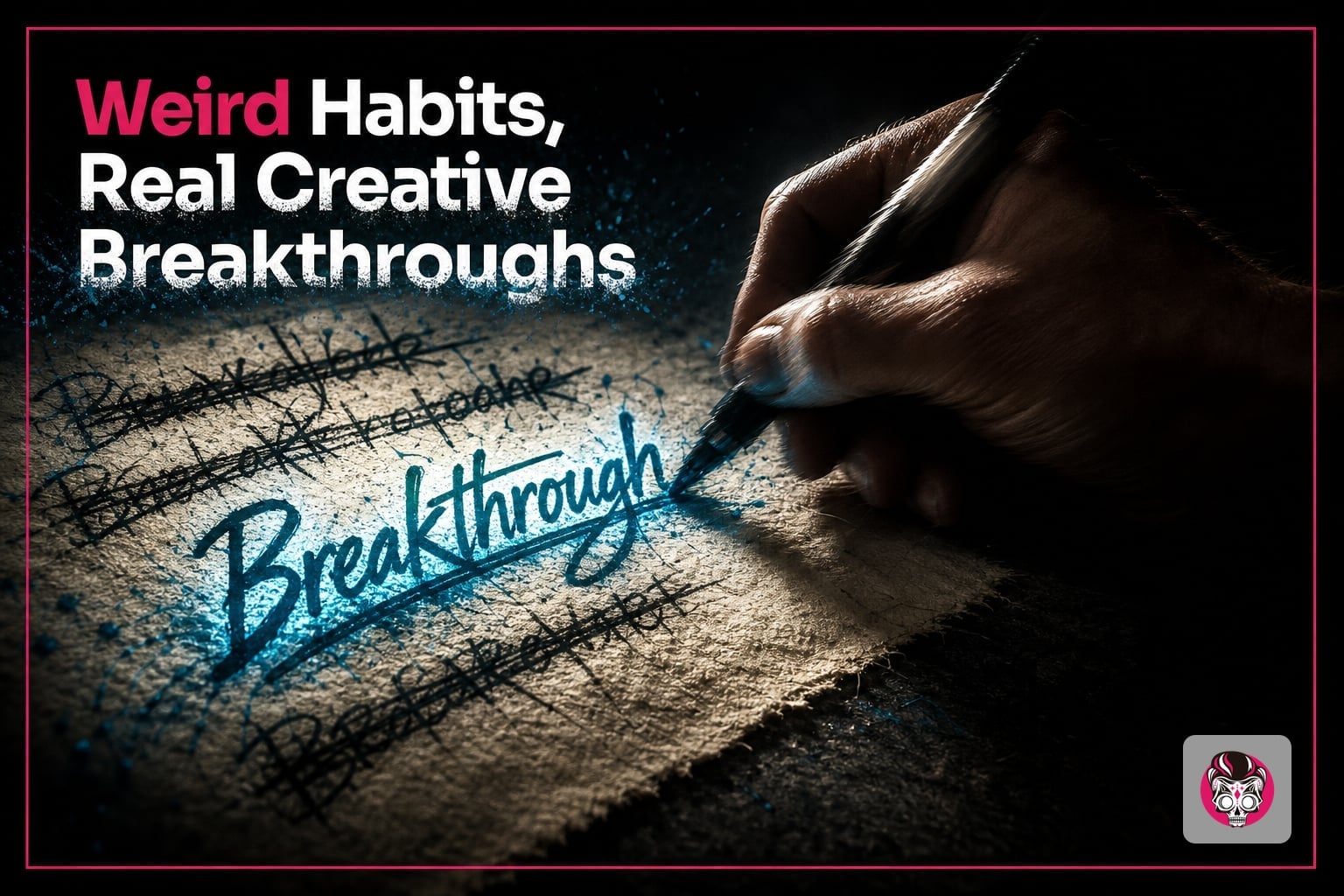
Picture this. It is 7am. One of our strategists at coolest.marketing is sitting at a notebook writing complete gibberish in longhand. Not journaling. Not planning. Pure, unprompted nonsense. Why? Handwriting activates the DMN in a way typing does not. The physical resistance of pen on paper creates just enough friction to break the brain out of autopilot mode and into generative territory.
A second expert runs a daily “steel-man” drill: she picks her own strongest idea from the day before and spends five minutes building the best possible argument against it. Not devil’s advocate theater. A genuine attempt to destroy her own thinking. This is a classic Artificial Challenge: it forces the brain to hold two opposing models simultaneously, which is exactly the non-linear load that produces original insight.
A third expert schedules twenty minutes of structured boredom daily. No phone, no input, no task. Intelligent Change notes that the less creatives think and judge, and the more they simply do, the more creative they become. Boredom is not wasted time. It is DMN activation on a timer.
None of these habits would appear on a list of famous dead artists’ routines. That is exactly why they work for people operating in an AI-driven economy right now.
How to Build Your Own Artificial Challenge Stack
An Artificial Challenge stack is a personal sequence of two or three daily friction habits designed to target your specific cognitive comfort zones and preserve divergent thinking.
You do not copy someone else’s weird habit. You design friction that targets your own blind spots. James Dyson needed more than 5,000 prototypes before landing a breakthrough vacuum design. The friction was the process, not the obstacle.
Here is the three-step framework:
- Identify your comfort zone. Do you always type? Always brainstorm alone? Always start with research? That default is your target.
- Design the opposite friction. Write longhand. Argue out loud against yourself. Sit with a blank page and no input for fifteen minutes. The discomfort is the signal you are in the right zone.
- Stack and sequence. Pair two or three challenges into a daily block of thirty minutes or less. Sequence matters: start with the physical friction (handwriting, walking without a podcast), then move to the cognitive friction (steel-manning, constraint writing).
coolest.marketing’s approach to marketing education in the AI era is built on exactly this principle: professionals who proactively train their creative intelligence, not just their tool fluency, are the ones who stay irreplaceable. The goal is preserving that 40% divergence that keeps your brand identity genuinely human.
The habits worth keeping are the ones that feel slightly broken. That friction is not a bug. It is the feature your AI workflow will never have.
Ready to find out which creative muscles you should be training right now? Explore our Artificial Challenges framework and discover exactly where your divergent thinking needs the most protection.