Marketing Tools vs Custom Build: What Smart Marketers Actually Choose
The build-vs-use decision is not a technical question. It is a strategic one. Build only when no existing tool covers your specific use case AND the output directly differentiates your results. In every other situation, use what already exists. Most competing content either cheerleads custom builds or dismisses them entirely. We give you the framework to decide, fast.
- The 2×2 framework: Map every tool decision against competitive differentiation vs. available coverage.
- Vibe coding has a lane: One-off custom tools, niche automations, data connectors. Not CRM replacements.
- The 3-question audit: Full coverage? Gap hurts results? Buildable in a day? Yes to all three: build.
- Strategic beats technical: Marketers who treat this as a strategy call, not a tech call, win consistently.
The Build-vs-Use Decision Framework Every Marketer Needs (marketing tools vs custom build)
The build-vs-use decision is the practice of evaluating whether a marketing capability should come from an existing tool or a custom-built solution, based on competitive value and available coverage, not personal preference or hype.
Here is the uncomfortable stat: the 2024 marketing technology landscape lists nearly 14,000 solutions. If a tool for your use case does not exist in that universe, you have a genuinely rare problem. Most of the time, you are just avoiding the work of finding the right fit.
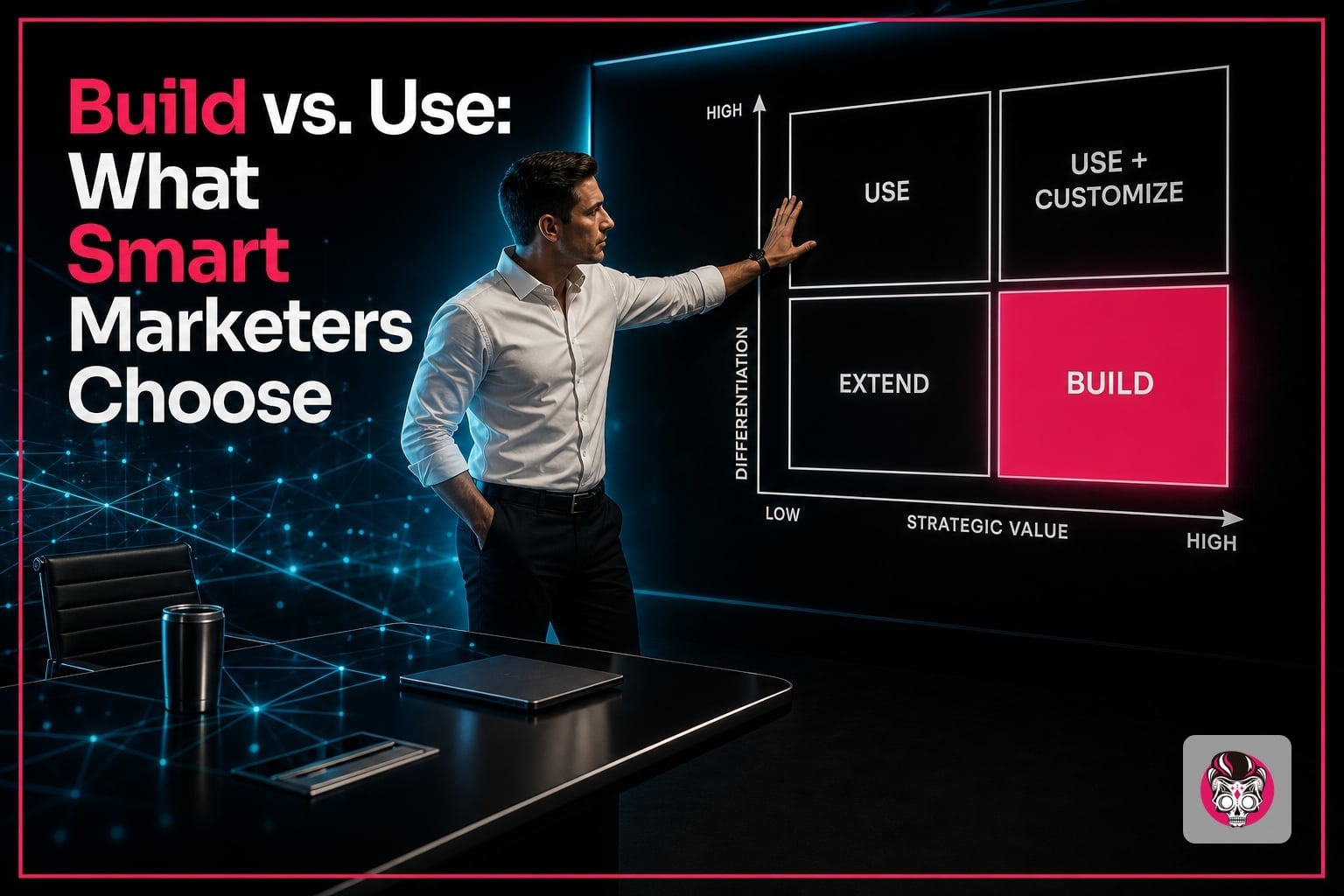
Use this 2×2 to cut through the noise. The axes are “Competitive Differentiation” (low to high) and “Available Tool Coverage” (good to poor):
- Good coverage + low differentiation: Use the tool. No debate.
- Good coverage + high differentiation: Customize it. Bend the tool to your edge case.
- Poor coverage + high differentiation: Build it. This is the only quadrant where custom wins.
- Poor coverage + low differentiation: Deprioritize it. Not worth your time either way.
This framework does one thing most advice skips: it forces you to answer whether the capability actually moves your competitive needle before you write a single line of code or pay for another seat. That question separates strategists from tool collectors.
Where Vibe Coding Actually Moves the Needle (and Where It Doesn’t)
Vibe coding is a development practice where you describe what you want in plain language and AI generates the working code, letting non-technical marketers build functional tools without writing syntax.
Vibe coding earns its place for one-off custom tools, niche automations, and data connectors. Not for rebuilding what Zapier, HubSpot, or GA4 already do well. The contrast is stark: a marketer who builds a custom lead-scoring script tied to their specific CRM fields is solving a real gap. A marketer who vibe-codes their own email automation platform is burning time on a solved problem.
Biron Clark, a recruiter-turned-marketer, documented building a working political trading tracker app using Lovable with no prior coding experience. His verdict: worth it for unique single-purpose tools, but the AI made logic errors he only caught because he understood the domain. That last part matters. Vibe coding without marketing judgment produces confidently wrong output.
The risk is real. Naomi West, a marketing technologist, warns that vibe-coded tools built for teams often cover only 10% of the actual requirements and create security and maintenance nightmares. Vibe coding is great for pet projects and net-new one-offs. It is not a strategy for rebuilding your stack.
coolest.marketing’s approach to this, grounded in marketing education for the AI era, is direct: learn vibe coding as a capability extender, not a stack replacement. The skill is real. The hype is overcooked.
How to Audit Your Stack and Decide What to Build Next (marketing tools vs custom build)
A stack audit is a structured review of every tool you currently pay for or use, evaluated against three questions that determine whether a gap is worth building or buying around.
Run this 3-question audit on every tool in your stack. Does it cover the use case fully? Does the gap hurt results? Can you build a better version in under a day? If yes to all three, build. If not, find a better tool or cut the gap entirely.
Here is a scenario most marketers recognize: you are paying for a reporting tool that pulls from four channels but misses your fifth. You spend three hours a month manually merging the data. That gap costs real time and introduces errors. Improvado’s 2026 analysis notes that building custom analytics only makes sense when you have three or more data engineers with spare capacity or highly custom attribution needs. Otherwise, a better tool is faster and cheaper than a custom build.
Here is your audit checklist:
- List every tool in your stack with its monthly cost.
- For each tool, write the one job it must do.
- Rate coverage: full, partial, or none.
- For partial or none: does the gap directly affect a KPI?
- If yes: can you close it with a one-day build or a better tool?
- Decide: use, customize, build, or cut.
Marketers who run this audit quarterly, not annually, stop paying for tool overlap and stop under-investing in the gaps that actually cost them pipeline. coolest.marketing offers frameworks like this inside its marketing courses built for the AI era, because clarity on your stack is a competitive asset, not a housekeeping task.
The decision is always strategic first. Technology second.
The marketers who will win are not the ones who can code. They are the ones who know when coding is the right answer and when it is a distraction from the actual strategy.
Luis Fernandez, Tech Executive Director, VML, via CMSWire
Your next move: Pull up your stack list right now. Pick the one tool where you feel the most friction. Run the 3-question audit on it. You will know within five minutes whether to build, replace, or cut. See how the sharpest marketers make build-vs-use calls without second-guessing themselves: explore the full decision toolkit inside Coolest.Marketing.