
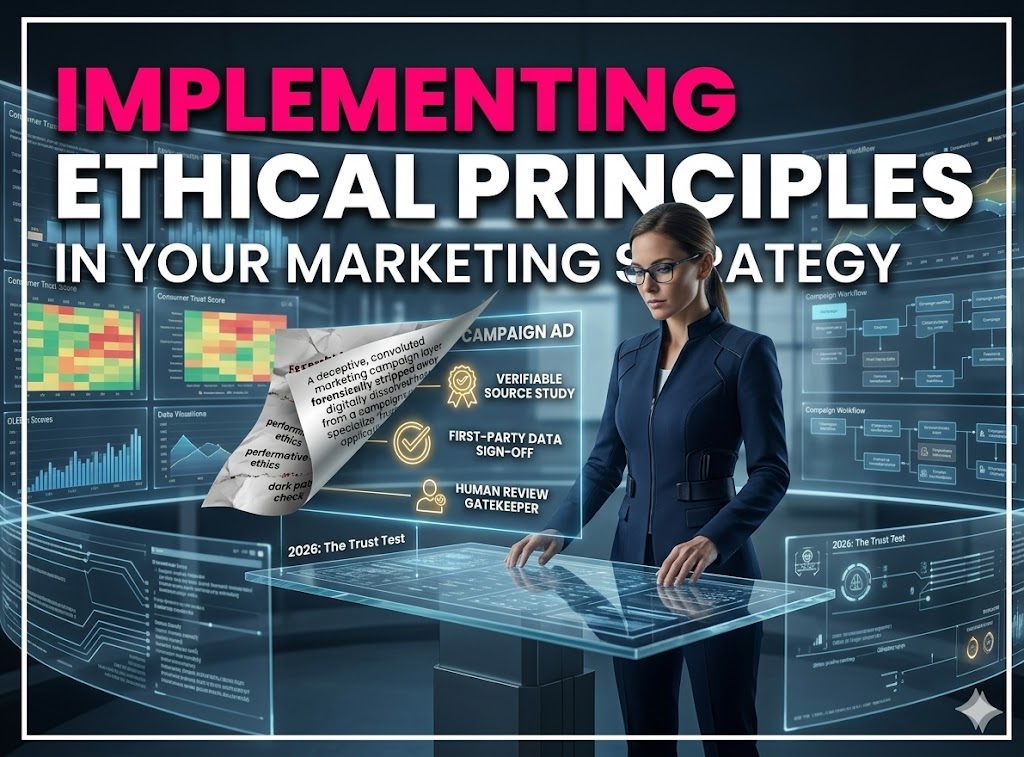
Most marketers think ethics is a values statement on the website. It is not. It is a set of daily decisions that either build or destroy consumer trust, and in 2026, those decisions are more visible than ever. This guide gives you a concrete system for embedding ethical marketing strategies into your actual workflow, not just your mission statement.
Implementing ethical marketing strategies means making transparency, honesty, and consumer respect the default setting in every campaign decision, not an afterthought. Start by auditing your current messaging for misleading claims, then build accountability checkpoints into your production process.
Ethical principles in marketing are the standards that govern how brands communicate, target, and sell to consumers, covering honesty in advertising, data privacy, and fair representation. They are not optional anymore.
According to a bibliometric analysis of ethics and marketing responsibility published in ScienceDirect, ethical considerations in marketing directly shape consumer trust and long-term loyalty. The research spans decades of evidence: brands that embed ethics structurally outperform those that treat it as a PR exercise.
Here is the hard truth: 81% of global consumers say they must be able to trust a brand before they buy from it, according to Edelman’s 2023 Trust Barometer. That number has not dropped since. Trust is now a purchase driver, not a bonus.
You are probably running campaigns that prioritize conversion over clarity. That trade-off costs you repeat customers and long-term revenue. The math is simple: a trusted brand retains more, spends less on acquisition, and weathers crises better.
The core ethical principles in marketing are honesty, transparency, fairness, consumer privacy, and social responsibility. Each one maps to a specific set of practices you can apply today.
Honesty means your claims are verifiable. If you say “clinically proven,” you have the study. If you say “most popular,” you have the data.
Transparency means disclosing what consumers need to make informed decisions: pricing structures, data collection practices, and paid partnerships. The FTC updated its endorsement guidelines in 2023, and non-compliance is now a reputational and legal risk.
Fairness means your targeting does not exploit vulnerable populations. Payday loan ads targeted at people in financial distress is the textbook example of what not to do.
Privacy means collecting only the data you actually need and being explicit about how you use it. With third-party cookies largely phased out, first-party data ethics are now a front-line issue.
Social responsibility means your brand’s impact on communities and the environment is part of the marketing calculus, not just the CSR report.
Integrating ethical marketing best practices into your strategy is a process of replacing vague intentions with specific, repeatable decisions built into your workflow.
Pull your last five campaigns. Flag every claim that cannot be independently verified. Flag every dark pattern in your checkout flow or email unsubscribe process. This is your baseline. You cannot fix what you have not measured.
Add one question to your creative approval process: “Would this ad embarrass us if a journalist screenshotted it?” It sounds simple, but it catches the majority of ethical slip-ups before they go live. Assign a named owner to this checkpoint, not a committee.
Audit every form, pixel, and cookie on your site. Remove data collection that serves no clear customer benefit. Rewrite your consent language so a 12-year-old can understand it. This is not just ethical, it is a conversion rate improvement: clear consent flows increase opt-in rates by up to 40%, according to research from the International Association of Privacy Professionals.
A written ethics policy that nobody reads is theater. Run a 60-minute workshop with your marketing team using real examples from your own category. Use competitor failures as case studies. Make it concrete and make it annual.
Brands that publish their advertising standards publicly hold themselves accountable in a way that internal memos cannot. This is a differentiator almost no mid-size brand uses, and it signals confidence in your own practices.
Patagonia remains the clearest proof that ethical marketing is a revenue strategy, not a sacrifice. Their “Don’t Buy This Jacket” campaign, which ran in 2011 and became a long-term brand pillar, drove a 30% sales increase in the year following launch, according to reporting by Harvard Business Review. The campaign was honest about overconsumption in a category built on it.
Ethical marketing is not about being nice. It is about being credible. Credibility is the only sustainable competitive advantage a brand has.
Rohit Bhargava, Founder, Non-Obvious Company and author of Non-Obvious Megatrends
Ben & Jerry’s is another named example worth studying. Their consistent alignment between public advocacy and internal sourcing practices (Fairtrade-certified ingredients since 2005) means their ethics are verifiable, not just stated. That verifiability is what separates authentic ethical marketing from greenwashing.
Measuring the impact of implementing marketing ethics requires tracking both leading indicators (consumer sentiment, trust scores) and lagging indicators (retention rates, lifetime value, and complaint volume).
Set up a quarterly ethics scorecard with four metrics: net promoter score trends, data complaint volume, ad complaint rate, and press sentiment analysis. These are not soft metrics. They are early warning systems for brand risk and early signals of brand strength.
Share results internally and externally. Brands like REI publish annual stewardship reports that include marketing accountability metrics. This is not altruism. It is brand-building with receipts.
The brands that will lead in 2026 are not the ones with the best ethics statement. They are the ones with the best ethics process. Start your audit today: pull your last five campaigns, apply the five core principles from this guide, and flag every gap. That list is your 30-day action plan.

 Coolest.Admin
How Hyper-Personalization is Transforming Inbound Marketing Frameworks: Strategies, Tools, and Actionable Steps for 2026 Key Takeaways: What Marketers Need to
How to Implement Ethical Principles in Your Marketing Strategy: A Practical Guide for 2026 Most marketers think ethics is a
 Coolest.Admin
How to Identify Your Golden Persona: A Step-by-Step Guide for Community-Driven Brands Most brand managers think they know their audience.
Coming soon...